
White vs Striped vs Hybrid vs Yellow Bass: How to Tell Them Apart
Identification features from state and provincial wildlife pages. Reviewed October 25, 2026.
What to look for, fish by fish
White bass
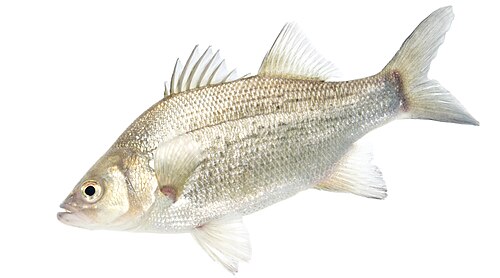

- Silvery and spiny-rayed with several dark horizontal streaks, and a blue-gray back (Missouri).
- An arched back just behind the head and one round or heart-shaped tongue patch (Oklahoma).
- Most fish run about half a pound to 1.5 pounds, and rarely exceed 3.5 pounds (Oklahoma).
Striped bass
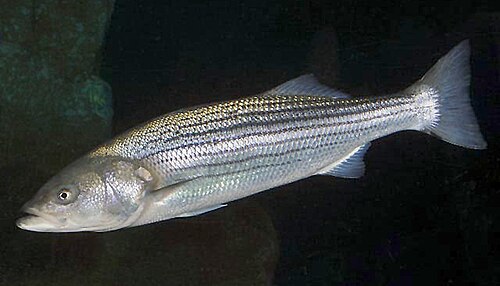

- Prominent dark, horizontal stripes on a silvery, elongated body (Missouri); seven or eight stripes (North Carolina).
- Stripes run continuously (NOAA). Estuarine fish are typically 18 to 24 inches and ocean fish 30 to 40 inches (North Carolina).
Hybrid striped bass (wiper)
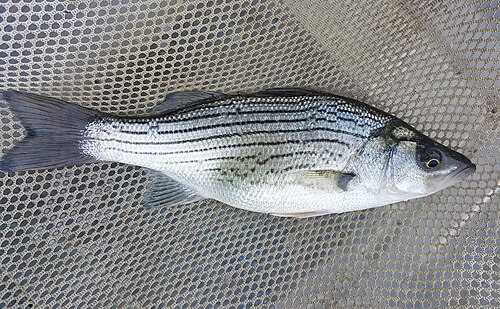

- Dark streaks that are often discontinuous, a sharp spine on the gill cover, a dorsal fin whose spiny and soft parts are entirely separate, and a lower jaw that projects beyond the upper (Missouri).
- Two tooth patches near the middle of the tongue, and the first stripe below the lateral line runs complete to the tail (Iowa).
- The deep, flat body and back arch of a white bass with the thick stripes of a striped bass (Iowa).
Yellow bass
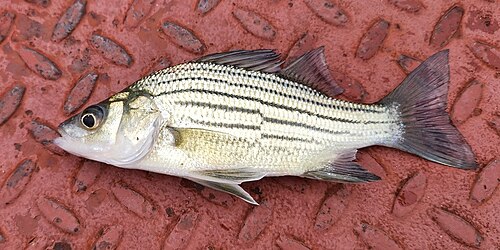

- Yellow-olive to silvery-yellow, fading to yellowish-white on the belly (Iowa).
- Six to seven dark horizontal side stripes, broken and offset above the front of the anal fin (Iowa).
- The anal fin usually has 9 soft rays and 3 spines, with the first spine much shorter. Rarely exceeds a pound (Iowa).
Feature by feature
Stripes
- White bass: Several dark horizontal streaks (Missouri).
- Striped bass: Prominent dark, horizontal stripes, seven or eight (Missouri, North Carolina).
- Hybrid: Streaks often discontinuous (Missouri); first stripe below the lateral line complete to the tail (Iowa).
- Yellow bass: Six to seven side stripes, broken and offset above the front of the anal fin (Iowa).
Tongue
- White bass: One round or heart-shaped patch (Oklahoma).
- Hybrid: Two tooth patches near the middle of the tongue (Iowa).
Gill cover, dorsal fin and jaw
- Hybrid: A sharp spine on the gill cover, separate spiny and soft dorsal fins, and a lower jaw that projects beyond the upper (Missouri).
Good to know
- Iowa says identifying hybrids is easier when comparing against purebred parent fish.
- Ontario says white bass have dark spots in faint horizontal lines and a second anal spine distinctly shorter than the third, while white perch have second and third anal spines roughly equal and no obvious spots or stripes.
- Oklahoma lists white bass, striped bass, hybrid striped bass, yellow bass and white perch as one family.
If you are still not sure
Photos can hide the features above: a side view of the whole fish, in good light, shows the most. Your state fish and wildlife agency publishes its own identification guide and can answer species questions for your waters. See also How to identify a fish from a photo.
Taking this fishing? Save it to your phone so it opens without a signal.
On iPhone: tap the Share button, then Add to Home Screen.
Sources
- Missouri Department of Conservation: Temperate bass
- Oklahoma Department of Wildlife Conservation: Catch the white bass run
- Iowa Department of Natural Resources: Hybrid Striped Bass
- Iowa Department of Natural Resources: Yellow Bass
- North Carolina Division of Marine Fisheries: Striped Bass
- NOAA Fisheries: Atlantic Striped Bass
- Ontario Ministry of Natural Resources: White Bass
- Ontario Ministry of Natural Resources: White Perch
This page is information only. It reports identification features the agencies above publish, from different states and years, and features vary with age, season and water. It is not legal advice and does not tell anyone what to keep, catch or eat. CatchCheck uses AI to identify fish from photos, and the ID can be wrong.