
Yellow Bass: How to Catch More of Them
A playbook built from state and provincial wildlife pages. Reviewed October 25, 2026.
Also called: brassy bass, streaker
Jump to: How to recognize one · Where they hold · Baits and lures · Releasing a fish · Sources
The five-minute version
- Find the school: keep moving until you find it, then stay with it (Iowa).
- Keep the bait within six inches of the bottom (Iowa).
- Use small lead-head jigs from 1/16 down to 1/64 ounce (Iowa).
- A light spinning outfit and 4 to 6 pound monofilament is the setup Iowa lists.
- In winter, they are most active at low light, around sunrise and sunset (Iowa).
How to recognize one
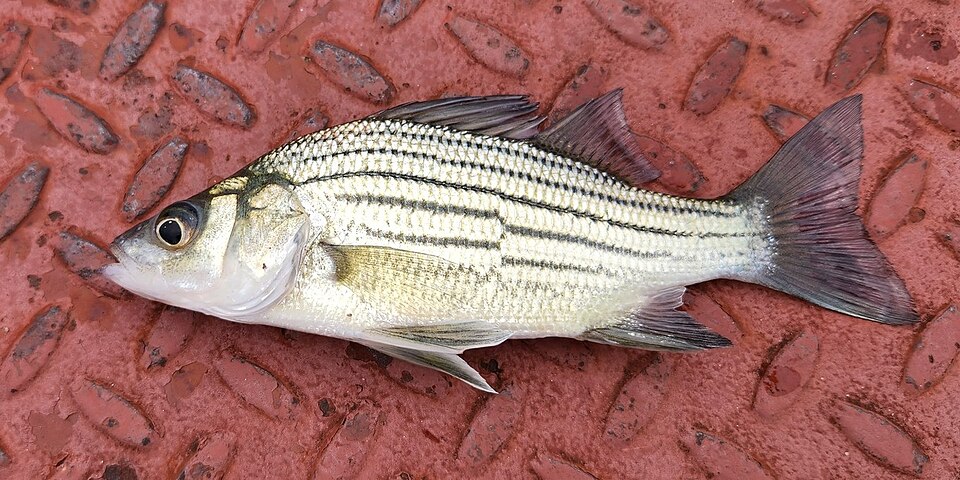
- A laterally compressed, slab-sided, spiny-rayed fish, yellow-olive to silvery-yellow, fading to yellowish-white on the belly (Iowa DNR).
- Six to seven dark horizontal side stripes, broken and offset above the front of the anal fin.
- The dorsal fin has two slightly connected lobes. The anal fin usually has 9 soft rays and 3 spines, with the first spine much shorter.
Side-by-side help: White vs Striped vs Hybrid vs Yellow Bass
Where they hold
- Large natural lakes in northern Iowa, oxbow lakes and large reservoirs (Iowa).
- Spawning: firm bottoms of rock, gravel or sand, in shallow rocky shorelines or rock reefs. Summer: mud flats in the main lake basin. Fall: the outside edges of emergent vegetation such as bulrush or cattails. Winter: mud flats in deeper water.
How the seasons change where they are
These notes come from the Iowa agency page listed at the bottom, and timing shifts by region.
Spring: the May spawn at 60 to 65
Iowa says yellow bass spawn in May when water is about 60 to 65 degrees (the page does not say Fahrenheit or Celsius), mostly in 2 to 3 feet of water.
- Iowa lists small "crappie minnows" as live bait in spring.
Summer: offshore schools
Iowa says that after spawning they move offshore to 10 to 20 feet of water and school through summer, on mud flats in the main lake basin.
- Iowa lists a roughly one-inch piece of nightcrawler in summer.
Fall and winter
Iowa says they move shallower in fall as the water cools, along the outside edges of vegetation, and in winter they sit in 6 to 12 feet of water on deeper mud flats.
- Iowa lists cut bait, especially belly or throat meat, when the bite is fast.
Techniques that work
Bait near the bottom
Iowa says to keep the bait within six inches of the bottom, since yellow bass often grab bait while you search for depth.
Float or no float
Suspend a jig under a small float, or fish without one (Iowa).
Stay with the school
Keep moving until you find a school, then stay with it (Iowa).
Baits and lures
Small jigs
Lead-head jigs from 1/16 down to 1/64 ounce, dressed with hair or plastic skirts. Tube or twister-style plastics are popular (Iowa).
Other lures
Inline spinners, jigging spoons, and beaded nymphs for fly fishing (Iowa).
Live and cut bait
Small minnows in spring, about a one-inch piece of nightcrawler in summer, and cut bait when the bite is fast (Iowa).
- Iowa says cut bait can be reused for several fish.
A starter setup
- A light spinning outfit, ultra-light to medium-light action, about a 6 foot rod (Iowa).
- Line: 4 to 6 pound monofilament. Lighter line improves casting distance (Iowa).
If you are releasing a fish
These are general handling tips from Texas Parks & Wildlife. They say nothing about harvest rules: check your state's rules for that.
- Wet your hands, or use a wet rag or glove, before handling a fish.
- Minimize the time the fish is out of the water: no longer than you can hold your breath.
- Use needle-nose pliers, hemostats or a hook remover to take out the hook and protect your hands, and consider barbless hooks.
- If a net is needed, use a rubber-mesh landing net instead of abrasive nylon.
- When fishing in deep water, bring fish in slowly so they can adjust to the changing pressure.
Taking this fishing? Save it to your phone so it opens without a signal.
On iPhone: tap the Share button, then Add to Home Screen.
Sources
This page is information only. It reports what the agencies above publish, from different states and years, so local waters can differ. It is not legal advice and does not tell anyone what to keep, catch or eat. Bait, tackle and hook rules vary by state and by water, so confirm with your state fish and wildlife agency. CatchCheck uses AI to identify fish from photos, and the ID can be wrong.