
Striped Bass: How to Catch More of Them
A playbook built from state and provincial wildlife pages. Reviewed October 25, 2026.
Also called: striper, rockfish, linesider, rock
Jump to: How to recognize one · Where they hold · Baits and lures · Releasing a fish · Sources
The five-minute version
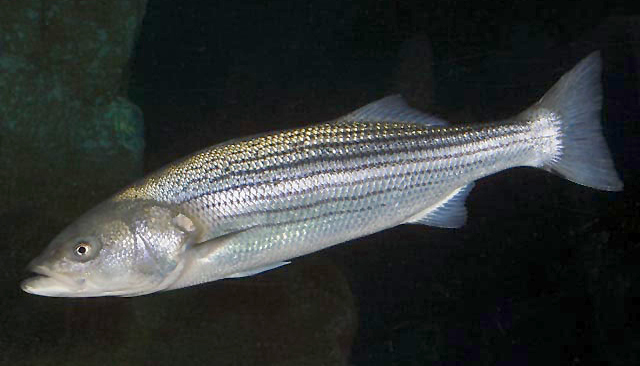
- Look for seven or eight continuous horizontal black stripes on a silver body (NOAA, North Carolina).
- Piers, jetties, surf troughs, rips, flats and rocks hold them (North Carolina).
- Methods listed: trolling, casting or jigging with artificial baits, floating or bottom fishing with natural baits, and surf fishing with spoons or heavy lures (North Carolina).
- In spring, mature fish move to fresh or brackish water to spawn (NOAA).
- They are opportunistic fish-eaters: menhaden, anchovies, flounder, weakfish and herrings, plus crabs and squid (North Carolina, NOAA).
How to recognize one
- A stout, elongated body, silvery sides with seven or eight horizontal black stripes, and a back that ranges from dark olive-green to steel blue or grayish black (North Carolina; NOAA lists seven to eight continuous stripes).
- Two dorsal fins, one soft and one spiny, joined at the base, a large mouth and a slightly forked tail. Estuarine fish are typically 18 to 24 inches, and ocean fish 30 to 40 inches (North Carolina).
Look-alikes
- Hybrid striped bass and white bass: North Carolina says striped bass can be confused with hybrid striped bass and white bass. Missouri describes hybrids with discontinuous streaks, a sharp spine on the gill cover and a projecting lower jaw.
Side-by-side help: White vs Striped vs Hybrid vs Yellow Bass
Where they hold
- Along the Atlantic coast from the St. Lawrence River in Canada to the St. Johns River in Florida, and in the Gulf from Florida to Louisiana (NOAA, North Carolina).
- Anadromous: they live in the ocean and return to fresh water to spawn. Some adults stay in rivers or estuaries, and others migrate north and south seasonally in the ocean (NOAA).
- Introduced to inland lakes and reservoirs and to the West Coast, now found from Mexico to British Columbia (NOAA). Missouri says striped bass are stocked into many U.S. reservoirs.
- North Carolina lists piers, jetties, surf troughs, rips, flats and rocks.
Seasonal movement
These notes come from the NOAA, North Carolina and Missouri agency pages listed at the bottom. None gives water-temperature numbers or exact dates.
Spring: spawning runs
NOAA says mature fish migrate back to fresh or brackish water to spawn in the spring. North Carolina says females reach maturity at age 4 or 5 and then move from the ocean up rivers to freshwater spawning grounds in spring.
- NOAA says larvae drift downstream to nursery areas in river deltas and inland coastal sounds and estuaries.
The rest of the year
NOAA says juveniles usually stay in estuaries for 2 to 4 years before moving to the Atlantic, and that some adults migrate north and south seasonally in the ocean.
- North Carolina lists fishing from the surf, piers and boats and says striped bass are caught in estuaries and the ocean.
Baits and lures
Artificial baits
North Carolina lists trolling, casting or jigging with artificial baits and surf fishing with spoons or heavy lures.
Natural baits
Floating or bottom fishing with natural baits (North Carolina). The agency's diet list is menhaden, anchovies, flounder, weakfish, herrings and invertebrates such as crabs and squid.
- North Carolina's page does not name specific lures, colors or sizes, or give tackle specifications.
If you are releasing a fish
These are general handling tips from Texas Parks & Wildlife. They say nothing about harvest rules: check your state's rules for that.
- Wet your hands, or use a wet rag or glove, before handling a fish.
- Minimize the time the fish is out of the water: no longer than you can hold your breath.
- Use needle-nose pliers, hemostats or a hook remover to take out the hook and protect your hands, and consider barbless hooks.
- If a net is needed, use a rubber-mesh landing net instead of abrasive nylon.
- When fishing in deep water, bring fish in slowly so they can adjust to the changing pressure.
Taking this fishing? Save it to your phone so it opens without a signal.
On iPhone: tap the Share button, then Add to Home Screen.
Sources
- NOAA Fisheries: Atlantic Striped Bass
- North Carolina Division of Marine Fisheries: Striped Bass
- Missouri Department of Conservation: Temperate bass
- Texas Parks & Wildlife: Catch & Release Tips
This page is information only. It reports what the agencies above publish, from different states and years, so local waters can differ. It is not legal advice and does not tell anyone what to keep, catch or eat. Bait, tackle and hook rules vary by state and by water, so confirm with your state fish and wildlife agency. CatchCheck uses AI to identify fish from photos, and the ID can be wrong.