
Hybrid Striped Bass: How to Catch More of Them
A playbook built from state and provincial wildlife pages. Reviewed October 25, 2026.
Also called: wiper, whiterock bass, sunshine bass, palmetto bass, hybrid
Jump to: How to recognize one · Where they hold · Baits and lures · Releasing a fish · Sources
The five-minute version
- Locate the forage first, then the predators (Iowa).
- Look for diving gulls, which signal feeding schools at the surface (Iowa).
- In summer, sunrise, sunset and cloudy or foggy days are usually best (Iowa).
- Match the size and shape of the forage: white, silver and fire tiger colors (Iowa).
- If surface feeding stops, let a jig sink before retrieving (Iowa).
How to recognize one
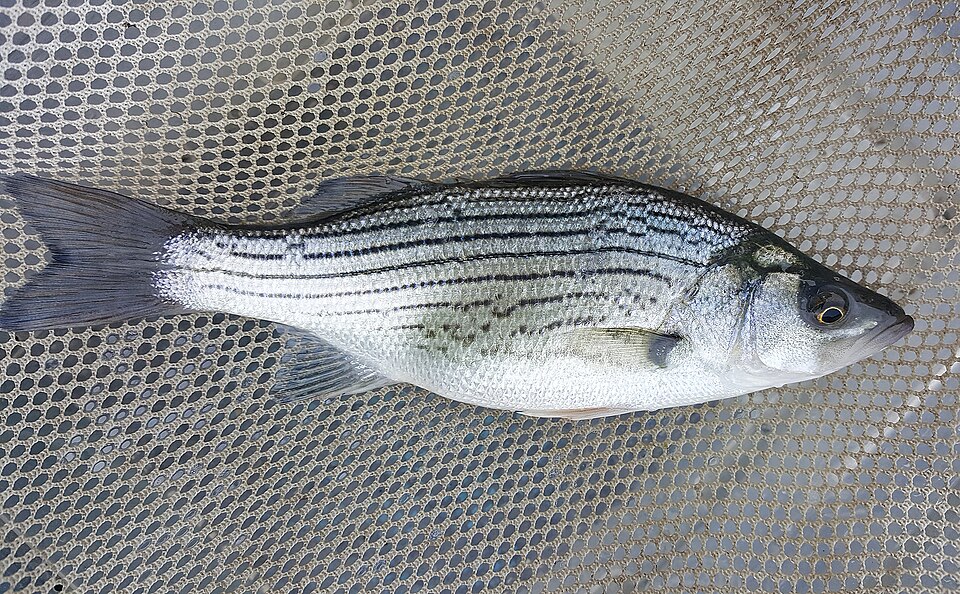
- Silvery and spiny-rayed with several dark streaks that are often discontinuous, a sharp spine on the gill cover, a dorsal fin with the spiny and soft parts entirely separate, and a lower jaw that projects beyond the upper (Missouri).
- Iowa describes the deep, flat body, small head and back arch of a white bass, plus the dark, thick longitudinal stripes of a striped bass, and says the first stripe below the lateral line runs complete to the tail.
- Iowa says identification is easier when comparing with the purebred parent fish.
Look-alikes
- White bass: Smaller, with several dark streaks and a back arch just behind the head (Missouri, Oklahoma).
- Striped bass: Prominent dark, horizontal stripes on an elongated body (Missouri).
Side-by-side help: White vs Striped vs Hybrid vs Yellow Bass
Where they hold
- Rivers: below dams, riffles, deep holes, outside bends, brush piles and current seams where baitfish gather (Iowa).
- Lakes: bays and flats (especially where warm water enters in spring), creek channels, flooded timber, drop-offs, windblown shorelines with mud lines, and the deep basin (Iowa).
How the seasons change where they are
These notes come from the Iowa agency page listed at the bottom, and timing shifts by region. It gives no exact water-temperature thresholds.
Spring: warm inflows and spawning white bass
Iowa says to fish shallow bay and flat areas near warm inflows, and later to target areas where baitfish and white bass spawn. Fish may break the surface near shore.
- In rivers, Iowa suggests casting jigs tipped with minnows or soft plastics to current seams and retrieving through calmer water.
Summer: low light and deep schools
Iowa says sunrise, sunset and cloudy or foggy days are usually best, and that at midday you can troll while watching a depth finder for suspended baitfish. When the water is in the 70s to 80s °F, baitfish can be found anywhere in a lake, so fish drop-offs and points.
- Iowa says that when surface feeding stops, let a jig sink before retrieving, since wipers pick off wounded baitfish.
Fall: feeding heavily before winter
Iowa says baitfish move into deep water in fall, so vertical jig around schools while watching a depth finder. When water cools and the lake turns over, baitfish return to the warmest water and hybrids feed heavily before winter, often near windblown rocky shorelines.
- Iowa says to look for diving gulls that signal feeding schools at the surface.
Baits and lures
Hard baits
Crankbaits, rattle traps, topwater lures and jerkbaits (Iowa).
Spoons and jigs
Spoons, hair jigs and soft plastics such as twister tails and swimbaits (Iowa).
Live bait
Live fathead minnows, fished on the bottom or under a bobber (Iowa).
Colors
White, silver and fire tiger are often used to match baitfish (Iowa).
- Iowa says fish can be picky about baitfish size, or lure placement may matter more than size and color.
A starter setup
- Medium to medium-heavy action spinning or baitcasting rods with 6 to 12 pound monofilament or braided line. Heavier line is often used near docks or flooded timber (Iowa).
- Trolling: 7 to 10 foot rods with planer boards to spread lures (Iowa).
If you are releasing a fish
These are general handling tips from Texas Parks & Wildlife. They say nothing about harvest rules: check your state's rules for that.
- Wet your hands, or use a wet rag or glove, before handling a fish.
- Minimize the time the fish is out of the water: no longer than you can hold your breath.
- Use needle-nose pliers, hemostats or a hook remover to take out the hook and protect your hands, and consider barbless hooks.
- If a net is needed, use a rubber-mesh landing net instead of abrasive nylon.
- When fishing in deep water, bring fish in slowly so they can adjust to the changing pressure.
Taking this fishing? Save it to your phone so it opens without a signal.
On iPhone: tap the Share button, then Add to Home Screen.
Sources
- Iowa Department of Natural Resources: Hybrid Striped Bass
- Missouri Department of Conservation: Temperate bass
- Texas Parks & Wildlife: Catch & Release Tips
This page is information only. It reports what the agencies above publish, from different states and years, so local waters can differ. It is not legal advice and does not tell anyone what to keep, catch or eat. Bait, tackle and hook rules vary by state and by water, so confirm with your state fish and wildlife agency. CatchCheck uses AI to identify fish from photos, and the ID can be wrong.