
White Bass: How to Catch More of Them
A playbook built from state and provincial wildlife pages. Reviewed October 25, 2026.
Also called: sand bass, silver bass, streaker, stripe
Jump to: How to recognize one · Where they hold · Baits and lures · Releasing a fish · Sources
The five-minute version
- Watch water temperature: spawning activity starts at 50°F with peak activity around 55°F (Oklahoma).
- The run is short: usually a one- to three-week window on a given water (Oklahoma).
- Outside the run, find the shad: gulls, surface disturbances, points, riprap and ledges (Oklahoma).
- White or silver lures in clear water, chartreuse or red in stained water (Oklahoma).
- Match the forage: start small, since white bass can key on 1 to 2 inch shad (Oklahoma).
How to recognize one
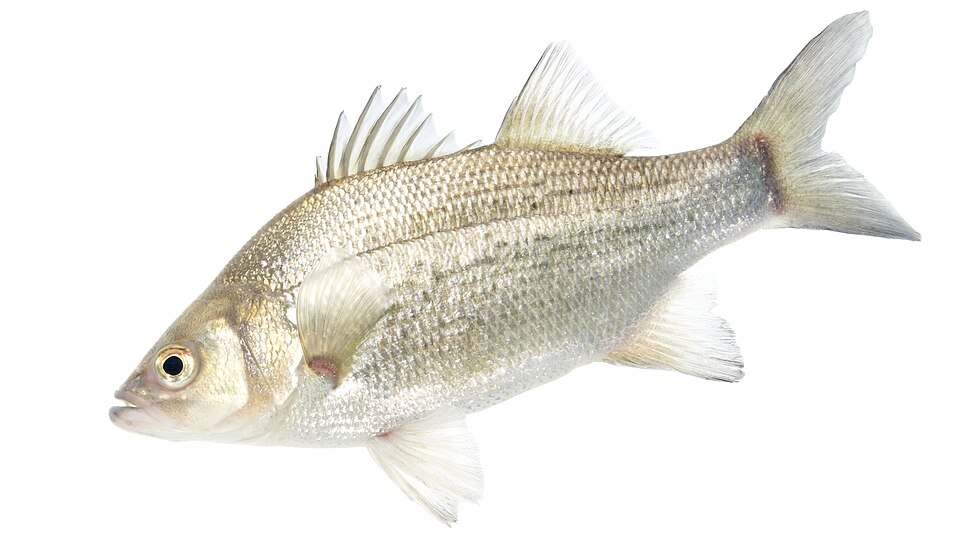
- Silvery, spiny-rayed and elongated, with several dark horizontal streaks (Missouri Department of Conservation).
- The back is blue-gray with silvery reflections and the sides have a faint blue-green tinge.
- Oklahoma lists an arched back just behind the head and one tongue patch, round or heart-shaped. Most fish run about half a pound to 1.5 pounds.
Look-alikes
- Hybrid and striped bass: Oklahoma lists striped bass, hybrid striped bass, yellow bass and white perch as relatives in the same family. Missouri describes hybrids with discontinuous streaks, a sharp spine on the gill cover and a lower jaw that projects beyond the upper.
Side-by-side help: White vs Striped vs Hybrid vs Yellow Bass · Yellow Perch vs White Perch vs White Bass
Where they hold
- During the run: mouths of inflowing creeks and rivers, then upstream along tributaries as far as water flow allows, brushy banks, riffles, shoals, and below dams or low-water dams that block upstream passage (Oklahoma).
- Missouri says many of the larger creeks that flow into Ozark reservoirs have spring white bass runs, and that the dam can be stacked with fish after the walleye run.
- Outside the run: open water near mid-coves, creek and river mouths and wind-blown points, riprap along dams, and ledges, channel breaks and deep flats (Oklahoma).
The spawning run and the rest of the year
These notes come from the Oklahoma and Missouri agency pages listed at the bottom, and timing shifts by region.
Pre-spawn: schools hold deep until the water warms
Oklahoma says pre-spawn schools hold deep, waiting for roughly 50 to 55°F, and that spawning activity starts at 50°F with peak activity seen around 55°F. Once a lake reaches 50°F, bank anglers can start at public creek and river access sites.
- Oklahoma says mid-March through early May is the typical best window.
The run: 55 to 60°F and a little warmer
Oklahoma cites 55 to 60°F as the key range for a strong river or creek run, and says one lake's biologist reports runs at 58 to 62°F, usually in late March. Missouri says white bass are aggressive feeders during the spring run, and fishing can be fast once fish are located.
- Oklahoma says dawn and dusk are the most active periods.
- In low-water springs, Oklahoma says to stick to staging areas at the mouths of inflows or barriers that prevent upstream migration.
After the run: follow the shad
Oklahoma says outside the run to focus on locating shad schools, around wind-driven sides of a lake, points, riprap and coves, and watch for circling and diving gulls. In summer, top-water action is strongest in late evenings at some lakes.
- Oklahoma says to change locations often and follow the shad if the bite stops.
Techniques that work
Steady retrieve
Oklahoma suggests a steady retrieve, except when vertical jigging. Keep lures near the bottom when fish are not feeding on the surface.
Vertical jig a spoon or slab
Jig a spoon or slab off the bottom by pulling the rod tip from about 3 o'clock to 12 o'clock, and watch for bites on the fall (Oklahoma).
Surface feeding
Use a fixed bobber a foot or two above the hook when fish are feeding on the surface, or switch to topwater lures if they keep feeding (Oklahoma).
Find them by trolling
Troll to locate schools, then fish where you get hits. A double jig rig fishes two depths at once (Oklahoma).
Baits and lures
Jigs and grubs
Curly-tail grubs, hair and marabou jigs, and Road Runners (Oklahoma). Missouri lists white jigs and small crankbaits as good choices.
Spinners, spoons and slabs
Inline spinners, spoons and slabs (Oklahoma).
Crankbaits and topwater
Lipless and diving crankbaits, jerkbaits and topwater poppers (Oklahoma).
Live bait
Fathead minnows or freshly netted shad 2 to 4 inches, plus worms and crayfish (Oklahoma). Missouri lists jigs or minnows.
Colors and size
White or silver with dark backs in clear water, chartreuse or red in stained or muddy water. Match the forage, usually 1 to 2 inch shad (Oklahoma).
- Oklahoma says a school can be keyed to small shad, so start with lures that match the forage size.
A starter setup
- Rod: medium-light to medium, with a spinning, spincasting or baitcasting reel (Oklahoma).
- Line: 6 to 12 pound test. Jig heads about 1/16 to 1/4 ounce, depending on depth (Oklahoma).
- Live-bait rig: a small to medium hook, a 12-inch leader, a barrel swivel and a 1/4 to 1 ounce egg weight, with a slip bobber from shore (Oklahoma).
If you are releasing a fish
These are general handling tips from Texas Parks & Wildlife. They say nothing about harvest rules: check your state's rules for that.
- Wet your hands, or use a wet rag or glove, before handling a fish.
- Minimize the time the fish is out of the water: no longer than you can hold your breath.
- Use needle-nose pliers, hemostats or a hook remover to take out the hook and protect your hands, and consider barbless hooks.
- If a net is needed, use a rubber-mesh landing net instead of abrasive nylon.
- When fishing in deep water, bring fish in slowly so they can adjust to the changing pressure.
Taking this fishing? Save it to your phone so it opens without a signal.
On iPhone: tap the Share button, then Add to Home Screen.
Sources
- Oklahoma Department of Wildlife Conservation: Catch the white bass run
- Missouri Department of Conservation: White bass and walleye run
- Missouri Department of Conservation: Temperate bass
- Texas Parks & Wildlife: Catch & Release Tips
This page is information only. It reports what the agencies above publish, from different states and years, so local waters can differ. It is not legal advice and does not tell anyone what to keep, catch or eat. Bait, tackle and hook rules vary by state and by water, so confirm with your state fish and wildlife agency. CatchCheck uses AI to identify fish from photos, and the ID can be wrong.