
Bluegill vs Redear vs Pumpkinseed vs Green Sunfish: How to Tell Them Apart
Identification features from state and provincial wildlife pages. Reviewed October 25, 2026.
What to look for, fish by fish
Bluegill
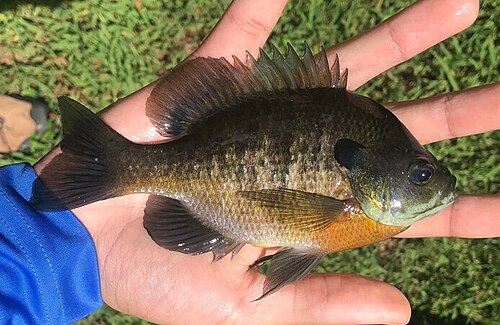

- A black ear flap extending from the edge of the gill cover (Missouri), and bright blue on the chin and gill covers (Iowa).
- A black spot near the base of the soft dorsal fin and a small mouth whose upper jaw does not reach the front of the eye (Iowa).
Redear sunfish
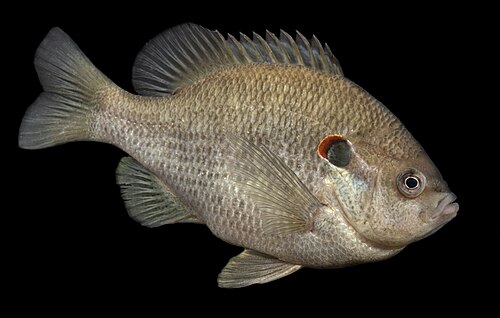

- A red or orange edge along the ear flap (North Carolina); Missouri describes a black ear flap with a whitish border and a prominent orange or red spot.
- No blue lines on the cheeks, unlike redbreast or pumpkinseed sunfish (North Carolina).
- A small mouth whose upper jaw does not reach past the front of the eye, and pointed pectoral fins (Missouri, North Carolina).
Pumpkinseed
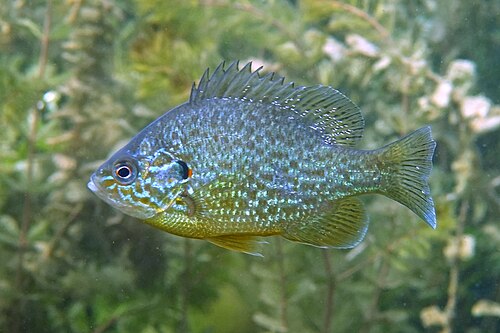

- Wavy, blue-green stripes on the sides of the head and an ear flap with an orange or red spot (Ontario).
- A small mouth that does not extend below the middle of the eye, and an unnotched dorsal fin with 10 to 11 spines (Ontario).
Green sunfish
- Thick-bodied with a large mouth, the upper jaw extending to about the middle of the eye (Missouri).
- Bluish-green back and sides fading to pale yellow or white on the belly (Missouri).
Longear sunfish
- A deep, slab-sided body with a long, black, often white-bordered ear flap and a rounded pectoral fin (Missouri).
- A moderate mouth whose upper jaw nearly reaches the front of the eye (Missouri).
Rock bass
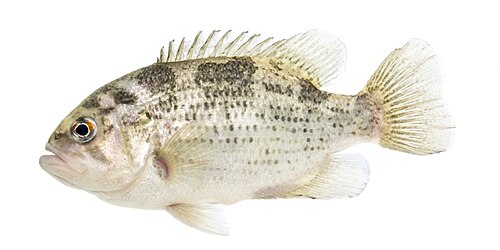

- A large red eye, a large mouth reaching below the middle of the eye, and regular rows of spots along the sides (Ontario).
- A dorsal fin with 10 to 13 spines and an anal fin with 6 spines (Ontario).
Feature by feature
Ear flap
- Bluegill: Black, extending from the edge of the gill cover (Missouri).
- Redear: Red or orange edge (North Carolina).
- Pumpkinseed: Orange or red spot (Ontario).
- Longear: Long, black, often white-bordered (Missouri).
Cheeks and head
- Bluegill: Bright blue chin and gill covers (Iowa).
- Redear: No blue lines on the cheeks (North Carolina).
- Pumpkinseed: Wavy blue-green stripes on the sides of the head (Ontario).
Mouth
- Bluegill, redear, pumpkinseed: Small mouths (Iowa, Missouri, Ontario).
- Green sunfish: Large mouth, jaw to about the middle of the eye (Missouri).
- Rock bass: Large mouth reaching below the middle of the eye (Ontario).
Good to know
- South Carolina says redear are commonly confused with pumpkinseed.
- Ontario lists rock bass and bluegill as similar species to pumpkinseed.
If you are still not sure
Photos can hide the features above: a side view of the whole fish, in good light, shows the most. Your state fish and wildlife agency publishes its own identification guide and can answer species questions for your waters. See also How to identify a fish from a photo.
Taking this fishing? Save it to your phone so it opens without a signal.
On iPhone: tap the Share button, then Add to Home Screen.
Sources
- Missouri Department of Conservation: Sunfish
- Iowa Department of Natural Resources: Bluegill
- North Carolina Wildlife Resources Commission: Redear Sunfish
- South Carolina DNR: Redear Sunfish
- Ontario Ministry of Natural Resources: Pumpkinseed
- Ontario Ministry of Natural Resources: Rock Bass
This page is information only. It reports identification features the agencies above publish, from different states and years, and features vary with age, season and water. It is not legal advice and does not tell anyone what to keep, catch or eat. CatchCheck uses AI to identify fish from photos, and the ID can be wrong.