
Rock Bass: How to Catch More of Them
A playbook built from state and provincial wildlife pages. Reviewed October 25, 2026.
Also called: goggle-eye, rockie
Jump to: How to recognize one · Where they hold · Baits and lures · Releasing a fish · Sources
The five-minute version
- Look for a large red eye and rows of spots along the sides (Ontario).
- Try cool, rocky lakes and slow streams, and cover such as docks and sunken wood in strong sunlight (Ontario).
- They bite all day in summer (Ontario).
- Small plugs, spinners and jigs, plus live worms or insects (Ontario).
- Use light line, but larger baits than for other sunfish (Ontario).
How to recognize one
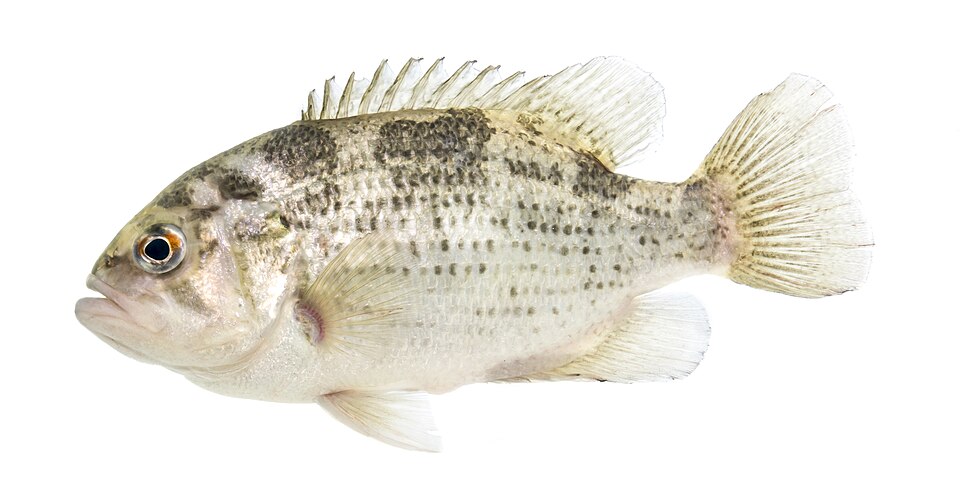
- Small and very deep-bodied, with a brown to olive back and golden tints, regular rows of spots along the side, a large red eye and a large mouth that extends to below the middle of the eye (Ontario).
- The dorsal fin has 10 to 13 spines and the anal fin has 6 spines. Length is typically 6 to 8 inches (Ontario).
- Missouri describes it as thicker-bodied than most sunfish, with large mouth and very large eyes.
Look-alikes
- Pumpkinseed and bluegill: Ontario lists pumpkinseed and bluegill among sunfish found alongside rock bass.
Side-by-side help: Bluegill vs Redear vs Pumpkinseed vs Green Sunfish
Where they hold
- Cool lakes and slow-moving streams with rocky bottoms, often swimming with other sunfish and bass (Ontario).
- In strong sunlight they take cover under docks and sunken wood, and spend most of their time in a relatively small area (Ontario).
Baits and lures
Small lures
Small plugs, spinners and jigs (Ontario).
Live bait
Live worms or insects, dangled from a small bobber (Ontario).
Other methods
Fly-fishing, casting small lures, slow-trolling and drifting (Ontario).
- Ontario says rock bass are most active in summer and "will bite all day."
A starter setup
- Light line is best, but use larger baits than you would for other sunfish species (Ontario).
If you are releasing a fish
These are general handling tips from Texas Parks & Wildlife. They say nothing about harvest rules: check your state's rules for that.
- Wet your hands, or use a wet rag or glove, before handling a fish.
- Minimize the time the fish is out of the water: no longer than you can hold your breath.
- Use needle-nose pliers, hemostats or a hook remover to take out the hook and protect your hands, and consider barbless hooks.
- If a net is needed, use a rubber-mesh landing net instead of abrasive nylon.
- When fishing in deep water, bring fish in slowly so they can adjust to the changing pressure.
Taking this fishing? Save it to your phone so it opens without a signal.
On iPhone: tap the Share button, then Add to Home Screen.
Sources
- Ontario Ministry of Natural Resources: Rock Bass
- Missouri Department of Conservation: Goggle-eye (rock bass) and warmouth
- Texas Parks & Wildlife: Catch & Release Tips
This page is information only. It reports what the agencies above publish, from different states and years, so local waters can differ. It is not legal advice and does not tell anyone what to keep, catch or eat. Bait, tackle and hook rules vary by state and by water, so confirm with your state fish and wildlife agency. CatchCheck uses AI to identify fish from photos, and the ID can be wrong.