
Redear Sunfish (Shellcracker): How to Catch More of Them
A playbook built from state and provincial wildlife pages. Reviewed October 25, 2026.
Also called: shellcracker, sunfish
Jump to: How to recognize one · Where they hold · Baits and lures · Releasing a fish · Sources
The five-minute version
- Look for the red or orange edge on the ear flap (North Carolina, Florida).
- Fish hard bottoms and deeper water than where bluegill hold (Florida).
- Natural bait wins: earthworms and grubs (North Carolina), and earthworms around the March and April full moons (Florida).
- Early spring is the easiest time, when they concentrate on spawning beds (North Carolina).
- Do not expect topwater strikes: redear rarely come to the surface (North Carolina).
How to recognize one
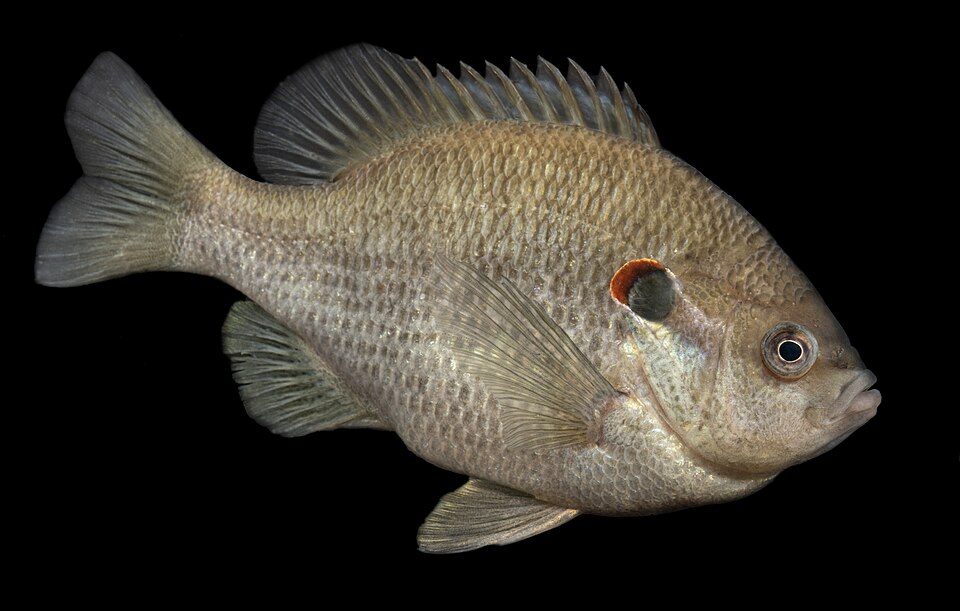
- A deep, slab-sided body with pointed pectoral fins, light green to gold sides with red or orange flecks, and a yellowish-orange belly (North Carolina).
- The key mark is a red or orange edge along the ear flap. Unlike redbreast or pumpkinseed sunfish, it has no blue lines on its cheeks (North Carolina).
- Missouri describes an ear flap that is black with a whitish border and a prominent orange or red spot, and an upper jaw that does not reach past the front of the eye.
Look-alikes
- Bluegill: A black ear flap extending from the edge of the gill cover (Missouri).
- Pumpkinseed: South Carolina notes redear are commonly confused with the pumpkinseed.
Side-by-side help: Bluegill vs Redear vs Pumpkinseed vs Green Sunfish
Where they hold
- Ponds, lakes, reservoirs, swamps, streams and small rivers, favoring slow or still water, often near vegetation, over mud or sand bottoms (South Carolina).
- Florida says they prefer hard bottoms and congregate in deeper water than bluegill.
- South Carolina says redear are often stocked in small farm ponds alongside bluegill and largemouth bass.
- They eat mostly aquatic clams and snails, which they crush with grinding teeth in the throat, plus insect larvae, nymphs, fish eggs and crayfish (North Carolina).
Spawning and the seasons
These notes come from the Florida, North Carolina and South Carolina agency pages listed at the bottom, and timing shifts by region.
Spawn: late spring, above 70°F
South Carolina says spawning generally starts above 70°F, usually late spring to early summer, and males build shallow nests, 6 inches to several feet deep, on sand, gravel or mud, sometimes in groups of up to about 100. North Carolina says they are caught most easily in early spring when they concentrate on spawning beds.
- Florida says redear are caught most often on earthworms around the full moons of March and April, when their spawning activity peaks.
- North Carolina suggests natural bait, small spinners and flies on the spawning beds.
Baits and lures
Natural bait
Earthworms and grubs (North Carolina). Florida names earthworms.
Small spinners and flies
North Carolina suggests small spinners and flies when fish are on spawning beds.
- North Carolina says redear rarely rise to take flies or other topwater lures.
If you are releasing a fish
These are general handling tips from Texas Parks & Wildlife. They say nothing about harvest rules: check your state's rules for that.
- Wet your hands, or use a wet rag or glove, before handling a fish.
- Minimize the time the fish is out of the water: no longer than you can hold your breath.
- Use needle-nose pliers, hemostats or a hook remover to take out the hook and protect your hands, and consider barbless hooks.
- If a net is needed, use a rubber-mesh landing net instead of abrasive nylon.
- When fishing in deep water, bring fish in slowly so they can adjust to the changing pressure.
Taking this fishing? Save it to your phone so it opens without a signal.
On iPhone: tap the Share button, then Add to Home Screen.
Sources
- Florida Fish and Wildlife Conservation Commission: Sunfish (redear)
- North Carolina Wildlife Resources Commission: Redear Sunfish
- South Carolina DNR: Redear Sunfish
- Missouri Department of Conservation: Sunfish
- Texas Parks & Wildlife: Catch & Release Tips
This page is information only. It reports what the agencies above publish, from different states and years, so local waters can differ. It is not legal advice and does not tell anyone what to keep, catch or eat. Bait, tackle and hook rules vary by state and by water, so confirm with your state fish and wildlife agency. CatchCheck uses AI to identify fish from photos, and the ID can be wrong.