
Bluegill: How to Catch More of Them
A playbook built from state and provincial wildlife pages. Reviewed October 25, 2026.
Also called: bream, brim, sunfish, perch
Jump to: How to recognize one · Where they hold · Baits and lures · Releasing a fish · Sources
The five-minute version
- Find the school: Iowa says bluegill gather in specific places that change with the season, and good spots tend to repeat year after year.
- Spawning time is the easy time: they gather in the shallows and bite readily.
- Use small hooks (size 6 or 8, Missouri and Iowa) and 2 to 4 pound line.
- Natural bait wins: worms, crickets, grasshoppers, even when fishing jigs (Iowa).
- Fish slowly. Iowa says bluegill rarely chase food.
How to recognize one
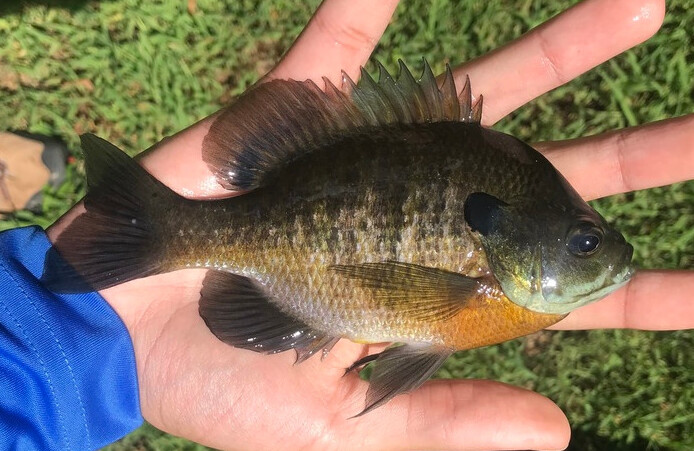
- A deep, slab-sided sunfish with a small mouth. The upper jaw does not reach the front of the eye when the mouth is closed (Iowa DNR).
- A black spot near the base of the soft dorsal fin, and a black, flexible tip on the gill cover.
- Dark olive-green back and sides, a yellow or reddish-orange breast and belly, and bright blue on the chin and gill covers. Spawning males often have a deep red breast.
Side-by-side help: Bluegill vs Redear vs Pumpkinseed vs Green Sunfish
Where they hold
- Pennsylvania lists weedy shorelines of lakes and ponds, and gravel and rocky areas. Iowa says bluegill are schooling fish, not spread randomly through a lake.
- Spawning: shallow water close to shore, about 2 to 6 feet deep, where males build saucer-shaped nests (Iowa). Missouri says nests are circular depressions 15 to 20 inches wide, no deeper than 12 inches in murky water and as deep as 6 feet in clear water.
- Summer: Iowa says big bluegill are usually in 6 to 12 feet, suspended just above the thermocline, along weed edges, deep coves, humps, creek-channel drop-offs, brush shelters and rock piles.
- Fall: mid-depth water near spawning sites, along points and ridges in 8 to 10 feet with flooded timber, brush or rock (Iowa). Winter: deeper water, roughly 15 to 20 feet, near points, ridges and brush.
How the seasons change where they are
These notes come from the Iowa and Missouri agency pages listed at the bottom, and timing shifts by region. Missouri's article is from 2010.
Spawn: water in the 70s, around Memorial Day in Iowa
Iowa says spawning peaks when the water reaches 75°F, usually around Memorial Day, and that smaller, murkier waters warm faster than larger, clearer, deeper ones. Missouri says males move to the shallows when water temperatures reach into the 70s. Iowa describes spring and early summer as the easiest time to catch them, when they gather in the shallows and become aggressive.
- Iowa suggests casting beyond the bed and retrieving slowly through the nesting area, with a float set 2 to 4 feet deep and the lure and float kept small.
- Missouri says that in clear water you should stay back from the beds so you do not spook the fish, and that females gathered at the bed edges bite readily.
- Missouri says bluegill bite in the morning, midday or evening during the spawn, and that weather matters little.
Summer: suspended over deeper water
Iowa says big bluegill suspend in 6 to 12 feet of water near weed edges, brush, rock piles and humps. Large bluegill begin leaving summer haunts around late September.
- Iowa suggests drift-fishing with the wind and suspending bait at 6 to 12 feet, or tying two lures 2 to 4 feet apart to cover different depths.
- In rivers, Iowa suggests fishing 10-foot water along undercut banks, near aquatic plants and sunken trees, casting upstream and letting the current carry the bait through.
Fall and winter: deeper and slower
Iowa says that as water cools in fall and winter, bluegill move into deeper water, 8 to 10 feet in fall and roughly 15 to 20 feet in winter. In winter, schools may move onto flats 10 to 12 feet deep to feed.
- Iowa says to fish slowly, since bluegill rarely chase food and mainly eat slow-moving aquatic insects.
Techniques that work
Bobber and bait
Missouri suggests a small bobber and small split shot to hold the bait just off the bottom. Pennsylvania lists a piece of nightcrawler, waxworm or mealworm on a hook below a bobber.
Short casts, slow retrieve
Iowa says lowering bait over the side of a boat or making short casts with a slow retrieve also works.
Return to productive spots
Iowa says to note where fish are caught, since those spots are typically good year to year.
Baits and lures
Live bait
Worms (Iowa says use only an inch or two), grasshoppers, crickets and catalpa worms. Missouri calls live bait often the most productive. Pennsylvania lists nightcrawler pieces, waxworms and mealworms.
Tiny jigs
Iowa lists 1/32 and 1/64 ounce lead-head jigs tipped with marabou, rubber grubs or twister tails. Missouri lists 1/32 ounce lead-head jigs, cast or suspended under a bobber. Adding a small piece of worm or scented bait often increases bites (Iowa).
Colors
Iowa says all colors catch bluegill, with black or brown the typical go-to. Pennsylvania lists white, yellow or chartreuse twisters and poppers, 1/32 to 1/8 ounce.
Scented artificials
Iowa lists scented baits that mimic a worm or grub.
- Iowa says to use natural bait, even when fishing jigs.
A starter setup
- Light line and an ultra-light rod: Iowa lists 2 to 4 pound test on an ultra-light spinning rod and small reel. Missouri lists 4 or 6 pound test with light to medium tackle.
- Hooks: size 6 or 8 (Iowa, Missouri); Pennsylvania lists sizes 6 to 12. Long-shank hooks are easier to remove from a bluegill's small mouth, and thin wire hooks keep live bait lively (Iowa).
- Needle-nose pliers help with hook removal (Iowa, Missouri).
If you are releasing a fish
These are general handling tips from Texas Parks & Wildlife. They say nothing about harvest rules: check your state's rules for that.
- Wet your hands, or use a wet rag or glove, before handling a fish.
- Minimize the time the fish is out of the water: no longer than you can hold your breath.
- Use needle-nose pliers, hemostats or a hook remover to take out the hook and protect your hands, and consider barbless hooks.
- If a net is needed, use a rubber-mesh landing net instead of abrasive nylon.
- When fishing in deep water, bring fish in slowly so they can adjust to the changing pressure.
Taking this fishing? Save it to your phone so it opens without a signal.
On iPhone: tap the Share button, then Add to Home Screen.
Sources
- Iowa Department of Natural Resources: Bluegill
- Missouri Department of Conservation: Bluegill tips (2010)
- Pennsylvania Fish & Boat Commission: All About Bluegill
- Texas Parks & Wildlife: Catch & Release Tips
This page is information only. It reports what the agencies above publish, from different states and years, so local waters can differ. It is not legal advice and does not tell anyone what to keep, catch or eat. Bait, tackle and hook rules vary by state and by water, so confirm with your state fish and wildlife agency. CatchCheck uses AI to identify fish from photos, and the ID can be wrong.