
Chinook vs Coho vs Pink vs Atlantic Salmon vs Kokanee: How to Tell Them Apart
Identification features from state and provincial wildlife pages. Reviewed October 25, 2026.
What to look for, fish by fish
Chinook salmon
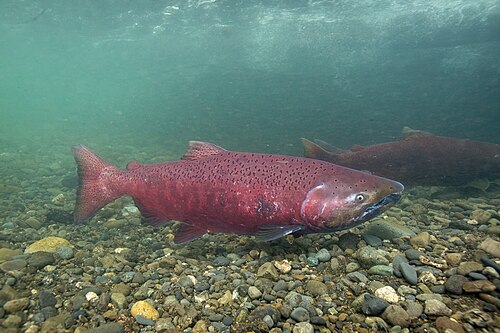

- Black irregular spots on the back, dorsal fins and both lobes of the tail, and black gums (Alaska).
- A spotted tail, black mouth and gums, and a leading anal-fin ray that extends about one-third of the fin's length (Ontario).
- A short, narrow caudal peduncle (Ontario).
Coho salmon
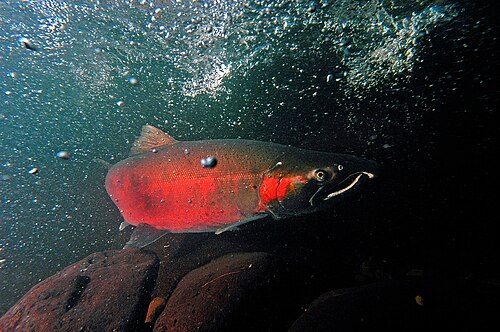

- A tail spotted on the upper lobe only (Ontario).
- A dark mouth with light gray gums, and a leading anal-fin ray that extends one-half to two-thirds of the fin (Ontario).
- Smaller than Chinook salmon (Ontario).
Pink salmon
- Large black spots on the back and tail fin, but not on the dorsal fin (Ontario).
- A forked tail, a narrow caudal peduncle and a leading anal-fin ray extending about one-third to one-half of the fin (Ontario).
Atlantic salmon
- A white mouth and gums, a few large black spots on the gill cover, and no spots on the tail (Ontario).
- The leading ray of the anal fin extends the length of the fin, with a long, narrow caudal peduncle and dark pectoral fins (Ontario).
Kokanee
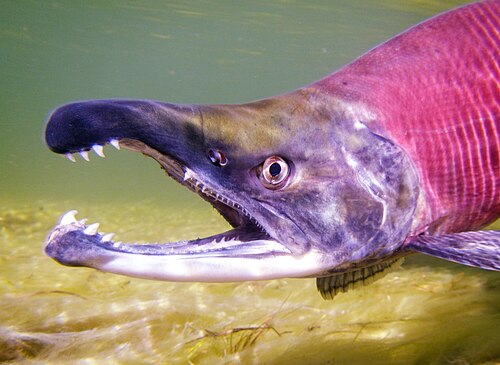

- Bright silver sides and a deeply forked tail, which separates them from rainbow trout (California).
- Average 10 to 12 inches. More, more densely spaced gill rakers than Chinook (California).
- Spawning fish turn bright red with olive-green heads and tails (California).
Feature by feature
Tail spots
- Chinook: Spots on both tail lobes (Alaska); spotted tail (Ontario).
- Coho: Spots on the upper lobe only (Ontario).
- Pink: Large black spots on the tail fin (Ontario).
- Atlantic: No spots on the tail (Ontario).
Mouth and gums
- Chinook: Black mouth and gums (Ontario, Alaska).
- Coho: Dark mouth with light gray gums (Ontario).
- Atlantic: White mouth and gums (Ontario).
Leading anal-fin ray
- Chinook: About one-third of the fin (Ontario).
- Pink: About one-third to one-half of the fin (Ontario).
- Coho: One-half to two-thirds of the fin (Ontario).
- Atlantic: The length of the fin (Ontario).
Good to know
- Ontario says Chinook are commonly confused with brown trout, rainbow trout and coho salmon, and coho with Chinook, rainbow trout and brook trout.
- California says kokanee are the landlocked form of sockeye salmon.
If you are still not sure
Photos can hide the features above: a side view of the whole fish, in good light, shows the most. Your state fish and wildlife agency publishes its own identification guide and can answer species questions for your waters. See also How to identify a fish from a photo.
Taking this fishing? Save it to your phone so it opens without a signal.
On iPhone: tap the Share button, then Add to Home Screen.
Sources
- Ontario Ministry of Natural Resources: Chinook Salmon
- Ontario Ministry of Natural Resources: Coho Salmon
- Ontario Ministry of Natural Resources: Pink Salmon
- Ontario Ministry of Natural Resources: Atlantic Salmon
- Alaska Department of Fish and Game: Chinook (King) Salmon
- California Department of Fish and Wildlife: Fishing for Kokanee
This page is information only. It reports identification features the agencies above publish, from different states and years, and features vary with age, season and water. It is not legal advice and does not tell anyone what to keep, catch or eat. CatchCheck uses AI to identify fish from photos, and the ID can be wrong.