
Kokanee Salmon: How to Catch More of Them
A playbook built from state and provincial wildlife pages. Reviewed October 25, 2026.
Also called: kokanee, silver trout, little redfish
Jump to: How to recognize one · Where they hold · Baits and lures · Releasing a fish · Sources
The five-minute version
- Troll slowly: 0.8 to 1.5 mph, which California calls critical to success.
- Use a dodger or flasher just ahead of the lure to draw fish in.
- Pink and orange are the most common lure colors.
- Depth matters: kokanee stay near the surface in early season and low light, deeper as lakes stratify in summer.
- Tip your lure with a kernel of white shoepeg corn.
How to recognize one
- Non-spawning: bright silver sides, a dark blue to green back, occasional small dark spots on the back and tail fin, and a deeply forked tail, which separates them from rainbow trout (California DFW).
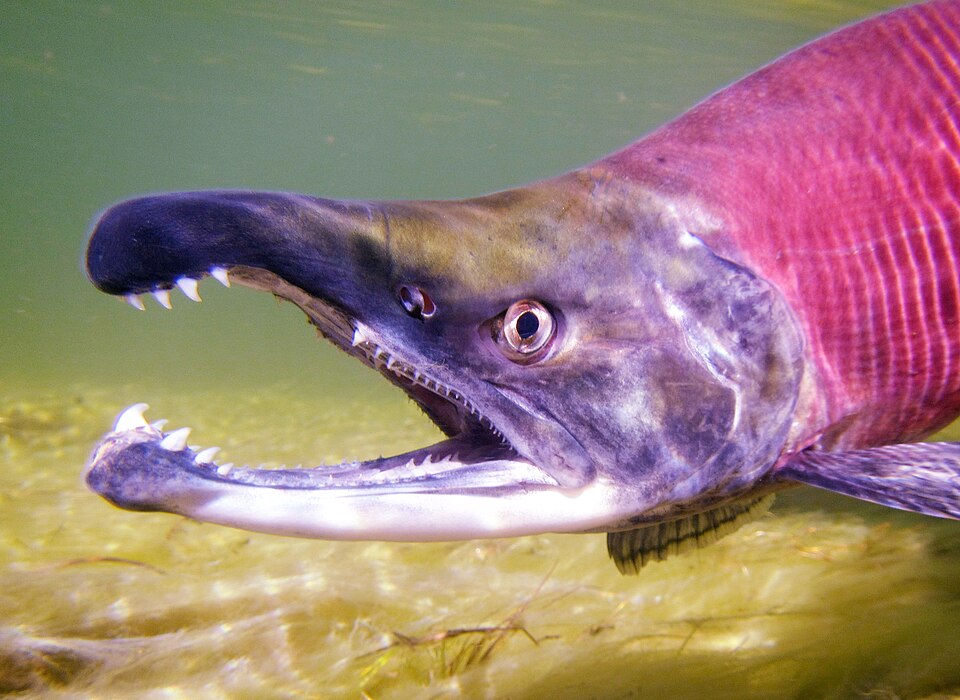
- Spawning: both sexes turn bright red with an olive-green head and tail, and males develop a hooked jaw and humped back.
- Average size is 10 to 12 inches, and up to 20 inches in some reservoirs. Kokanee have more, more densely spaced gill rakers than Chinook.
Side-by-side help: Chinook vs Coho vs Pink vs Atlantic Salmon vs Kokanee
Where they hold
- Landlocked sockeye salmon that mature in lakes or reservoirs and spawn in tributaries in the fall (California).
- Preferred water temperature is 10 to 13°C (50 to 55°F), tolerating up to 15°C (59°F).
- They feed almost exclusively on zooplankton, and in the weeks before spawning gather in dense schools near tributary mouths.
Seasons and depth
These notes come from the California agency page listed at the bottom, and timing shifts by region.
Early season and low light: near the surface
California says kokanee are schooling fish that stay near the surface in early season and in low light.
- California says anglers usually start in spring, with peak effort in summer.
Summer: deeper, in cooler layers
California says that as water warms and lakes stratify in summer, kokanee move deeper, in water of about 10 to 13°C (50 to 55°F), tolerating up to 15°C (59°F).
- Anglers use downriggers to reach depth, or leadcore line or lead weights (California).
Techniques that work
Troll slowly
California says boat fishing offers the most success and that trolling is most common, at 0.8 to 1.5 mph, which it calls critical.
Reach the depth
Downriggers, leadcore line or lead weights get the lure to the school (California).
Dodger first
A dodger or flasher placed just ahead of the lure helps attract fish (California).
Baits and lures
Small lures
Small spinners, soft plastic tubes ("hoochies" or "squids") and small spoons (California).
Colors
Pink and orange are the most common colors (California).
Corn
Top anglers tip lures with a kernel of white shoepeg corn, often scented (California).
- California does not list line test, leader length or hook sizes.
A starter setup
- Ultra-light action rods are typical because kokanee fight aggressively (California).
If you are releasing a fish
These are general handling tips from Texas Parks & Wildlife. They say nothing about harvest rules: check your state's rules for that.
- Wet your hands, or use a wet rag or glove, before handling a fish.
- Minimize the time the fish is out of the water: no longer than you can hold your breath.
- Use needle-nose pliers, hemostats or a hook remover to take out the hook and protect your hands, and consider barbless hooks.
- If a net is needed, use a rubber-mesh landing net instead of abrasive nylon.
- When fishing in deep water, bring fish in slowly so they can adjust to the changing pressure.
Taking this fishing? Save it to your phone so it opens without a signal.
On iPhone: tap the Share button, then Add to Home Screen.
Sources
- California Department of Fish and Wildlife: Fishing for Kokanee
- Texas Parks & Wildlife: Catch & Release Tips
This page is information only. It reports what the agencies above publish, from different states and years, so local waters can differ. It is not legal advice and does not tell anyone what to keep, catch or eat. Bait, tackle and hook rules vary by state and by water, so confirm with your state fish and wildlife agency. CatchCheck uses AI to identify fish from photos, and the ID can be wrong.