
Chinook Salmon: How to Catch More of Them
A playbook built from state and provincial wildlife pages. Reviewed October 25, 2026.
Also called: king salmon, king, tyee, blackmouth, spring salmon
Jump to: How to recognize one · Where they hold · Baits and lures · Releasing a fish · Sources
The five-minute version
- Recognize them by black spots on the back and on both lobes of the tail, plus a black mouth and gums (Alaska, Ontario).
- In the Great Lakes, troll deep with plugs, spoons or live or dead bait, using downriggers (Ontario).
- Late summer and early fall: fish gather at river mouths before running upstream (Ontario).
- Fish that have moved upstream usually stop feeding, but will strike lures in defence, so try rattle baits, spinners and plugs (Ontario).
- Chinook are highly light-sensitive, so they are unlikely to feed at the surface (Ontario).
How to recognize one
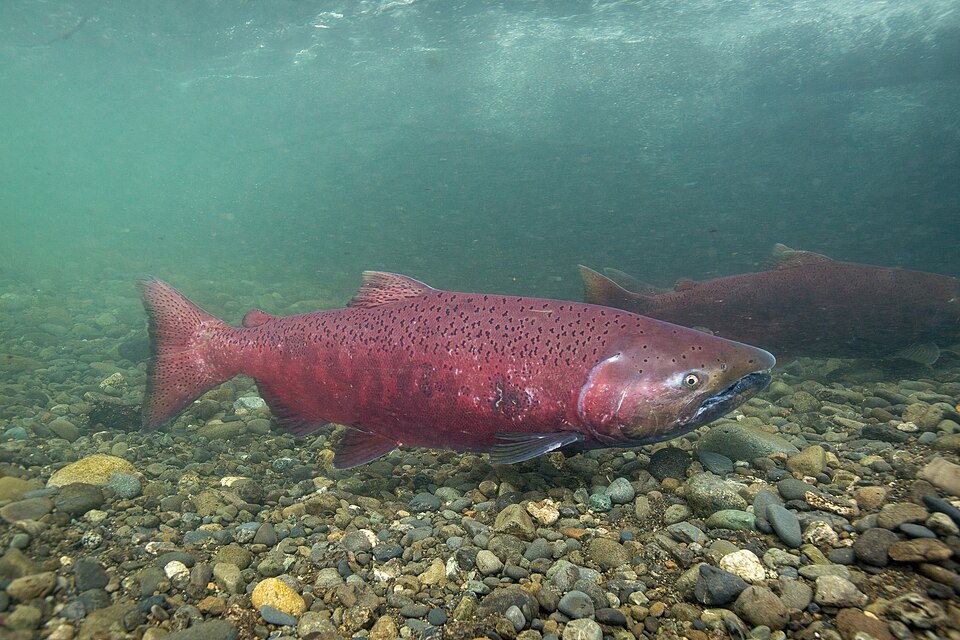
- The largest Pacific salmon, with black irregular spots on the back, dorsal fins and both lobes of the tail fin, and black gums, which gives them the nickname "blackmouth" (Alaska DFG).
- Ocean fish are blue-green on the back and silver on the sides. Spawners range from red to copper to deep gray (Alaska).
- Ontario adds a short, narrow tail base and a leading anal-fin ray that extends about one-third the fin's length.
Look-alikes
- Coho, rainbow and brown trout: Ontario says Chinook are commonly confused with brown trout, rainbow trout and coho salmon.
Side-by-side help: Chinook vs Coho vs Pink vs Atlantic Salmon vs Kokanee
Where they hold
- Anadromous: they hatch in fresh water, rear in the ocean and return to fresh water to spawn (Alaska).
- Washington lists spawning in large rivers such as the Columbia and Snake and in some smaller streams, and lists Lake Chelan, Lake Washington, Lake Sammamish and other lakes and reservoirs where they live.
- In the Great Lakes, Ontario says they spend most of the year in cold lake water and return to tributary streams to spawn.
Timing of the runs
These notes come from the Alaska, Washington and Ontario agency pages listed at the bottom. Timing differs a lot by river and region, so check the agency for your water.
Alaska: May through July
Alaska says streams normally receive one Chinook run, between May and July.
- Alaska lists the Yukon, Kuskokwim, Nushagak, Susitna, Kenai, Copper, Alsek, Taku and Stikine rivers among its major runs.
Washington: spring and summer runs enter early
Washington says spring and summer runs enter streams early because they travel far upstream, fall runs spawn closer to the ocean, often in small coastal streams, and all Chinook reach their spawning grounds by fall.
- Washington says some travel hundreds of miles upstream.
Great Lakes: river mouths in late summer and early fall
Ontario says Chinook gather at river mouths in late summer and early fall before migrating upstream. They usually stop feeding once they move upstream in fall but remain aggressive and territorial.
- Ontario says to still-fish with live, salted or fresh-cut herring in moderately deep water.
Techniques that work
Downrigging and trolling
Ontario says downrigging and trolling work best in the Great Lakes: troll deep with plugs, spoons or live or dead bait.
Still-fishing
Ontario says to still-fish in moderately deep water with herring (live, salted or fresh-cut).
Fall provocation
Fish in fall will strike when provoked rather than feeding actively, so Ontario suggests rattle baits, spinners and plugs.
Baits and lures
Plugs, spoons and flies
Plugs, spoons and trolling flies (Ontario).
Herring
Live, salted or fresh-cut herring for still-fishing (Ontario).
Rattle baits and spinners
For fish moving upstream in fall (Ontario).
- Alaska says adult Chinook do not feed during the spawning migration and lose condition as the run progresses.
If you are releasing a fish
These are general handling tips from Texas Parks & Wildlife. They say nothing about harvest rules: check your state's rules for that.
- Wet your hands, or use a wet rag or glove, before handling a fish.
- Minimize the time the fish is out of the water: no longer than you can hold your breath.
- Use needle-nose pliers, hemostats or a hook remover to take out the hook and protect your hands, and consider barbless hooks.
- If a net is needed, use a rubber-mesh landing net instead of abrasive nylon.
- When fishing in deep water, bring fish in slowly so they can adjust to the changing pressure.
Taking this fishing? Save it to your phone so it opens without a signal.
On iPhone: tap the Share button, then Add to Home Screen.
Sources
- Ontario Ministry of Natural Resources: Chinook Salmon
- Alaska Department of Fish and Game: Chinook (King) Salmon
- Washington Department of Fish and Wildlife: Chinook Salmon
- Texas Parks & Wildlife: Catch & Release Tips
This page is information only. It reports what the agencies above publish, from different states and years, so local waters can differ. It is not legal advice and does not tell anyone what to keep, catch or eat. Bait, tackle and hook rules vary by state and by water, so confirm with your state fish and wildlife agency. CatchCheck uses AI to identify fish from photos, and the ID can be wrong.