
Yellow Perch: How to Catch More of Them
A playbook built from state and provincial wildlife pages. Reviewed October 25, 2026.
Also called: perch, ring-necked perch, jack perch
Jump to: How to recognize one · Where they hold · Baits and lures · Releasing a fish · Sources
The five-minute version
- Find the school first: troll or drift until you do, then anchor and still-fish or cast (Iowa).
- Keep bait on or near the bottom. Strikes often come as the bait is lifted off the bottom (Iowa).
- Go small: 1/64 and 1/32 ounce lead-heads are the most popular lures in Iowa.
- Use a small bobber or slip-bobber, since perch can strip bait without moving the bobber (Iowa).
- If there is no action after 15 to 20 minutes, move to a new spot (Iowa).
How to recognize one
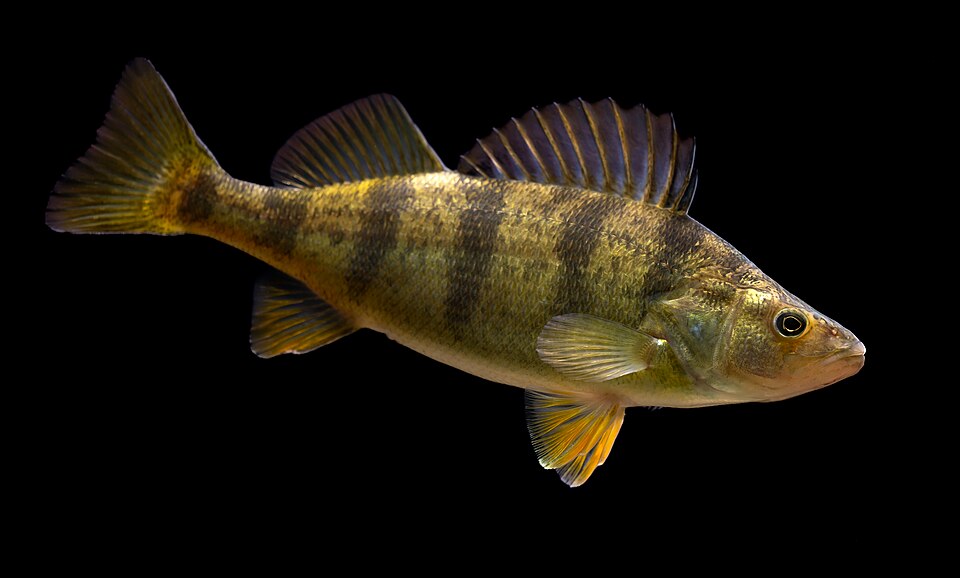
- Sides are bright yellow to brassy-green with seven dark vertical bars, a lighter belly and a dark olive-green back (Iowa DNR).
- No canine teeth on the jaws or roof of the mouth.
- The head is slightly concave above the eyes, giving a somewhat hump-backed look.
Side-by-side help: Yellow Perch vs White Perch vs White Bass
Where they hold
- Pennsylvania lists clear, cool, open lakes and ponds, and a few slow-moving streams with rocky bottoms.
- Iowa says that for much of the year they stay in deeper water and gather around bottom structure such as rock piles, reefs, drop-offs and submerged plant beds.
- Late spring and early summer: often 10 to 20 feet deep, near the bottom. Mid-summer: the outside edge or pockets of submerged vegetation in 10 to 15 feet (Iowa).
- Autumn: back to 10 to 20 feet. Winter: they stay deep, often over large, featureless sand and silt flats in mid-lake (Iowa).
How the seasons change where they are
These notes come from the Iowa and Pennsylvania agency pages listed at the bottom. Iowa gives depths rather than water temperatures.
Spring: afternoons in Pennsylvania, early and late in Iowa
Pennsylvania recommends afternoons in March and April. Iowa lists early morning or evening in late spring and early summer, when perch are often 10 to 20 feet deep, near the bottom.
- Iowa says to keep bait on or near the bottom and to lift it slowly, since strikes often come as the bait is lifted.
Summer: weed pockets and thermocline edges
Iowa says perch favor the outside edge or pockets of submerged vegetation in 10 to 15 feet in mid-summer. In deep, layered lakes, larger perch may hold where the thermocline meets the bottom, usually 30 to 40 feet in Iowa's Okoboji lakes.
- Iowa lists late afternoon or evening in late summer, and says natural lakes are usually best from late summer through late fall.
Fall and winter: deeper
Iowa says perch return to 10 to 20 feet in autumn, and Okoboji perch may be at 40 to 50 feet in late fall. In winter they stay deep, often over large sand and silt flats in mid-lake.
- In autumn and winter, Iowa lists small metal jigging spoons from 1/32 to 1/8 ounce, often with a single size 6 or 8 hook. Iowa lists morning and late afternoon to evening for autumn.
Techniques that work
Find the school
Troll or drift until you find a school, then anchor and still-fish or cast (Iowa).
When it slows
Cast in a circle around the boat and let the bait hit bottom before reeling (Iowa).
Attract them
Iowa says swishing a rod in shallow water, running the motor while anchored or pounding the anchor may attract perch.
Do not stay too long
If there is no action after 15 to 20 minutes, move to a new spot (Iowa).
Baits and lures
Live bait
Small minnows (the favorite for trolling and drifting) and insect larvae such as silver wigglers and maggots work year-round. Nightcrawlers and small worms are effective at times, usually on a stinger or trailer hook. Wax worms, mousees and grubs are used at certain times. Crayfish meat is excellent, especially in mid- and late summer (Iowa). Pennsylvania lists worms or grubs fished on or near the bottom.
Jigs
Lead-heads in 1/64 and 1/32 ounce are the most popular, and skirted mini-jigs are among the most effective. Yellow, white and yellow-white skirts work best in natural lakes, with red-white, purple and green also producing bites (Iowa). Heavier lead-heads up to 1/8 ounce suit trolling and drifting.
Other lures
Pennsylvania lists spinners, twisters and crankbaits in white, yellow and green, 1/32 to 1/8 ounce.
- Iowa suggests floating jig heads to keep lures off snags.
A starter setup
- Iowa lists a stiffer 6 to 6½ foot rod with a medium-to-fast tip for trolling or drifting, and a 5½ to 7 foot rod for jigging or casting, with open- or closed-face spinning reels in ultra-light or medium sizes.
- Line: monofilament, 4 to 8 pound for trolling or drifting, 4 to 6 pound for still-fishing or casting, and 2 pound for the smallest lures (Iowa). Pennsylvania lists 2 to 4 pound and hook sizes 4 to 8.
- Iowa suggests a small bobber or slip-bobber.
If you are releasing a fish
These are general handling tips from Texas Parks & Wildlife. They say nothing about harvest rules: check your state's rules for that.
- Wet your hands, or use a wet rag or glove, before handling a fish.
- Minimize the time the fish is out of the water: no longer than you can hold your breath.
- Use needle-nose pliers, hemostats or a hook remover to take out the hook and protect your hands, and consider barbless hooks.
- If a net is needed, use a rubber-mesh landing net instead of abrasive nylon.
- When fishing in deep water, bring fish in slowly so they can adjust to the changing pressure.
- Iowa suggests cutting two barbs off a treble hook to make a single hook.
Taking this fishing? Save it to your phone so it opens without a signal.
On iPhone: tap the Share button, then Add to Home Screen.
Sources
- Iowa Department of Natural Resources: Yellow Perch
- Pennsylvania Fish & Boat Commission: Yellow Perch
- Texas Parks & Wildlife: Catch & Release Tips
This page is information only. It reports what the agencies above publish, from different states and years, so local waters can differ. It is not legal advice and does not tell anyone what to keep, catch or eat. Bait, tackle and hook rules vary by state and by water, so confirm with your state fish and wildlife agency. CatchCheck uses AI to identify fish from photos, and the ID can be wrong.