
White Perch: How to Catch More of Them
A playbook built from state and provincial wildlife pages. Reviewed October 25, 2026.
Also called: white perch
Jump to: How to recognize one · Where they hold · Baits and lures · Releasing a fish · Sources
The five-minute version
- Look in tidal rivers, estuaries, murky shallows and reservoirs (Maryland, Connecticut, New York).
- Small baits and lures work: jigs, worms and minnows (Connecticut).
- New York lists worms, grubs, small lures and flies.
- Maryland says catches are greatest during the spring spawning season and from September through November.
- Connecticut describes white perch as schooling fish.
How to recognize one
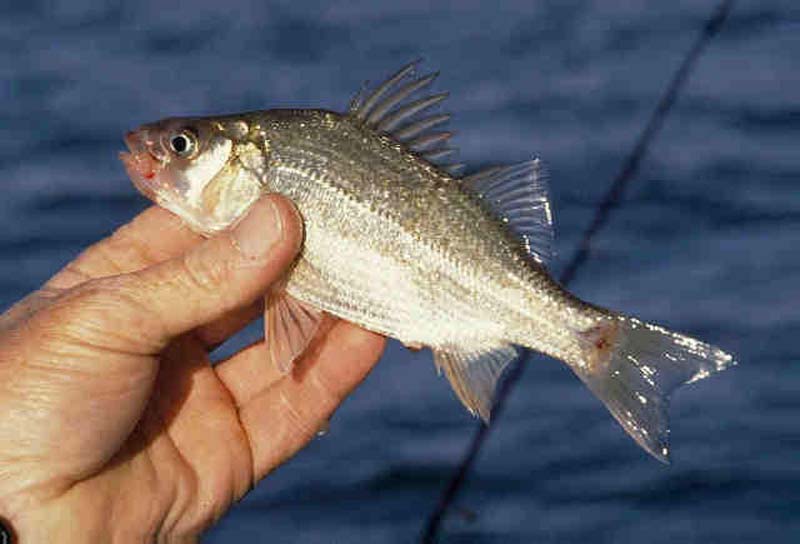
- Silvery-gray to silvery white on the sides with a white belly, a greenish to brownish back, and no horizontal stripes or other conspicuous marks (New York, Connecticut).
- Deep-bodied, with a lower jaw that does not protrude much beyond the upper, a single small spine on the edge of the gill cover, and 8 to 10 soft anal rays (Connecticut).
- Maryland says white perch frequently have irregular dusky lengthwise lines on the body, small teeth, and an anal fin with three strong spines.
- Connecticut says juveniles may have faint vertical bars and mottling, and that a 3-inch juvenile looks very much like an adult.
- Size: Connecticut says commonly 5 to 9 inches. Maryland says 7 to 10 inches is more common, though they can reach about 19 inches. New York says they can exceed 12 inches in tidal water.
Look-alikes
- Striped bass: New York calls the white perch a cousin of the striped bass and the smallest member of the true bass family. Its body lacks the horizontal stripes of a striped bass.
- Yellow perch and white bass: See the side-by-side comparison of yellow perch, white perch and white bass for the markings that separate them.
Side-by-side help: Yellow Perch vs White Perch vs White Bass
Where they hold
- Maryland says they are semi-anadromous, migrating to tidal fresh and slightly brackish water each spring to spawn, and that they range from Nova Scotia to South Carolina and are most abundant from the Hudson River to the Chesapeake Bay. They are also established in some larger Maryland reservoirs.
- Connecticut says they are semi-pelagic schooling fish that prefer estuarine and tidal environments but tolerate a wide range of salinity, and that they inhabit most Connecticut estuaries and larger tidal rivers. Landlocked populations also exist.
- New York says they are primarily found in murky, shallow areas of rivers, lakes and reservoirs.
- Maryland says adults tend to inhabit open water close to shore and may frequent quiet streams well up into tributaries from March through November, and that in winter they move to the downstream parts of tributaries and deeper channel areas.
Seasons
These notes come from the Maryland, New York and Connecticut pages listed at the bottom, and timing shifts by region.
Spring: the spawning run
Maryland says white perch spawn from April through June in fresh to low-salinity waters of large rivers over gravel or sand, and that catches are greatest during the spring spawning season and again from September through November.
- New York says that in tidal streams they are most often caught in late winter and spring.
Techniques that work
Find the school
Connecticut describes them as schooling fish, so look for where the fish are in tidal rivers and estuaries.
Small baits and lures
Connecticut says white perch can readily be caught with a wide range of small baits and lures such as jigs, worms and minnows. New York says they are commonly caught on worms, grubs, small lures or flies.
Shore or boat
Maryland says they are available to anglers from shore and from boats because they are distributed among a variety of habitats, including inshore waters.
Baits and lures
Worms
Connecticut and New York list worms.
Minnows
Connecticut lists minnows.
Jigs and grubs
Connecticut lists jigs and New York lists grubs.
Small lures and flies
New York lists small lures and flies.
- Maryland says white perch are taken in nearly all types of fishing gear typically used on the Chesapeake Bay. If a rule limits the gear or bait you can use, check your state agency.
If you are releasing a fish
These are general handling tips from Texas Parks & Wildlife. They say nothing about harvest rules: check your state's rules for that.
- Wet your hands, or use a wet rag or glove, before handling a fish.
- Minimize the time the fish is out of the water: no longer than you can hold your breath.
- Use needle-nose pliers, hemostats or a hook remover to take out the hook and protect your hands, and consider barbless hooks.
- If a net is needed, use a rubber-mesh landing net instead of abrasive nylon.
- When fishing in deep water, bring fish in slowly so they can adjust to the changing pressure.
- Connecticut says white perch have long, sharp spines that make them difficult for both anglers and predators to handle.
Taking this fishing? Save it to your phone so it opens without a signal.
On iPhone: tap the Share button, then Add to Home Screen.
Sources
- Maryland DNR: Fish Facts, White Perch
- Connecticut DEEP: White Perch (Freshwater Fishes of Connecticut, 2009)
- New York DEC: Guide to Capital District Fishing
- Texas Parks & Wildlife: Catch & Release Tips
This page is information only. It reports what the agencies above publish, from different states and years, so local waters can differ. It is not legal advice and does not tell anyone what to keep, catch or eat. Bait, tackle and hook rules vary by state and by water, so confirm with your state fish and wildlife agency. CatchCheck uses AI to identify fish from photos, and the ID can be wrong.