
Walleye: How to Catch More of Them
A playbook built from state and provincial wildlife pages. Reviewed October 25, 2026.
Also called: walleyed pike, pickerel, eyes
Jump to: How to recognize one · Where they hold · Baits and lures · Releasing a fish · Sources
The five-minute version
- Think low light: early morning, late evening and night (Iowa, Pennsylvania).
- Look for rock and current breaks: riffles, boulders, outside bends, drop-offs and the upstream side of wing dams.
- Jigs tipped with a minnow, leech or nightcrawler are the go-to (Iowa, Pennsylvania).
- Use a jig just heavy enough to touch bottom, since heavier jigs make bites hard to detect (Iowa).
- If you have not caught a walleye in 20 minutes, Iowa suggests moving to a new spot.
How to recognize one
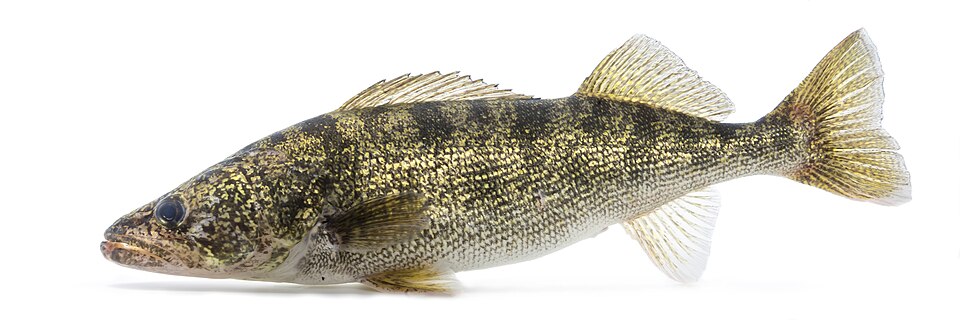
- Large, whitish, glossy eyes and strong canine teeth (Iowa DNR).
- A brassy olive-buff body, sometimes yellowish on the sides and white underneath, with brown or black mottling and no distinct dark bars.
- The lower lobe of the tail has a silver or milk-white tip, and one large dark blotch sits near the base of the last 2 to 3 spines of the rear dorsal fin.
Side-by-side help: Walleye vs Sauger
Where they hold
- Pennsylvania lists deep, clear lakes and large rivers with a rocky or gravel bottom.
- Rivers: outside bends, log jams, fallen trees and current breaks that offer cover and resting areas, and riffles and shallow rocky areas, rip-rap and boulders (Iowa).
- Deep, low-current overwintering areas (Iowa).
- Summer: deep weed-bed edges, drop-offs and hard-bottomed flats in reservoirs. On the Mississippi, flowing side channels and the upstream side of wing dams (Iowa).
How the seasons change where they are
These notes come from the Iowa and Pennsylvania agency pages listed at the bottom, and timing shifts by region.
Late fall to ice-up: water below 40°F
Iowa says walleye start their move to overwintering areas when water temperatures drop below 40°F.
- Iowa suggests a slow retrieve with live bait in overwintering areas.
Spawn: 42 to 54°F
Iowa says fish begin moving as ice melts and flows or temperatures rise, with pre-spawn fish gathering in shallower water near barriers, riffles and rocks. Spawning starts at 42 to 54°F, usually in early April in Iowa. After the spawn, fishing can be difficult for a couple of weeks.
- Iowa suggests fishing near known spawning areas, especially at night.
- Iowa says riffles can be productive in spring (April) and fall (October), in low light when walleye move into the shallows.
Summer: deeper and spread out
Iowa says fish move to deeper water and spread out in summer, then move to shallower areas in September as the water cools.
- In summer, Iowa suggests fishing eddies around boulders and downed trees, and working the current seam with jigs.
- On the Mississippi, Iowa suggests a three-way rig on the upstream side of wing dams.
- Pennsylvania lists nighttime for summer, and morning and late day in spring.
Techniques that work
Jigs
Iowa says to use a jig just heavy enough to touch the bottom. About 1/8 ounce works for most river and lake conditions; use 1/4 ounce or heavier for fast current, deep water or high wind.
Slip bobber
Set a slip bobber so the bait is within a foot of the bottom, for lazy fish (Iowa).
Three-way rig
Three-way rigs with live bait work well when walleyes are inactive, and can be trolled to cover water (Iowa).
Crankbaits
Troll or cast minnow-imitating crankbaits and vary boat speed and retrieve (Iowa).
How to hook bait
Thread a whole nightcrawler on the hook, or use half to improve hookups. Hook minnows through both lips on a jig or three-way rig, or just below the dorsal fin on a slip bobber. Hook leeches through the sucker disk (Iowa).
Baits and lures
Live bait
Minnows, leeches and nightcrawlers on a jig head or a slip ring on or near the bottom (Pennsylvania, Iowa).
Jigs and twisters
Jigs tipped with twister tails or live bait (Iowa). A colored hook with a couple of red or chartreuse beads in front of it.
Crankbaits
Silver, gold, blue and black suit clear water. Brighter colors suit dark, stained water (Iowa). Crayfish-imitating baits near rocky areas.
Colors (Pennsylvania)
Bright green, yellow, gold, silver, black and purple.
- Pennsylvania also lists spinners among its lures.
A starter setup
- Spinning: a sensitive 6 or 6½ foot medium or medium-light graphite rod with 6 to 8 pound monofilament or braided line (Iowa).
- Casting: a 6 or 6½ foot medium or medium-heavy rod with 8 to 10 pound line, suited to trolling larger crankbaits or three-way rigs (Iowa).
- Pennsylvania lists 6 to 12 pound test, hook sizes 3/0 to 4 and lure sizes 1/8 to 1 ounce.
If you are releasing a fish
These are general handling tips from Texas Parks & Wildlife. They say nothing about harvest rules: check your state's rules for that.
- Wet your hands, or use a wet rag or glove, before handling a fish.
- Minimize the time the fish is out of the water: no longer than you can hold your breath.
- Use needle-nose pliers, hemostats or a hook remover to take out the hook and protect your hands, and consider barbless hooks.
- If a net is needed, use a rubber-mesh landing net instead of abrasive nylon.
- When fishing in deep water, bring fish in slowly so they can adjust to the changing pressure.
Taking this fishing? Save it to your phone so it opens without a signal.
On iPhone: tap the Share button, then Add to Home Screen.
Sources
- Iowa Department of Natural Resources: Walleye
- Pennsylvania Fish & Boat Commission: Walleye
- Texas Parks & Wildlife: Catch & Release Tips
This page is information only. It reports what the agencies above publish, from different states and years, so local waters can differ. It is not legal advice and does not tell anyone what to keep, catch or eat. Bait, tackle and hook rules vary by state and by water, so confirm with your state fish and wildlife agency. CatchCheck uses AI to identify fish from photos, and the ID can be wrong.