
Spotted Bass: How to Catch More of Them
A playbook built from state and provincial wildlife pages. Reviewed October 25, 2026.
Also called: Kentucky bass, spot, Kentucky spotted bass
Jump to: How to recognize one · Where they hold · Baits and lures · Releasing a fish · Sources
The five-minute version
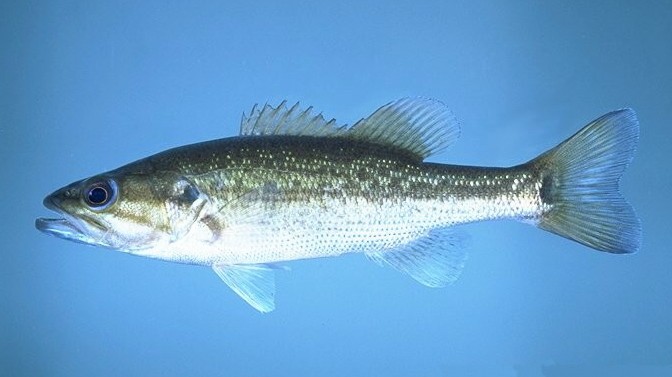
- Look for rows of small black spots on the lower sides, and a shallow notch between the dorsal fins (Kentucky).
- In fall, schools run along rock bluffs and over points, submerged humps and channel drops.
- When schools trap shad against the surface, throw large chrome topwater lures (Kentucky).
- A medium-light spinning rod with 6 pound fluorocarbon is all you need (Kentucky).
- If you catch one, stay on that spot (Kentucky).
How to recognize one
- Adults have horizontal rows of small black spots on the lower sides, unlike the plain sides of a largemouth (Kentucky Department of Fish and Wildlife Resources).
- A shallow notch separates the spiny and soft dorsal fins, while a largemouth has a deep notch.
- A circular patch of teeth is present on the tongue. Juveniles have a three-colored tail fin: orange at the base, black in the middle, and white at the edge.
Look-alikes
- Largemouth bass: Plain sides, a deep notch between the dorsal fins, and no tooth patch on the tongue (Kentucky).
- Smallmouth bass: Kentucky says spotted bass are much less common than smallmouth bass in cool, clear upland streams.
Side-by-side help: Largemouth vs Smallmouth vs Spotted Bass
Where they hold
- Common statewide in Kentucky except the far western Mississippi Coastal Plain, mainly in streams and rivers, but also in oxbow lakes and reservoirs, where they are less numerous than largemouth.
- Like other black bass, they tend to stay near cover such as logs, stumps and other submerged structure (Kentucky).
- Size: most adults are about 10 to 15 inches and 1 to 3 pounds, and they can grow to about 24 inches and 8 pounds (Kentucky).
Fall schooling
These notes come from two Kentucky agency pages listed at the bottom. They give no water-temperature numbers, and timing shifts by region.
Fall: schools on bluffs, points and drops
Kentucky says that once fall winds blow, spotted bass school along rock bluffs or suspend over points, submerged humps and channel drops. In early to mid-fall, schools often trap shad against the surface.
- Large chrome topwater lures thrown into surface-feeding activity draw strong strikes, and the same lures worked over points, humps and drops can draw fish from below (Kentucky).
- Kentucky lists a 4-inch black finesse worm on a 3/16-ounce shaky head fished slowly down points, and a hammered silver jigging spoon fished along bluffs.
- On another lake, Kentucky lists a 1/4-ounce football jig in green, brown or chartreuse.
Baits and lures
Finesse worms and jigs
4-inch black finesse worm on a 3/16-ounce shaky head, and a 1/4-ounce football jig in green, brown or chartreuse (Kentucky).
Spoons
A hammered silver jigging spoon fished along bluffs (Kentucky).
Topwater
Large chrome topwater lures when schools trap shad at the surface (Kentucky).
Live bait
Large crappie minnows on size 1 circle hooks, with two split shot about 18 inches above the hook. Kentucky says live bait works best on one lake (Kentucky).
- Kentucky says to work a spot again once you find fish, because a school often holds more of them.
A starter setup
- A medium-light spinning rod with a reel spooled with 6 pound fluorocarbon line (Kentucky).
If you are releasing a fish
These are general handling tips from Texas Parks & Wildlife. They say nothing about harvest rules: check your state's rules for that.
- Wet your hands, or use a wet rag or glove, before handling a fish.
- Minimize the time the fish is out of the water: no longer than you can hold your breath.
- Use needle-nose pliers, hemostats or a hook remover to take out the hook and protect your hands, and consider barbless hooks.
- If a net is needed, use a rubber-mesh landing net instead of abrasive nylon.
- When fishing in deep water, bring fish in slowly so they can adjust to the changing pressure.
Taking this fishing? Save it to your phone so it opens without a signal.
On iPhone: tap the Share button, then Add to Home Screen.
Sources
- Kentucky Department of Fish and Wildlife Resources: Spotted Bass
- Kentucky Department of Fish and Wildlife Resources: Spotted bass school in fall
- Texas Parks & Wildlife: Catch & Release Tips
This page is information only. It reports what the agencies above publish, from different states and years, so local waters can differ. It is not legal advice and does not tell anyone what to keep, catch or eat. Bait, tackle and hook rules vary by state and by water, so confirm with your state fish and wildlife agency. CatchCheck uses AI to identify fish from photos, and the ID can be wrong.