
Spanish Mackerel: How to Catch More of Them
A playbook built from state and provincial wildlife pages. Reviewed October 25, 2026.
Also called: spanish, spots
Jump to: How to recognize one · Where they hold · Baits and lures · Releasing a fish · Sources
The five-minute version
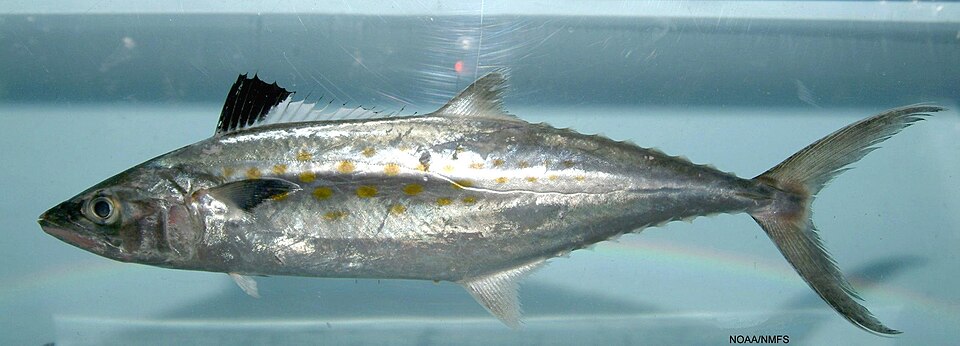
- Look for the black front of the first dorsal fin, and golden yellow spots above and below the lateral line (North Carolina).
- Almost any small, shiny metal lure or jig works when retrieved or trolled quickly (North Carolina).
- Fish from the surf, piers and boats (North Carolina).
- In summer, they may be found in sounds and river mouths (North Carolina).
- Large ones are often caught by slow-trolling live bait intended for king mackerel (North Carolina).
How to recognize one
- Greenish backs with silvery sides and belly, with golden yellow spots above and below the lateral line. The front of the first dorsal fin is black and the lateral line curves gently to the tail base (North Carolina DMF).
- Juveniles can be confused with juvenile king mackerel (North Carolina).
Look-alikes
- King mackerel: King mackerel lack a black area on the front of the first dorsal fin (North Carolina).
Side-by-side help: King vs Spanish Mackerel
Where they hold
- Open coastal waters from the Gulf of Maine to the Yucatan Peninsula, moving with water temperatures. In summer, they may be found in sounds and river mouths (North Carolina).
- They feed on small fish such as anchovies, sardines, threadfin herring and silversides, plus shrimp and squid (North Carolina).
Seasonal movements
These notes come from North Carolina's marine fisheries agency, which gives no dates, distances or water-temperature thresholds.
Summer: sounds and river mouths
North Carolina says Spanish mackerel migrate north and south with water temperatures, spawn in the ocean at night from May to September, and may be found in sounds and river mouths in summer.
- North Carolina lists catching them from the surf, piers and boats.
Techniques that work
Fast retrieve or troll
Almost any small, shiny metal lure or jig works when retrieved or trolled quickly (North Carolina).
Slow-trolled live bait
Large individuals are often caught by slow-trolling live bait intended for king mackerel (North Carolina).
Baits and lures
Small metal lures and jigs
Small, shiny metal lures and jigs (North Carolina).
Live bait
Live bait slow-trolled for king mackerel sometimes catches large Spanish mackerel (North Carolina).
- North Carolina does not describe rods, reels, line or leaders for Spanish mackerel.
If you are releasing a fish
These are general handling tips from Texas Parks & Wildlife. They say nothing about harvest rules: check your state's rules for that.
- Wet your hands, or use a wet rag or glove, before handling a fish.
- Minimize the time the fish is out of the water: no longer than you can hold your breath.
- Use needle-nose pliers, hemostats or a hook remover to take out the hook and protect your hands, and consider barbless hooks.
- If a net is needed, use a rubber-mesh landing net instead of abrasive nylon.
- When fishing in deep water, bring fish in slowly so they can adjust to the changing pressure.
Taking this fishing? Save it to your phone so it opens without a signal.
On iPhone: tap the Share button, then Add to Home Screen.
Sources
- North Carolina Division of Marine Fisheries: Spanish Mackerel
- Texas Parks & Wildlife: Catch & Release Tips
This page is information only. It reports what the agencies above publish, from different states and years, so local waters can differ. It is not legal advice and does not tell anyone what to keep, catch or eat. Bait, tackle and hook rules vary by state and by water, so confirm with your state fish and wildlife agency. CatchCheck uses AI to identify fish from photos, and the ID can be wrong.