
Smallmouth Bass: How to Catch More of Them
A playbook built from state and provincial wildlife pages. Reviewed October 25, 2026.
Also called: smallie, bronzeback, brown bass
Jump to: How to recognize one · Where they hold · Baits and lures · Releasing a fish · Sources
The five-minute version
- Look for rock and current: boulders, riffles, and the quiet edge of a pool beside a riffle.
- Go light: agencies list 2 to 10 pound line and light or medium-light spinning gear.
- Think crayfish: crayfish-style crankbaits, jigs and live crayfish show up on every source below.
- Early morning and late evening are surface time; in bright midday sun, fish stay deeper.
- In cold water, slow down and fish near the bottom around rocks and downed trees.
How to recognize one
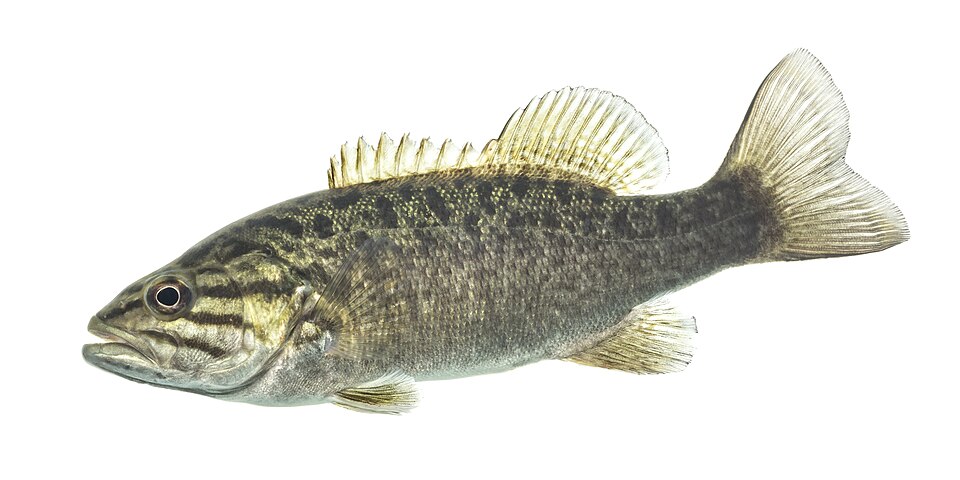
- A slender, streamlined bass. Iowa describes a golden-green body with faint olive blotches and olive-green bars radiating back from the eye.
- Pennsylvania lists a brown or bronze back, a white or pale-yellow belly and vertical broken bars on the sides.
- The upper jaw reaches about to the rear edge of the eye, and no farther (Iowa DNR; Pennsylvania Fish & Boat).
- Only a shallow notch separates the spiny and soft parts of the dorsal fin (Iowa DNR). Young fish have a three-colored tail with a black bar.
Look-alikes
- Largemouth bass: Green coloring and an upper jaw that reaches past the eye (Pennsylvania Fish & Boat). Iowa adds a deep notch in the dorsal fin.
- Spotted bass: Iowa notes that spotted and smallmouth bass both have a three-colored tail as young fish.
Side-by-side help: Largemouth vs Smallmouth vs Spotted Bass
Where they hold
- Rivers: free-flowing riffle-and-pool stretches with a lot of rock and low turbidity (Iowa DNR). Pennsylvania lists warm streams and rivers with gravel bottoms and rocky areas along weed beds.
- Lakes: a few clear lakes, ponds and reservoirs (Pennsylvania). Iowa says about a half-dozen of its lakes consistently produce them, around rocky reefs.
- Missouri's article puts them around boulders and logs, often on the outside of river bends near the head or tail of a pool.
- Iowa suggests the spots behind large boulders and the edge of a quiet pool next to a riffle.
How the seasons change where they are
These notes come from the agency pages listed at the bottom, mostly Iowa and Missouri, and timing shifts by region. Missouri's article is from 1996.
Winter: water in the 30s and 40s
Missouri says bass seek the deepest parts of pools, near large boulders and downed trees, and do not travel long distances to a wintering hole. Where a spring feeds the pool, they gather in the warmer flow. They still feed, but less.
- Missouri suggests fishing slowly on the bottom around rocks and downed trees with light spinning tackle, using crayfish, minnows or jigs tipped with pork rind.
Early spring: pre-spawn in the 40s and low 50s
Iowa says stream water is usually 40 to 50°F before spawning, and fish move up tributaries. In lakes, fish move shallow between mid-April and mid-May, in 4 to 12 feet of water.
- Iowa says lead-head jigs are slow-retrieved when water is 48 to 55°F, and lists one-eighth to one-quarter ounce hair or marabou jigs in white, blue or purple, and purple, yellow or white plastic twisters. Minnows can be tipped onto either.
- Iowa suggests about 2-inch crayfish-colored crankbaits for lake fish before the spawn.
Spawn: water in the low 60s
Missouri says that as water warms to the low 60s, males leave winter areas for shallow gravel where a rock or log breaks the current. They fan out platter-sized nests and guard the eggs until the fry reach nursery areas along stream edges.
- Missouri says aggressive males will hit spinners, jigs, small crankbaits or large streamers fished near them, and says to land fish quickly and release them right away.
Summer: low, clear water
Missouri says flows drop and streams clear. Medium and small bass hold in shallow riffles behind boulders, in eddies and among downed timber, while large bass use deeper areas near chunk rock or downed trees during the day and move through pools at dusk. Iowa says smaller stream fish are in one to two feet of water above and below riffles, and lake fish sit on reef tops in 8 to 10 feet with drop-offs to 20 feet or more nearby.
- Iowa lists crayfish-like crankbaits and a soft-shelled crayfish on a number 8 hook. Bottom-hugging crankbaits work in 4 to 5 feet of stream water.
- Missouri suggests jigs tipped with plastic, or crayfish or minnows under a float, around large rocks or downed trees in moving water.
Fall: cooling water
Missouri says feeding increases in early fall, then slows as water temperatures fall into the 40s, and bass move to deeper holding spots. It points to boulders and logs in two to four feet of water, usually on the outside of river bends near the head or tail of a pool. Iowa places lake fish near shallow rock reefs in 10 to 15 feet.
- Missouri suggests light spinning gear with small crankbaits, spinners, crayfish or minnows, or jigs tipped with plastic once streams cool in September.
- Iowa prefers deep-diving crankbaits in fall, then minnow-tipped lead-heads, then minnow-shaped plugs, with a split shot ahead of the crankbait when fishing deeper than 10 to 12 feet.
Techniques that work
Cast past, then retrieve through
Iowa says to cast past the suspected fish and retrieve through its location, placing the lure close without spooking it.
Change the retrieve
Iowa suggests testing a continuous retrieve against a crank-and-pause.
Watch the weather
Iowa says bass may become very active as a cold front approaches, then move deeper into structure once it settles.
Time of day
Iowa says smallmouth readily chase surface presentations in early morning and late evening, and stay deeper in bright midday sun. Pennsylvania lists daytime in spring and fall, and early morning and late evening in summer.
Baits and lures
Murky water
Iowa suggests spinnerbaits or rattling crankbaits when visibility is 6 inches or less, in chartreuse, brown, black or silver or gold flake. In spring and fall, run spinnerbaits one to two feet below the surface.
Crankbaits
Crayfish-like crankbaits in summer, shallow minnow-type crankbaits in spring and fall, and deep-diving crankbaits for deeper fall fish (Iowa).
Jigs and twisters
Hair, marabou or bucktail jigs (Iowa, Pennsylvania) and plastic twisters. Missouri lists jigs tipped with plastic or pork rind.
Surface lures
Pennsylvania lists topwater poppers and stickbaits among the lures.
Live bait
Crayfish, minnows and hellgrammites on a jig head or light wire hook (Pennsylvania). Iowa lists a soft-shelled crayfish on a number 8 hook.
- Pennsylvania lists lure weights of about 1/16 to 3/4 ounce.
- Missouri recommends light spinning gear with small crankbaits, spinners and jigs through fall and winter.
A starter setup
- Rod and reel: a light or medium-light spinning rod with an open-faced reel. Iowa says light baitcasting gear is an option for bigger water.
- Line: Iowa lists 2 to 6 pound test, with monofilament as the standard, fluorocarbon leaders, and braid for jig fishing or snaggy areas. Pennsylvania lists 4 to 10 pound test.
- Hooks: Pennsylvania lists sizes 1 to 4 for live bait.
If you are releasing a fish
These are general handling tips from Texas Parks & Wildlife. They say nothing about harvest rules: check your state's rules for that.
- Wet your hands, or use a wet rag or glove, before handling a fish.
- Minimize the time the fish is out of the water: no longer than you can hold your breath.
- Use needle-nose pliers, hemostats or a hook remover to take out the hook and protect your hands, and consider barbless hooks.
- If a net is needed, use a rubber-mesh landing net instead of abrasive nylon.
- When fishing in deep water, bring fish in slowly so they can adjust to the changing pressure.
- Missouri says to land spawning males quickly and release them right away.
Taking this fishing? Save it to your phone so it opens without a signal.
On iPhone: tap the Share button, then Add to Home Screen.
Sources
- Iowa Department of Natural Resources: Smallmouth Bass
- Missouri Department of Conservation: Smallmouth Bass for the Seasons (1996)
- Pennsylvania Fish & Boat Commission: Smallmouth, Largemouth and Spotted Bass
- Texas Parks & Wildlife: Catch & Release Tips
This page is information only. It reports what the agencies above publish, from different states and years, so local waters can differ. It is not legal advice and does not tell anyone what to keep, catch or eat. Bait, tackle and hook rules vary by state and by water, so confirm with your state fish and wildlife agency. CatchCheck uses AI to identify fish from photos, and the ID can be wrong.