
Largemouth Bass: How to Catch More of Them
A playbook built from state and provincial wildlife pages. Reviewed October 25, 2026.
Also called: bigmouth, green bass, bucketmouth, LMB
Jump to: How to recognize one · Where they hold · Baits and lures · Releasing a fish · Sources
The five-minute version
- Look for cover and structure first: weeds, sunken wood, docks and overhanging trees.
- In summer, early morning, late evening and night are the times agencies point to.
- Match the lure to the water: natural colors in clear water, brighter colors and bigger blades in stained water.
- Slow down in cold water, and speed up when the bass are chasing.
- Soft plastics and jigs took the most big bass in the Texas review cited below.
How to recognize one
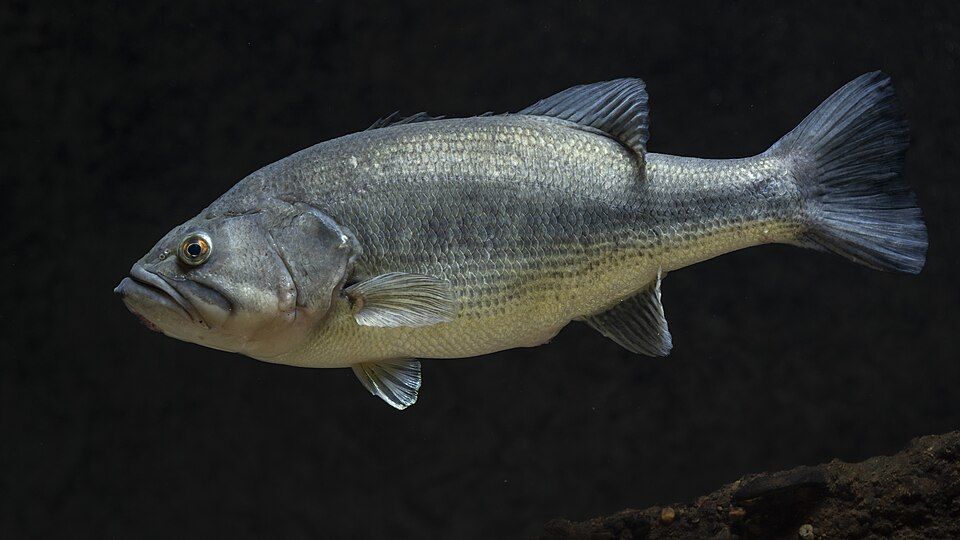
- Green to olive back, with a broad dark stripe along the middle of the side (it can be unclear in big adults and in murky water).
- The upper jaw reaches past the back edge of the eye. That is the clearest feature (Iowa DNR, Pennsylvania Fish & Boat).
- A deep notch nearly separates the spiny and soft parts of the dorsal fin.
- Belly is greenish-white to yellowish, and the eye is usually gold.
Look-alikes
- Smallmouth bass: Brown or bronze back, a white or pale-yellow belly and vertical broken bars on the sides. The upper jaw stops before the back edge of the eye (Pennsylvania Fish & Boat).
- Spotted bass: Young largemouth have a two-toned tail, while spotted and smallmouth bass have a three-colored tail (Iowa DNR).
- Rock bass: Ontario's page lists rock bass as a similar species.
Side-by-side help: Largemouth vs Smallmouth vs Spotted Bass
Where they hold
- Standing or dammed water: natural lakes, reservoirs, ponds, and slow or backwater parts of rivers. They avoid strong current (Iowa DNR, Pennsylvania Fish & Boat).
- Thick weeds, sunken wood, overhanging trees and docks (Ontario).
- Iowa lists sunken roadbeds, submerged islands, secondary points and flooded creek channels. Creek or tile inflows run a few degrees warmer than the lake and attract fish, and so do current seams and places where dark water meets clear water.
- New Jersey's agency lists grass beds, fallen or standing trees, docks and rocky banks for shallow fishing, and points, offshore humps, roadbeds and wood or rock piles for deep fishing.
What water temperature changes
Bass behavior follows water temperature more than the calendar. Temperatures below come from the agency pages listed at the bottom, mostly Iowa and New Jersey, and timing shifts by region. A water-temperature gauge or a nearby gauge reading helps.
About 50°F and colder
Iowa's wildlife agency says feeding is greatly reduced at about 50°F and below. New Jersey's agency says cold temperatures drive bass into deeper sections of the lake.
- Iowa says to start with slow presentations in early spring, then speed up the retrieve if the bass are feeding aggressively, and to match the size of the local baitfish or crayfish.
Mid-50s to low 60s: pre-spawn
Around 55°F bass move closer to spawning areas, and from 55 to 62°F they move into the shallows to feed actively (Iowa DNR). They often stop at staging areas first: deeper water close to the shallows (New Jersey).
- Iowa says faster-moving lures thrown into a female's swimming path often work in the pre-spawn.
- Texas's wildlife agency reviewed 346 bass of 13 pounds or more: 44% were caught in March and 26% in February. Soft plastics took the most of them (45%), with jigs second (23%).
Low-to-mid 60s: spawning
New Jersey's article puts spawning at 62 to 65°F, from mid-April through early June in New Jersey. Males build and guard nests and stay shallow longer than females (Iowa, New Jersey).
- Iowa says fishing success drops quickly during the spawn. Males do not feed, but will strike what enters their territory.
- Texas's catch-and-release guidance says to avoid capturing fish from spawning beds.
After the spawn
Bass stay near spawning areas for a number of weeks and are hard to catch while recovering (New Jersey). Iowa says females rest for about two weeks, then move to deeper edges and secondary points.
- Iowa suggests slower lures that suspend and can be paused for long periods on the outer edges of flats.
Summer heat (above about 75°F)
Iowa says water tops 75°F from late June to late August or early September, bass seek water around 77 to 80°F, and most avoid water above 80°F. It calls summer "the most difficult and challenging time to fish." Where lakes layer, there is no oxygen below a certain depth, and oxygen helps decide how deep bass can go (Iowa, New Jersey).
- Early morning and late evening are the times Iowa, New Jersey and Pennsylvania point to. Iowa adds night, and names riprap, vegetation edges and shoreline near deep water.
- New Jersey says that on sunny days bass hold tight to cover, so fish slower and closer to it. On cloudy days they roam farther, so faster lures work.
- Midday can still produce, especially on cloudy days (New Jersey).
Fall cooling (70°F down to 50°F)
Iowa says that after mid-September, as water falls to 70°F and below, bass move back into shallow water and feed aggressively to prepare for winter, and it calls the fall bite the easiest to find success. They are often on the deeper ends of flats in the evening and early morning, and move onto the flats at midday when the shallows warm.
- Feeding happens in shallow water close to deep water (New Jersey).
Baits and lures
Clear to lightly stained water
Natural-colored lures; smaller, thinner blades on spinnerbaits, in-line spinners and buzzbaits; crankbaits and jerkbaits with smaller bills (Iowa DNR).
Stained or muddy water
Brighter, more vibrant colors, larger blades and wider bills, which put out more vibration (Iowa DNR).
Soft plastics
Carolina, Texas, Florida, wacky and drop-shot rigs. Iowa says to use subtler baits when fish are tired and to use soft plastics for fish that short-strike hard baits. New Jersey lists 4 to 8 inch plastic worms in black, red shad or green.
Jigs
Quarter-ounce to half-ounce jigs in black, black and blue, or green (New Jersey). Pennsylvania also lists jigs among its lures.
Crankbaits
Shad patterns in clear water and chartreuse in muddy water (New Jersey).
Spinnerbaits and topwater
Quarter-ounce to half-ounce spinnerbaits in white or chartreuse, and topwater in shad or frog patterns, for shallow water (New Jersey).
Live bait
Golden shiners, nightcrawlers or small baitfish on 1/0 to 4/0 hooks, with a small split shot about a foot above the hook and a float to keep bait out of weeds or off the bottom (New Jersey). Pennsylvania lists large minnows and crayfish. Iowa says to keep live bait moving and says bass rarely take dead food from the bottom, but will take nightcrawlers year-round.
- Iowa says to match the size of the baitfish or crayfish the bass are eating locally.
- Ontario: if they are not biting, change your lure and your tactic. It also says largemouth have a keen sense of smell and can be fooled by adding scent to an artificial bait.
- Soft plastics gave up 45% of the big bass in Texas's review, jigs 23%, spinnerbaits 12%, and crankbaits and live bait 9% each. The data is from a 2004 article about Texas reservoirs, so treat it as a clue, not a rule.
A starter setup
- Line: 6 to 14 pound test. Hooks: size 3/0 to 4. Lures: 1/16 to 1 ounce. Good colors: black, brown, purple or green (Pennsylvania Fish & Boat).
- Spinning or baitcasting gear are both popular. Iowa says to use what you can handle comfortably: spinning reels suit lighter lures cast into or under cover, and baitcasting reels suit precise casts and flipping but take practice to avoid backlash.
- Iowa says braided line suits topwater, spinnerbaits and jigs, fluorocarbon sinks and suits clear water and deep-diving crankbaits, and monofilament stretches.
If you are releasing a fish
These are handling tips Texas Parks & Wildlife publishes for black bass. They say nothing about harvest rules: check your state's rules for that.
- Wet your hands before touching the fish. Dry hands strip the protective slime. Bare hands or smooth rubber gloves are preferred.
- Keep fish in the water as much as possible. Texas's rule of thumb is no longer out of water than you can hold your breath.
- Grasp a bass by the lower jaw without over-extending it, and never lift one by the gill cover or eye sockets.
- Use clean, sharp, barbless hooks where possible, and remove hooks quickly with pliers or a hook remover. If a net is needed, a rubber-mesh net is easier on fish than nylon.
- Texas says catch-and-release is stressful to black bass above 70°F and very stressful above 80°F, and to avoid catch-and-release angling in water deeper than 30 feet.
- If a fish must come out of the water, use a cool, wet, smooth surface and avoid hot engine covers or sun-baked decks.
A note on names
The scientific name is usually written Micropterus salmoides, but Ontario's page lists the species as Micropterus nigricans,. Both names refer to the largemouth bass anglers know.
Taking this fishing? Save it to your phone so it opens without a signal.
On iPhone: tap the Share button, then Add to Home Screen.
Sources
- Iowa Department of Natural Resources: Largemouth Bass
- Pennsylvania Fish & Boat Commission: Smallmouth, Largemouth and Spotted Bass
- New Jersey Division of Fish & Wildlife: bass fishing article (2001)
- Ontario Ministry of Natural Resources: Largemouth Bass
- Texas Parks & Wildlife: March is Big Bass Month (2004)
- Texas Parks & Wildlife: Catch and release guidelines for black bass
- Texas Parks & Wildlife: Catch & Release Tips
This page is information only. It reports what the agencies above publish, from different states and years, so local waters can differ. It is not legal advice and does not tell anyone what to keep, catch or eat. Bait, tackle and hook rules vary by state and by water, so confirm with your state fish and wildlife agency. CatchCheck uses AI to identify fish from photos, and the ID can be wrong.