
King Mackerel: How to Catch More of Them
A playbook built from state and provincial wildlife pages. Reviewed October 25, 2026.
Also called: kingfish, king
Jump to: How to recognize one · Where they hold · Baits and lures · Releasing a fish · Sources
The five-minute version
- No black area on the front of the first dorsal fin, and a lateral line that dips sharply at the second dorsal fin (North Carolina).
- Trolling is the main method, and slow trolling is the most popular: multiple baits at a very slow speed (North Carolina).
- Live Atlantic menhaden and cigar minnows, dead ribbonfish, spoons and jigs are the baits and lures listed.
- Fish from boats or from ocean fishing piers.
- In winter they congregate just inside the Gulf Stream; in summer and fall they move inshore along beaches and near the mouths of inlets and rivers (North Carolina).
How to recognize one
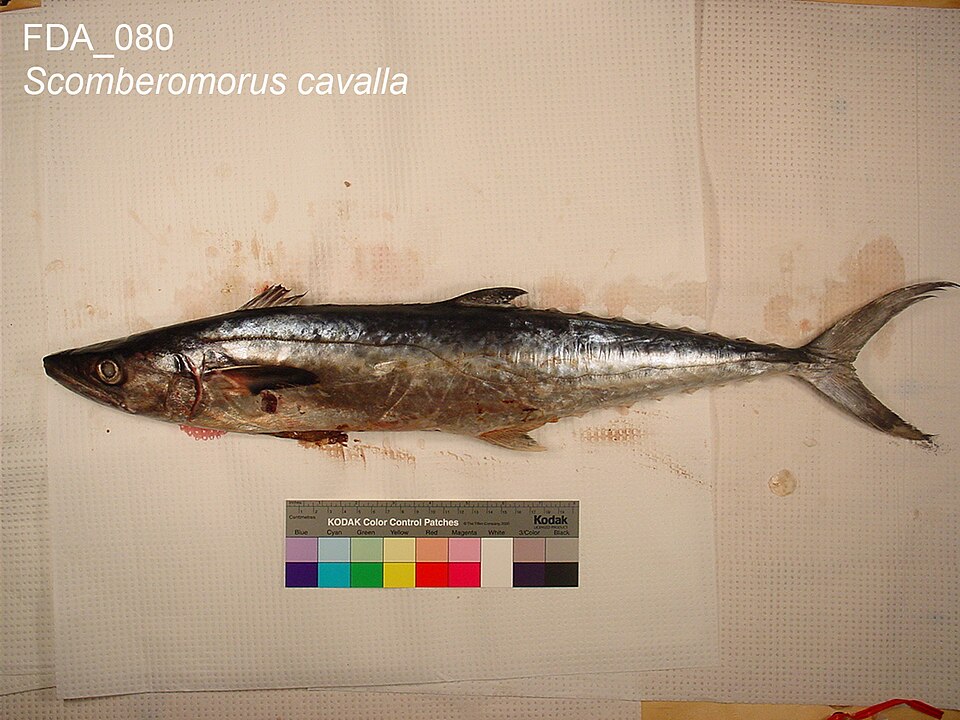
- A long, slender body with a greenish-blue back and silvery sides, faint bronze spots that may fade as fish grow, and a large, forked tail (North Carolina DMF).
- The lateral line starts high and dips sharply at the second dorsal fin, and king mackerel lack a black area on the front of the first dorsal fin.
- Size is up to 72 inches, though most catches are 30 to 45 inches.
Look-alikes
- Spanish mackerel: North Carolina says king mackerel are often confused with Spanish mackerel, which have a black front on the first dorsal fin and golden yellow spots (North Carolina Spanish mackerel profile).
Side-by-side help: King vs Spanish Mackerel
Where they hold
- Open ocean waters near the coast, from North Carolina to southeast Florida (North Carolina). Movements are triggered by water temperature and food supply.
- Winter: they congregate just inside the Gulf Stream along the edge of the continental shelf. Summer and fall: they move inshore along beaches and near the mouths of inlets and rivers.
- Diet: opportunistic carnivores that favor menhaden, mullet, thread herring, sardines and squid.
Techniques that work
Slow trolling
Trolling is the main method, and slow trolling is the most popular: multiple baits are pulled behind the boat at a very slow speed (North Carolina).
From a boat or a pier
Anglers catch them from boats or from ocean fishing piers (North Carolina).
Baits and lures
Live bait
Live Atlantic menhaden and cigar minnows (North Carolina).
Dead bait
Dead ribbonfish (North Carolina).
Artificials
Spoons, jigs and other artificial lures (North Carolina).
- North Carolina does not describe rods, reels, line, leaders or hooks for king mackerel.
If you are releasing a fish
These are general handling tips from Texas Parks & Wildlife. They say nothing about harvest rules: check your state's rules for that.
- Wet your hands, or use a wet rag or glove, before handling a fish.
- Minimize the time the fish is out of the water: no longer than you can hold your breath.
- Use needle-nose pliers, hemostats or a hook remover to take out the hook and protect your hands, and consider barbless hooks.
- If a net is needed, use a rubber-mesh landing net instead of abrasive nylon.
- When fishing in deep water, bring fish in slowly so they can adjust to the changing pressure.
Taking this fishing? Save it to your phone so it opens without a signal.
On iPhone: tap the Share button, then Add to Home Screen.
Sources
- North Carolina Division of Marine Fisheries: King Mackerel
- North Carolina Division of Marine Fisheries: Spanish Mackerel (look-alike comparison)
- Texas Parks & Wildlife: Catch & Release Tips
This page is information only. It reports what the agencies above publish, from different states and years, so local waters can differ. It is not legal advice and does not tell anyone what to keep, catch or eat. Bait, tackle and hook rules vary by state and by water, so confirm with your state fish and wildlife agency. CatchCheck uses AI to identify fish from photos, and the ID can be wrong.