
Yellowfin Tuna: How to Catch More of Them
A playbook built from state and provincial wildlife pages. Reviewed October 25, 2026.
Also called: yellowfin, ahi
Jump to: How to recognize one · Where they hold · Baits and lures · Releasing a fish · Sources
The five-minute version
- Look for schools below drifting objects such as logs, grass and debris (North Carolina).
- Troll brightly colored lures with ballyhoo at high speed (North Carolina).
- Slow-troll live blue runners, 6 to 8 inches, or chunk and chum (Alabama).
- Jig diamondhead jigs when fish are holding deep (Alabama).
- South Carolina says tunas, dolphin and wahoo feed near the top of the pelagic food chain.
How to recognize one
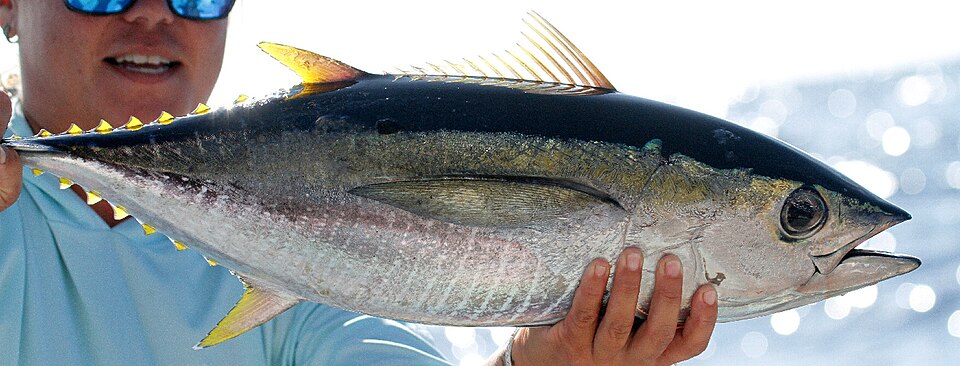
- A torpedo-shaped fish, metallic dark blue on the back and upper sides, with a golden-yellow stripe on the sides and a belly that changes to silver (Florida, North Carolina).
- The second dorsal and anal fins are very elongated, about one-fifth of the total length, and the second dorsal fin and all finlets are yellow, sometimes trimmed in black (Florida).
- The long pectoral fin reaches below the start of the second dorsal fin (Florida).
Look-alikes
- Blackfin tuna: Florida says the blackfin tuna lacks the elongated second dorsal and anal fins.
- Bigeye tuna and albacore: North Carolina lists the bigeye tuna, blackfin tuna and albacore as fish that yellowfin are sometimes confused with.
Where they hold
- Offshore waters (Florida).
- North Carolina says that in the western Atlantic they range from Massachusetts to Brazil, including the Gulf of Mexico and the Caribbean, and that they often school with other fish of the same size. They are frequently found schooling below drifting objects such as logs, grass and debris.
- South Carolina says tunas are generally open-water fish, and most pelagic fish tend to gather near floating objects such as logs, buoys or debris.
Seasons
These notes come from the North Carolina, South Carolina and Alabama pages listed at the bottom, and timing shifts by region.
Summer: spawning peak
North Carolina says spawning takes place at sea year-round but is most frequent in the summer. Florida says spawning peaks in the summer, and that they feed on fishes and invertebrates.
- Alabama lists April through December as the months anglers fish for them in offshore Gulf waters, with a peak in June and July.
Techniques that work
Troll lures with ballyhoo
Sport fishermen catch yellowfin tuna by trolling brightly colored lures with ballyhoo at high speeds (North Carolina).
Slow-troll live bait
Alabama lists slow-trolling live blue runners, 6 to 8 inches being the right size.
Chunk and chum
Alabama lists chunking and chumming.
Jig deep
Alabama lists jigging diamondhead jigs when fish are down deep.
Baits and lures
Ballyhoo (balao)
Ballyhoo under trolled lures (North Carolina). Alabama lists whole dead fish such as balao.
Live blue runners
Alabama lists live blue runners for slow-trolling.
Squid and lures
Alabama lists squid, feather lures, offshore trolling lures and large plugs.
- North Carolina says yellowfin feed on fishes and invertebrates associated with Sargassum, including larval crabs, shrimp, squids, filefish, triggerfish and jacks.
- If a rule limits the gear or bait you can use for tuna, it is in federal or state regulations, so check with NOAA Fisheries and your state agency.
If you are releasing a fish
These are general handling tips from Texas Parks & Wildlife. They say nothing about harvest rules: check your state's rules for that.
- Wet your hands, or use a wet rag or glove, before handling a fish.
- Minimize the time the fish is out of the water: no longer than you can hold your breath.
- Use needle-nose pliers, hemostats or a hook remover to take out the hook and protect your hands, and consider barbless hooks.
- If a net is needed, use a rubber-mesh landing net instead of abrasive nylon.
- When fishing in deep water, bring fish in slowly so they can adjust to the changing pressure.
Taking this fishing? Save it to your phone so it opens without a signal.
On iPhone: tap the Share button, then Add to Home Screen.
Sources
- Florida FWC: Yellowfin Tuna
- North Carolina Division of Marine Fisheries: Yellowfin Tuna
- South Carolina DNR: Offshore Pelagics, Tunas, Dolphin and Wahoo
- Outdoor Alabama: Saltwater Fishing Tips
- Texas Parks & Wildlife: Catch & Release Tips
This page is information only. It reports what the agencies above publish, from different states and years, so local waters can differ. It is not legal advice and does not tell anyone what to keep, catch or eat. Bait, tackle and hook rules vary by state and by water, so confirm with your state fish and wildlife agency. CatchCheck uses AI to identify fish from photos, and the ID can be wrong.