
Weakfish: How to Catch More of Them
A playbook built from state and provincial wildlife pages. Reviewed October 25, 2026.
Also called: gray trout, squeteague, tide runner
Jump to: How to recognize one · Where they hold · Baits and lures · Releasing a fish · Sources
The five-minute version
- Look for wavy lines of dark blotches on the sides that do not extend into the fins, yellow fins and two canine-like teeth (North Carolina).
- Bottom fishing and jigging are the methods listed (North Carolina).
- Natural or artificial baits can be used (North Carolina).
- Keep the line tight without pulling too hard: weakfish have soft mouths (North Carolina).
- They migrate south and offshore in autumn and winter, and north and inshore in spring and summer (North Carolina).
How to recognize one
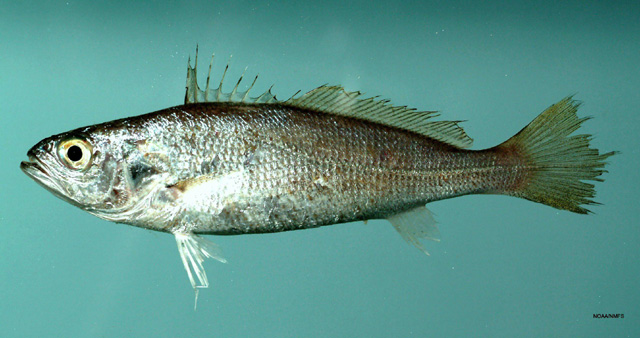
- Dark olive-green on top, silvery below, with a purple, lavender, green, blue, golden or copper sheen. Wavy lines of dark blotches run down and forward on the sides but not into the fins (North Carolina DMF).
- Yellow fins and two large, canine-like teeth in the upper jaw. Also called gray trout or trout.
Look-alikes
- Spotted seatrout: North Carolina says spots that do not appear on the tail or second dorsal fin separate weakfish from spotted seatrout.
Side-by-side help: Spotted Seatrout vs Weakfish
Where they hold
- Coastal waters from Nova Scotia to northeast Florida, with greater abundance between New York and North Carolina (North Carolina).
- Smaller fish mostly eat shrimp, crabs and small clams on the bottom, and larger fish eat butterfish, herrings and other fish.
- Juveniles move from higher-salinity to lower-salinity waters through summer and leave estuaries by winter (North Carolina).
Seasonal movements
These notes come from North Carolina's marine fisheries agency, which gives no dates, distances or water-temperature thresholds.
North and inshore in spring and summer, south and offshore in fall
North Carolina says weakfish migrate south and offshore in autumn and winter, and north and inshore in spring and summer.
- North Carolina lists bottom fishing and jigging as methods.
Techniques that work
Bottom fishing and jigging
North Carolina lists bottom fishing and jigging.
Soft hands
Because weakfish have soft mouths, keep the line tight without pulling too hard, or the hook could rip through the lip (North Carolina).
Baits and lures
Natural or artificial baits
North Carolina says natural or artificial baits can be used, and that anglers commonly use "sting silvers and spec rigs."
- North Carolina does not list hook sizes, line weights or rod types for weakfish.
If you are releasing a fish
These are general handling tips from Texas Parks & Wildlife. They say nothing about harvest rules: check your state's rules for that.
- Wet your hands, or use a wet rag or glove, before handling a fish.
- Minimize the time the fish is out of the water: no longer than you can hold your breath.
- Use needle-nose pliers, hemostats or a hook remover to take out the hook and protect your hands, and consider barbless hooks.
- If a net is needed, use a rubber-mesh landing net instead of abrasive nylon.
- When fishing in deep water, bring fish in slowly so they can adjust to the changing pressure.
Taking this fishing? Save it to your phone so it opens without a signal.
On iPhone: tap the Share button, then Add to Home Screen.
Sources
- North Carolina Division of Marine Fisheries: Weakfish
- North Carolina Division of Marine Fisheries: Spotted Seatrout (look-alike comparison)
- Texas Parks & Wildlife: Catch & Release Tips
This page is information only. It reports what the agencies above publish, from different states and years, so local waters can differ. It is not legal advice and does not tell anyone what to keep, catch or eat. Bait, tackle and hook rules vary by state and by water, so confirm with your state fish and wildlife agency. CatchCheck uses AI to identify fish from photos, and the ID can be wrong.