
Wahoo: How to Catch More of Them
A playbook built from state and provincial wildlife pages. Reviewed October 25, 2026.
Also called: ono
Jump to: How to recognize one · Where they hold · Baits and lures · Releasing a fish · Sources
The five-minute version
- Troll at high speed over deep ocean water (North Carolina).
- Use heavy line and a wire leader, because wahoo have razor-sharp teeth (North Carolina, South Carolina).
- Brightly colored ballyhoo skirts, high-speed plugs and feather lures are listed by the agencies (North Carolina, Alabama).
- Look near drifting objects like seaweed, in the Gulf Stream (North Carolina).
- Expect long runs and sudden changes of direction (Florida).
How to recognize one
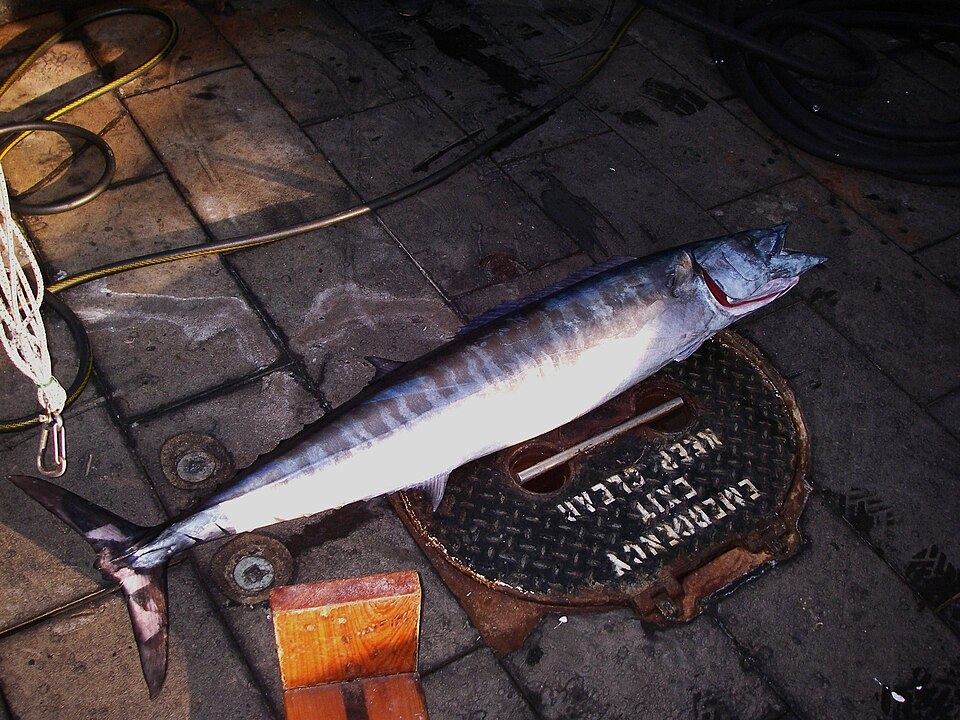
- A long, narrow, torpedo-shaped body with a dark bluish-green or steel-blue back, silvery sides and a whitish or pale belly (Florida, North Carolina).
- 24 to 30 wavy, dark blue vertical bars on the sides (Florida; North Carolina says 25 to 30). The bars extend below the lateral line (North Carolina).
- The jaws are elongated into a pointed beak with triangular, finely serrated teeth, and the first dorsal fin is low and long (Florida).
- South Carolina says they have a distinctively long snout with large, razor-sharp teeth.
Look-alikes
- King mackerel: Florida and North Carolina both list the king mackerel as a look-alike. Florida says the king mackerel's lateral line drops sharply.
Where they hold
- Offshore waters, generally not in schools (Florida).
- An offshore, warm-water fish usually found alone or in small groups near drifting objects like seaweed. In the western Atlantic they range from New Jersey to Colombia, moving north through the Gulf Stream in summer and back to the tropics in winter (North Carolina).
- South Carolina says wahoo occur year-round in the Gulf Stream off the southeast coast and frequent Sargassum, a floating algae that drifts in large rafts along the warm Gulf Stream waters.
Seasons
These notes come from the North Carolina, South Carolina and Alabama pages listed at the bottom, and timing shifts by region.
Spring and summer: the Carolinas
South Carolina says wahoo occur year-round in the Gulf Stream off the southeast coast and are abundant off the Carolinas during spring and summer, though never as abundant as tuna or dolphin. North Carolina says they spawn along the southeastern U.S. in the summer months.
- Alabama lists May through October as the months anglers troll for them in offshore Gulf waters.
Techniques that work
Troll fast
Boats troll at high speeds over deep ocean waters with heavy fishing line (North Carolina). Florida says wahoo are caught by trolling bait and artificial lures on flatlines.
Use a wire leader
North Carolina describes brightly colored ballyhoo skirts on wire leaders, and high-speed plugs and lures are also used.
Baits and lures
Ballyhoo skirts on wire
Brightly colored ballyhoo skirts on wire leaders (North Carolina). Alabama lists small dead fish such as balao.
High-speed plugs
High-speed plugs and lures (North Carolina). Alabama lists large plugs.
Plastic and feather lures
Alabama lists plastic trolling lures such as kona heads, feather lures and spoons.
- South Carolina says wahoo eat smaller tunas, king and Spanish mackerels, jacks, butterfish, flying fish and herrings.
- North Carolina says they feed mainly on other fish, as well as squid.
A starter setup
- North Carolina lists heavy fishing line rigged with lures on wire leaders.
If you are releasing a fish
These are general handling tips from Texas Parks & Wildlife. They say nothing about harvest rules: check your state's rules for that.
- Wet your hands, or use a wet rag or glove, before handling a fish.
- Minimize the time the fish is out of the water: no longer than you can hold your breath.
- Use needle-nose pliers, hemostats or a hook remover to take out the hook and protect your hands, and consider barbless hooks.
- If a net is needed, use a rubber-mesh landing net instead of abrasive nylon.
- When fishing in deep water, bring fish in slowly so they can adjust to the changing pressure.
- Florida says wahoo have triangular, finely serrated teeth, and South Carolina says large, razor-sharp teeth.
Taking this fishing? Save it to your phone so it opens without a signal.
On iPhone: tap the Share button, then Add to Home Screen.
Sources
- Florida FWC: Wahoo
- North Carolina Division of Marine Fisheries: Wahoo
- South Carolina DNR: Offshore Pelagics, Tunas, Dolphin and Wahoo
- Outdoor Alabama: Saltwater Fishing Tips
- Texas Parks & Wildlife: Catch & Release Tips
This page is information only. It reports what the agencies above publish, from different states and years, so local waters can differ. It is not legal advice and does not tell anyone what to keep, catch or eat. Bait, tackle and hook rules vary by state and by water, so confirm with your state fish and wildlife agency. CatchCheck uses AI to identify fish from photos, and the ID can be wrong.