
Tautog (Blackfish): How to Catch More of Them
A playbook built from state and provincial wildlife pages. Reviewed October 25, 2026.
Also called: blackfish, tog
Jump to: How to recognize one · Where they hold · Baits and lures · Releasing a fish · Sources
The five-minute version
- Fish rocky structure: reefs, rock piles, wrecks, jetties and pilings (Maryland, New York).
- Keep the hook close to the bottom and the sinker on the bottom (Maryland).
- Use crustacean bait such as rock crabs, fiddler crabs and sand fleas (Maryland).
- Bottom rigs baited with crabs or clams are used by New York anglers.
- Patience: wait for the second grab, because tautog break into a crab slowly (Maryland).
How to recognize one
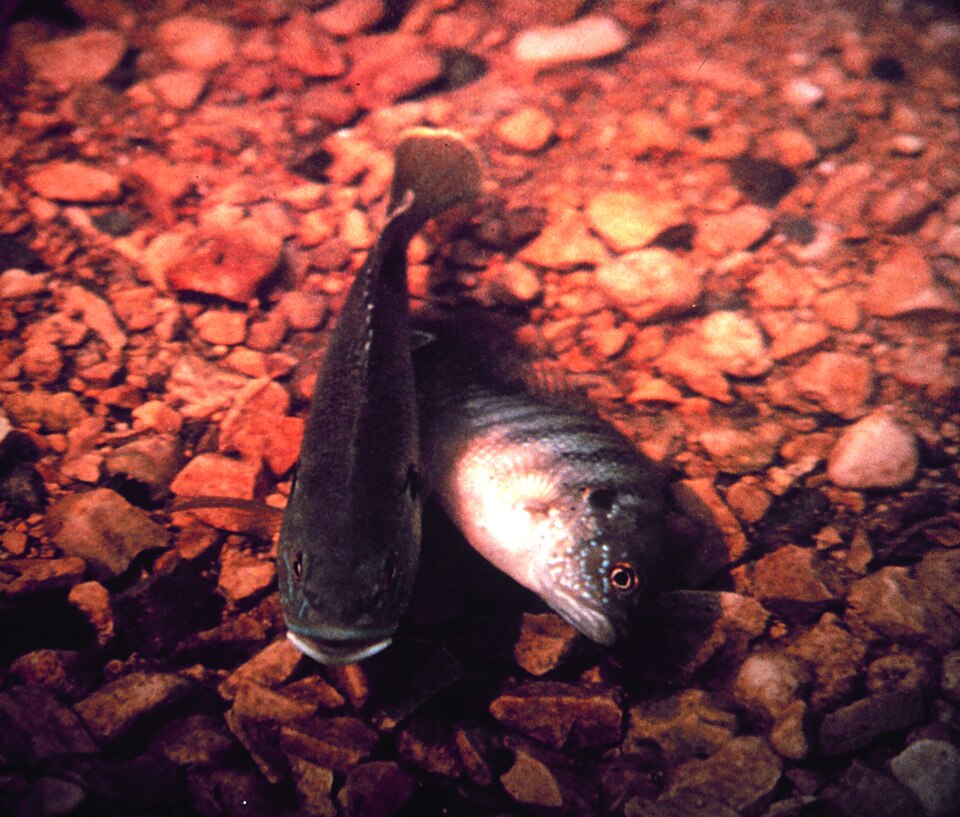
- A stout-bodied, dark-colored fish with thick rubbery lips and one long continuous dorsal fin (New York).
- Adults develop black and brown mottled sides with a lighter brown underbelly. The dorsal fin has fifteen or sixteen spines (Maryland).
- Adult males have a blunt forehead, a distinct white chin and white margins on the pectoral and tail fins. Females have a forehead that tapers toward the back of the body (Maryland).
- Juveniles are greenish in color (Maryland). Maryland says tautog can reach about 35.8 inches and 25 pounds, and New York lists a maximum of 3 feet and 25 pounds.
Where they hold
- Structure-oriented fish, commonly found around reefs, rock piles, wrecks and jetties. Juveniles are found in submerged aquatic vegetation (Maryland).
- New York says that in spring they move from deep water into shallow local waters, preferring rocky, sheltered areas near reefs, pilings, jetties and wrecks, or around mussel beds.
- Maryland says they are found from Nova Scotia to South Carolina but are most abundant between Cape Cod and Delaware Bay, and that north of Cape Cod they generally stay close to shore in water less than 60 feet deep.
Seasons
These notes come from the Maryland and New York pages listed at the bottom.
Spring: moving shallow
New York says that in spring tautog move from deep water into shallow local waters near rocky structure. Maryland says spawning in the Atlantic Ocean occurs in May and June.
- Maryland says tautog are inactive at night.
Techniques that work
Bottom rig
New York says anglers use bottom rigs baited with crabs or clams.
Hook near the bottom
Keep the hook close to the bottom and the sinker on the bottom (Maryland).
Wait for the second grab
Maryland says tautog break into the crab slowly, and waiting for the second grab on the line has a better chance of hooking the fish.
Baits and lures
Crabs
Maryland says bait for tautog usually consists of crustaceans such as rock crabs, fiddler crabs and sand fleas.
Clams
New York lists crabs or clams on bottom rigs.
- New York says tautog have blunt conical teeth for crushing barnacles, mussels, snails, crabs, shrimps and lobsters, and are bottom feeders.
If you are releasing a fish
These are general handling tips from Texas Parks & Wildlife. They say nothing about harvest rules: check your state's rules for that.
- Wet your hands, or use a wet rag or glove, before handling a fish.
- Minimize the time the fish is out of the water: no longer than you can hold your breath.
- Use needle-nose pliers, hemostats or a hook remover to take out the hook and protect your hands, and consider barbless hooks.
- If a net is needed, use a rubber-mesh landing net instead of abrasive nylon.
- When fishing in deep water, bring fish in slowly so they can adjust to the changing pressure.
Taking this fishing? Save it to your phone so it opens without a signal.
On iPhone: tap the Share button, then Add to Home Screen.
Sources
- Maryland DNR: Fish Facts, Tautog
- New York DEC: Nearshore Fish of New York
- Texas Parks & Wildlife: Catch & Release Tips
This page is information only. It reports what the agencies above publish, from different states and years, so local waters can differ. It is not legal advice and does not tell anyone what to keep, catch or eat. Bait, tackle and hook rules vary by state and by water, so confirm with your state fish and wildlife agency. CatchCheck uses AI to identify fish from photos, and the ID can be wrong.