
Snook: How to Catch More of Them
A playbook built from state and provincial wildlife pages. Reviewed October 25, 2026.
Also called: common snook, robalo, linesider, snuke
Jump to: How to recognize one · Where they hold · Baits and lures · Releasing a fish · Sources
The five-minute version
- Look at mangrove shorelines, passes, bridges, docks, deep holes and channels (Florida FWC).
- Fish moving tides, especially outgoing tides (Florida FWC).
- Winter favors artificial lures; spring and summer favor live bait (Florida FWC).
- Snook become lethargic in water below 65°F (Florida FWC).
- Crimp the barb, set the hook immediately, and keep the fish in the water while removing the hook (Florida FWC).
How to recognize one
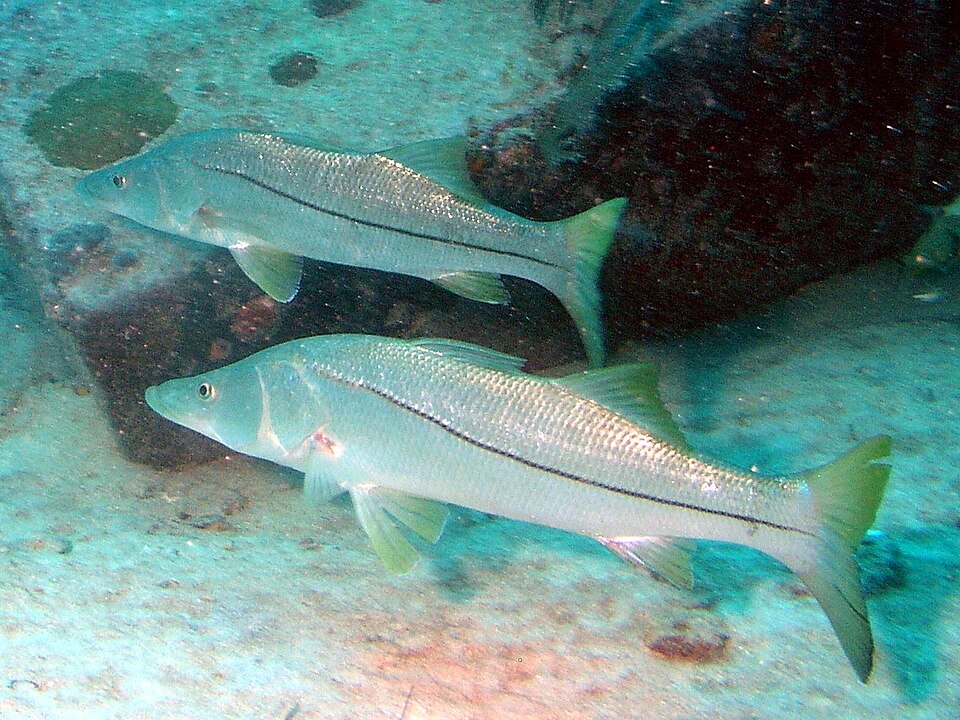
- A golden-yellow body with a distinct black lateral line, a sloping forehead and a protruding lower jaw (Florida Museum of Natural History).
- High, divided dorsal fins and relatively short anal spines. Pelvic and tail fins are noticeably more yellow during spawning.
- Common snook is the largest and most common of Florida's five snook species (FWC). Anglers also call it robalo or linesider.
Where they hold
- Along southern coastal Florida, from about Cape Canaveral on the Atlantic coast around the peninsula to about Tarpon Springs on the Gulf coast (FWC).
- Juveniles use quiet, mangrove-lined swamps, bayous and freshwater rivers and creeks. Adults use mangrove forests, beaches, river mouths, nearshore reefs, salt marshes and seagrass meadows (FWC, Florida Museum).
- FWC says snook are ambush predators that rarely chase prey far.
Cold water and the seasons
These notes come from Florida's wildlife agency (FWC) and the Florida Museum of Natural History. They are not tied to a fishing calendar; check FWC for current seasons and rules.
Cold water: below 65°F
FWC says snook become lethargic in water below 65°F, and that the upper estuary gives them winter refuge from predators. FWC also says the species' northern range is limited by the 50°F water isotherm. The Florida Museum lists lower lethal limits of about 42.8 to 53.6°F for adults and 48.2 to 57.2°F for juveniles.
- FWC says winter favors artificial lures, such as a plastic grub.
Spring through early fall: spawning and live bait
FWC says spawning runs from April or May through September or October, depending on climate and temperature, with release of eggs in late afternoon and early evening on all tides and lunar phases. In late spring and early summer snook leave low-salinity overwintering areas in the upper estuary for spawning grounds and return in late summer or early fall.
- FWC says spring and summer favor live bait.
- FWC lists known spawning sites including Jupiter and Lake Worth inlets, John's Pass, Clearwater Pass and parts of Tampa Bay.
Techniques that work
Moving tides
FWC says to fish on moving tides, especially outgoing tides, and on four-tide days when possible.
Deep holes and channels
Live sardines (FWC).
Dock-light edges
Shrimp (FWC).
Bridges at night
Live baitfish on the outgoing tide (FWC).
Baits and lures
Live bait
Live sardines, ladyfish, pinfish, grunts, shrimp and small blue crabs (FWC). Alternatives include threadfin herring, tilapia, mojarras, killifishes and small grunts.
Artificials
FWC says winter favors artificial lures such as a plastic grub, and that snook take both artificial and live bait.
- FWC says snook are conservative ambush predators that rarely chase prey far.
If you are releasing a fish
These are release tips from Florida's wildlife agency. They say nothing about harvest rules: check FWC's current snook rules for that.
- Use crimped barbs, set the hook immediately, and keep the fish in the water while removing the hook.
- FWC cites research showing about 2% of released snook die.
- Revive an exhausted fish by holding it gently in the current, preferably in shade, and avoid jerky movements.
Taking this fishing? Save it to your phone so it opens without a signal.
On iPhone: tap the Share button, then Add to Home Screen.
Sources
- Florida Fish and Wildlife Conservation Commission: Common snook
- Florida Museum of Natural History: Common Snook
This page is information only. It reports what the agencies above publish, from different states and years, so local waters can differ. It is not legal advice and does not tell anyone what to keep, catch or eat. Bait, tackle and hook rules vary by state and by water, so confirm with your state fish and wildlife agency. CatchCheck uses AI to identify fish from photos, and the ID can be wrong.