
Scup (Porgy): How to Catch More of Them
A playbook built from state and provincial wildlife pages. Reviewed October 25, 2026.
Also called: porgy, northern porgy
Jump to: How to recognize one · Where they hold · Baits and lures · Releasing a fish · Sources
The five-minute version
- Look at jetties, piers, artificial reefs, offshore ledges and estuaries (New York).
- Anchor over structure and bottom fish with live or dead bait (Connecticut).
- Squid, conch, sand worms, shrimp, nightcrawlers, mussels and clams are listed by Connecticut.
- New York says scup readily bite the bait or small lures anglers use.
- Scup move inshore in the spring (New York).
How to recognize one
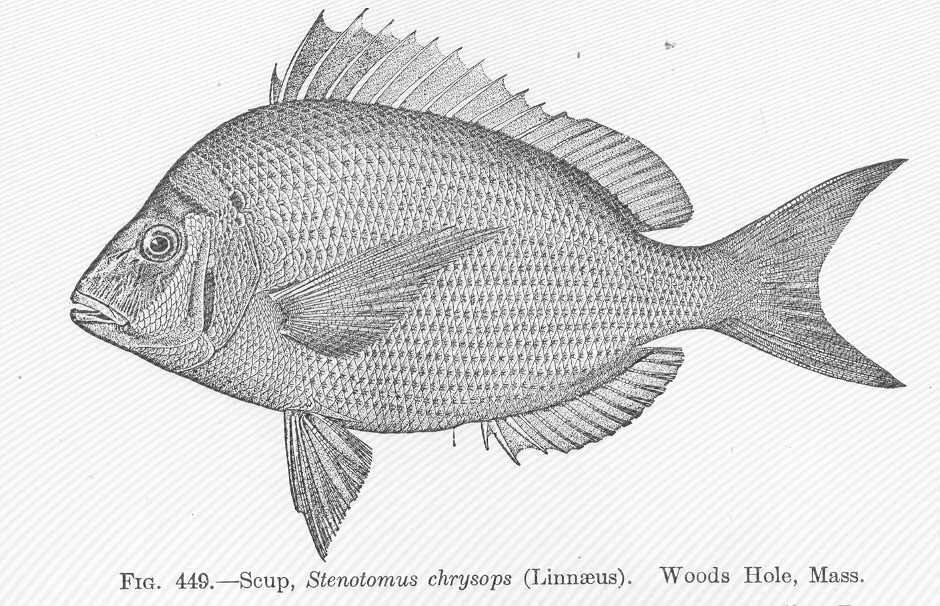
- Deep-bodied, deeper from back to belly than they are wide, dusky brown with bright silvery reflections below and spiny fins (NOAA).
- Adult fins are mottled with dark brown, and young scup fins may be faintly barred (NOAA).
- The front teeth are narrow and almost conical, with two rows of molars in the upper jaw (NOAA).
- New York says scup are laterally flattened, with an average length of 12 to 14 inches. NOAA says they grow up to about 20 inches and 4 pounds.
Look-alikes
- Longspine porgy: NOAA says the longspine porgy looks similar to scup but can be easily identified by the elongated spines on its back.
Where they hold
- Moving inshore in the spring, they occur over smooth or rocky bottoms and are particularly plentiful around jetties, piers, artificial reefs, offshore ledges and in estuaries (New York).
- Connecticut lists estuaries and bays, rock piles and reefs, oyster and mussel beds, and pilings and jetties as habitat.
- NOAA says they spawn over weedy or sandy areas in southern New England from Massachusetts Bay to the New York Bight from May through August, with peak activity in June.
Seasons
These notes come from the NOAA, New York and Connecticut pages listed at the bottom.
Spring through summer: inshore
New York says scup move inshore in the spring. NOAA says they spawn from May through August in southern New England, with peak activity in June.
- Connecticut lists fishing anchored over structure with live or dead bait.
Techniques that work
Anchor over structure
Connecticut lists anchoring over structure and bottom fishing with live or dead bait.
Bait or small lures
New York says scup are good fighters and readily bite the bait or small lures anglers use.
Baits and lures
Squid and sand worms
Connecticut lists squid, conch, sand worms and nightcrawlers.
Shrimp, mussels and clams
Connecticut lists shrimp, mussels and clams.
- New York says adults eat bottom invertebrates including small crabs, worms, clams, mussels, jellyfish and shrimp, and large adults also eat small fish.
If you are releasing a fish
These are general handling tips from Texas Parks & Wildlife. They say nothing about harvest rules: check your state's rules for that.
- Wet your hands, or use a wet rag or glove, before handling a fish.
- Minimize the time the fish is out of the water: no longer than you can hold your breath.
- Use needle-nose pliers, hemostats or a hook remover to take out the hook and protect your hands, and consider barbless hooks.
- If a net is needed, use a rubber-mesh landing net instead of abrasive nylon.
- When fishing in deep water, bring fish in slowly so they can adjust to the changing pressure.
Taking this fishing? Save it to your phone so it opens without a signal.
On iPhone: tap the Share button, then Add to Home Screen.
Sources
- NOAA Fisheries: Scup
- New York DEC: Nearshore Fish of New York
- Connecticut DEEP: How to Catch Saltwater Fish
- Texas Parks & Wildlife: Catch & Release Tips
This page is information only. It reports what the agencies above publish, from different states and years, so local waters can differ. It is not legal advice and does not tell anyone what to keep, catch or eat. Bait, tackle and hook rules vary by state and by water, so confirm with your state fish and wildlife agency. CatchCheck uses AI to identify fish from photos, and the ID can be wrong.