
Red Grouper: How to Catch More of Them
A playbook built from state and provincial wildlife pages. Reviewed October 25, 2026.
Also called: red grouper
Jump to: How to recognize one · Where they hold · Baits and lures · Releasing a fish · Sources
The five-minute version
- Fish on the bottom around ledges and natural or artificial reefs (Alabama, NOAA).
- Cut bait on a single-hook rig is listed by Alabama.
- Alabama lists a single 7/0 hook on a 5-foot dropper off the main leader, with an 8 to 12 ounce sinker, for large red grouper.
- Florida says they prefer water temperatures between 66 and 77 degrees F.
- Squid with long tentacles, whole cigar minnows, and live pinfish or tomtates are listed by Alabama.
How to recognize one
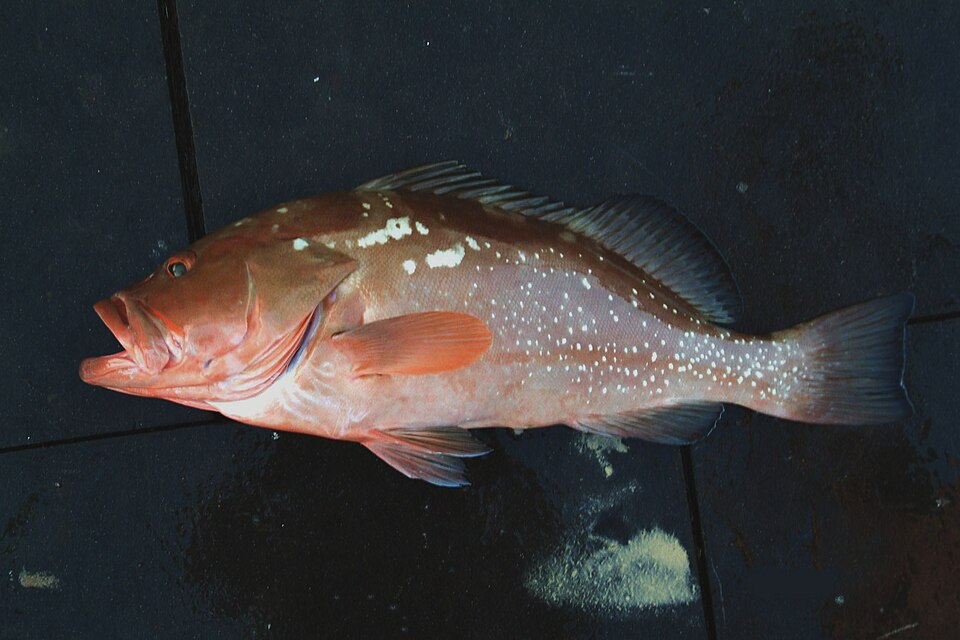
- Body color is brownish-red, with tiny black dots on the snout and a mouth lined in scarlet-orange (Florida).
- The sides have irregular white blotches, the second spine of the dorsal fin is long, and the pectoral fins are longer than the pelvic fins (Florida).
- NOAA says they have robust bodies with small scales, dark reddish-brown heads and bodies shading pink below, occasional white spots on the sides, and black spots on the cheeks.
- There is no large black spot on the base of the tail (Florida).
Look-alikes
- Nassau grouper: Florida says the Nassau grouper has a large black spot on the base of the tail, which red grouper lack.
Where they hold
- Bottom-dwelling fish over hard and muddy bottoms. Juveniles are found offshore along with adults over 6 years old, while fish from 1 to 6 years occupy nearshore reefs (Florida).
- NOAA says they are called shallow-water grouper because they are common in waters 10 to 60 feet deep. Juveniles prefer grass beds, rock formations and reefs in shallow, nearshore waters, and adults are most commonly found around ledges, crevices and caverns of rocky limestone reefs and near lower-profile live-bottom areas.
- NOAA says they are found in the western Atlantic from Massachusetts through the Gulf to Brazil.
Water temperature
These notes come from the Florida, NOAA and Alabama pages listed at the bottom.
Preferred water: 66 to 77°F
Florida says red grouper prefer water temperatures between 66 and 77 degrees F. It says they spawn in April and May, while NOAA says they spawn close to 26 times a year in shallow water from February through June.
- Alabama lists red grouper as available all year in Gulf waters.
Techniques that work
Bottom fish natural structure
Alabama says cut bait on single-hook rigs fished on the bottom around natural structure or artificial reefs is effective for smaller groupers.
Dropper rig for large fish
For large red grouper Alabama lists a favorite rig: a single 7/0 hook on a 5-foot dropper off the main leader, which ends in an 8 to 12 ounce sinker.
Baits and lures
Cut bait
Cut bait on single-hook rigs (Alabama).
Squid and cigar minnows
Alabama lists squid with long tentacles and whole cigar minnows.
Live pinfish and tomtates
Alabama lists live fish such as pinfish or tomtates, and fresh strips of bonito.
- NOAA says red grouper eat a wide variety of fish, octopus and crustaceans such as shrimp, lobsters and mantis shrimp, and that they are opportunistic feeders that eat any convenient prey.
A starter setup
- Alabama lists a 7/0 hook on a 5-foot dropper with an 8 to 12 ounce sinker for large red grouper.
If you are releasing a fish
These are general handling tips from Texas Parks & Wildlife. They say nothing about harvest rules: check your state's rules for that.
- Wet your hands, or use a wet rag or glove, before handling a fish.
- Minimize the time the fish is out of the water: no longer than you can hold your breath.
- Use needle-nose pliers, hemostats or a hook remover to take out the hook and protect your hands, and consider barbless hooks.
- If a net is needed, use a rubber-mesh landing net instead of abrasive nylon.
- When fishing in deep water, bring fish in slowly so they can adjust to the changing pressure.
Taking this fishing? Save it to your phone so it opens without a signal.
On iPhone: tap the Share button, then Add to Home Screen.
Sources
- Florida FWC: Red Grouper
- NOAA Fisheries: Red Grouper
- Outdoor Alabama: Saltwater Fishing Tips
- Texas Parks & Wildlife: Catch & Release Tips
This page is information only. It reports what the agencies above publish, from different states and years, so local waters can differ. It is not legal advice and does not tell anyone what to keep, catch or eat. Bait, tackle and hook rules vary by state and by water, so confirm with your state fish and wildlife agency. CatchCheck uses AI to identify fish from photos, and the ID can be wrong.