
Red Drum (Redfish): How to Catch More of Them
A playbook built from state and provincial wildlife pages. Reviewed October 25, 2026.
Also called: redfish, red, channel bass, spot-tail, puppy drum, bull red
Jump to: How to recognize one · Where they hold · Baits and lures · Releasing a fish · Sources
The five-minute version
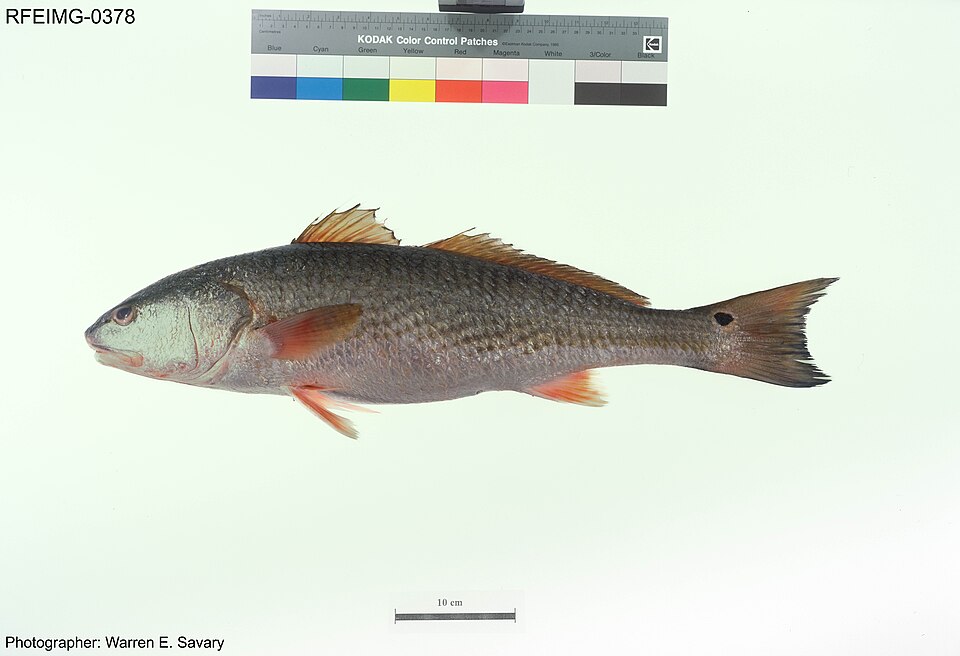
- Look for the large black spot on the upper tail base (Texas).
- Fish shallow grass flats of 1 to 4 feet, oyster reefs, coves, points, jetties and old pier pilings (Texas).
- Live shrimp, finger mullet, croaker and small blue crabs are the natural baits listed (Texas).
- Gold, copper or silver spoons of 1/2 or 1/4 ounce are listed as artificial staples (Texas).
- In fall, stormy weather brings large adults to gulf beaches: the "bull redfish run" (Texas).
How to recognize one
- The key mark is one large black spot on the upper part of the tail base. Multiple spots are common, and no spots are extremely rare (Texas Parks & Wildlife).
- Color ranges from deep blackish-coppery to nearly silver; the most common color is reddish-bronze.
Side-by-side help: Red Drum vs Black Drum vs Sheepshead
Where they hold
- Juveniles in their first three years live in bays or the surf zone near passes; adults move to the Gulf and visit bays only infrequently (Texas).
- Shallow water, 1 to 4 feet deep, along bay edges with submerged vegetation such as seagrasses; also over oyster reefs, soft mud, coves, points, jetties, old pier pilings and guts.
- They can live in fresh water and have been found many miles upriver.
How the seasons change where they are
This playbook draws on Texas Parks & Wildlife's Gulf coast red drum page, so Atlantic and Florida waters may differ. The page gives no water-temperature numbers.
Winter and cold spells: rivers and tidal creeks
Texas says anglers find concentrations in rivers and tidal creeks in winter, and large numbers gather there during cold spells.
- The daily shallow-to-deep movement is influenced by tides and water temperature (Texas).
Fall: spawning and the bull red run
Texas says spawning runs mid-August through mid-October in Gulf waters, near pass mouths and shorelines, and that in fall, especially in stormy weather, large adults move to gulf beaches in what is known as the "bull redfish run."
- For bull reds, Texas lists fresh cut mullet, live mullet of 6 to 8 inches and blue crab on single or double-drop bottom rigs with a heavy grabbing sinker.
Techniques that work
Popping cork or free-shrimping
Live shrimp under a popping cork, or "free shrimped" with a small weight (Texas).
Slip-sinker bottom rig
Live fish on the bottom with a slip-sinker rig, hooked through the lips or through the back behind the dorsal fin (Texas).
Blue crabs
Small blue crabs fished on the bottom, hooked through a rear swimming leg (Texas).
Wade and sight-cast
Wade fishing: stalking shallow grass flats. Fly fishing: sight-casting to cruising or tailing reds (Texas).
Baits and lures
Live bait
Live shrimp, small finger mullet, Atlantic croaker and small live blue crabs (Texas).
Spoons
1/2 and 1/4 ounce shallow-running gold, copper or silver spoons, and weedless spoons in heavy vegetation (Texas). For the surf, heavier spoons and slow-sinking fish-shaped plugs.
Plugs and soft plastics
Floating and shallow-running fish-shaped plugs, plastic worms and jigs (Texas).
Fly patterns
Small surface popping plugs, baitfish streamers, and shrimp or crab imitation flies (Texas).
- Texas lists different gear for bull reds in the surf and on piers than for smaller bay reds.
A starter setup
- Fish under 10 pounds: rods 6½ to 8 feet, medium action, with reels holding at least 100 yards (Texas).
- Line: 17 to 25 pound around oyster shell, rocks or pilings, and 8 to 15 pound on grass flats. Leaders are optional (Texas).
- Surf and pier bull reds: rods over 10 feet, stiff enough for heavy terminal tackle, with reels holding several hundred yards of 25 to 40 pound line and a good drag (Texas).
- Fly: 8½ to 9½ foot rods, 6 to 9 weight floating line, 7 to 9 foot leaders with 8 to 15 pound tippet (Texas).
If you are releasing a fish
These are general handling tips from Texas Parks & Wildlife. They say nothing about harvest rules: check your state's rules for that.
- Wet your hands, or use a wet rag or glove, before handling a fish.
- Minimize the time the fish is out of the water: no longer than you can hold your breath.
- Use needle-nose pliers, hemostats or a hook remover to take out the hook and protect your hands, and consider barbless hooks.
- If a net is needed, use a rubber-mesh landing net instead of abrasive nylon.
- When fishing in deep water, bring fish in slowly so they can adjust to the changing pressure.
Taking this fishing? Save it to your phone so it opens without a signal.
On iPhone: tap the Share button, then Add to Home Screen.
Sources
This page is information only. It reports what the agencies above publish, from different states and years, so local waters can differ. It is not legal advice and does not tell anyone what to keep, catch or eat. Bait, tackle and hook rules vary by state and by water, so confirm with your state fish and wildlife agency. CatchCheck uses AI to identify fish from photos, and the ID can be wrong.