
Pacific Halibut: How to Catch More of Them
A playbook built from state and provincial wildlife pages. Reviewed October 25, 2026.
Also called: halibut, barn door
Jump to: How to recognize one · Where they hold · Baits and lures · Releasing a fish · Sources
The five-minute version
- Fish on or near the bottom, often gravel bottoms in 150 to 500 feet of water, with heavy rods (Oregon).
- Large herring, jigs, spoons or shrimp flies are listed by Oregon.
- Use wire or very heavy monofilament leaders (Oregon).
- In deeper water halibut hunt mainly by smell, so bait scent matters (Oregon).
- Alaska says they prefer water temperatures of 37 to 46 degrees F and usually live between 20 and 1,000 feet.
How to recognize one
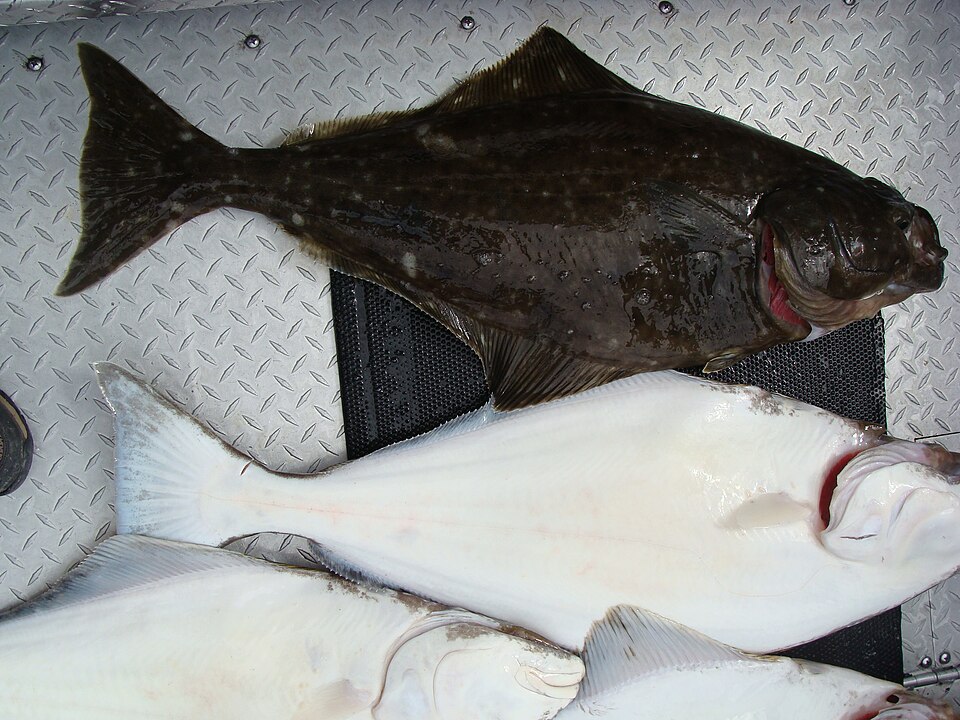
- Nearly all have both eyes on the right-hand side (Alaska, Oregon).
- The eyed side is greenish-brown to dark brown or black with lighter blotches, and the blind side is white to milky-white (Oregon). Alaska describes gray to brown or nearly black with mottling and the underside typically white.
- A large, stout but flat body shaped like an elongated diamond (Oregon). The tail is broad and symmetrical without a distinct fork, and the lateral line is strongly arched over the pectoral fin (Alaska).
- Alaska says the mouth extends to the middle of the lower eye or beyond. Oregon says they have been known to reach 500 pounds but average 40.
Look-alikes
- Arrowtooth flounder: Alaska says arrowtooth flounder have coarse scales and prominent needle-like teeth, and the lateral line is barely curved over the pectoral fin.
- California halibut: Oregon says the upper jaw of a California halibut reaches the rear of the lower eye, while on a Pacific halibut it only reaches the front of the lower eye, and California halibut can be left- or right-eyed.
Where they hold
- Alaska says they are typically found near the bottom over a variety of bottom types and sometimes swim up in the water column to feed. They usually inhabit water between 20 and 1,000 feet deep and prefer water temperatures in the range of 37 to 46 degrees F.
- Oregon says they spend much time near the bottom, prefer chilly water, and are primarily found in the Gulf of Alaska.
- Alaska says mature fish move to deeper offshore water in the fall to spawn and return to nearshore feeding areas in early summer.
Water temperature and seasons
These notes come from the Alaska and Oregon pages listed at the bottom.
Preferred water: 37 to 46°F
Alaska says Pacific halibut prefer water temperatures between 37 and 46 degrees F, and that they move seasonally between shallow and deep water: mature fish move to deeper offshore areas in the fall to spawn and return to nearshore feeding areas in early summer.
- Oregon says that in shallower water halibut hunt by sight and sound, while in deeper water they hunt primarily by smell.
Techniques that work
Heavy gear near the bottom
Boat anglers use heavy rods to fish on or near gravel bottoms in water 150 to 500 feet deep (Oregon).
Wire or heavy leaders
Offerings are deployed on wire or very heavy monofilament leaders (Oregon).
Baits and lures
Large herring
Oregon lists large herring.
Jigs and spoons
Oregon lists jigs and spoons.
Shrimp flies
Oregon lists shrimp flies.
- Alaska says larger halibut eat fish such as herring, sand lance, capelin, smelt, pollock, sablefish, cod and rockfish, plus octopus, crabs and clams.
A starter setup
- Oregon lists heavy rods and wire or very heavy monofilament leaders.
If you are releasing a fish
These are general handling tips from Texas Parks & Wildlife. They say nothing about harvest rules: check your state's rules for that.
- Wet your hands, or use a wet rag or glove, before handling a fish.
- Minimize the time the fish is out of the water: no longer than you can hold your breath.
- Use needle-nose pliers, hemostats or a hook remover to take out the hook and protect your hands, and consider barbless hooks.
- If a net is needed, use a rubber-mesh landing net instead of abrasive nylon.
- When fishing in deep water, bring fish in slowly so they can adjust to the changing pressure.
Taking this fishing? Save it to your phone so it opens without a signal.
On iPhone: tap the Share button, then Add to Home Screen.
Sources
- Oregon Department of Fish & Wildlife: Pacific Halibut
- Alaska Department of Fish and Game: Pacific Halibut
- Texas Parks & Wildlife: Catch & Release Tips
This page is information only. It reports what the agencies above publish, from different states and years, so local waters can differ. It is not legal advice and does not tell anyone what to keep, catch or eat. Bait, tackle and hook rules vary by state and by water, so confirm with your state fish and wildlife agency. CatchCheck uses AI to identify fish from photos, and the ID can be wrong.