
Muskellunge: How to Catch More of Them
A playbook built from state and provincial wildlife pages. Reviewed October 25, 2026.
Also called: musky, muskie
Jump to: How to recognize one · Where they hold · Baits and lures · Releasing a fish · Sources
The five-minute version
- Look for weed edges, rocky shoals and points that drop into deeper water (Minnesota).
- Cast big lures, typically 5 to 10 inches (Minnesota, Missouri).
- Do the figure-eight at the boat after every cast (Missouri, Minnesota): muskies often follow without striking.
- Use heavy gear: 50 to 80 pound braid and a steel leader (Missouri, Pennsylvania, Minnesota).
- Cool, overcast days are often better than hot, sunny ones (Minnesota, Missouri).
How to recognize one
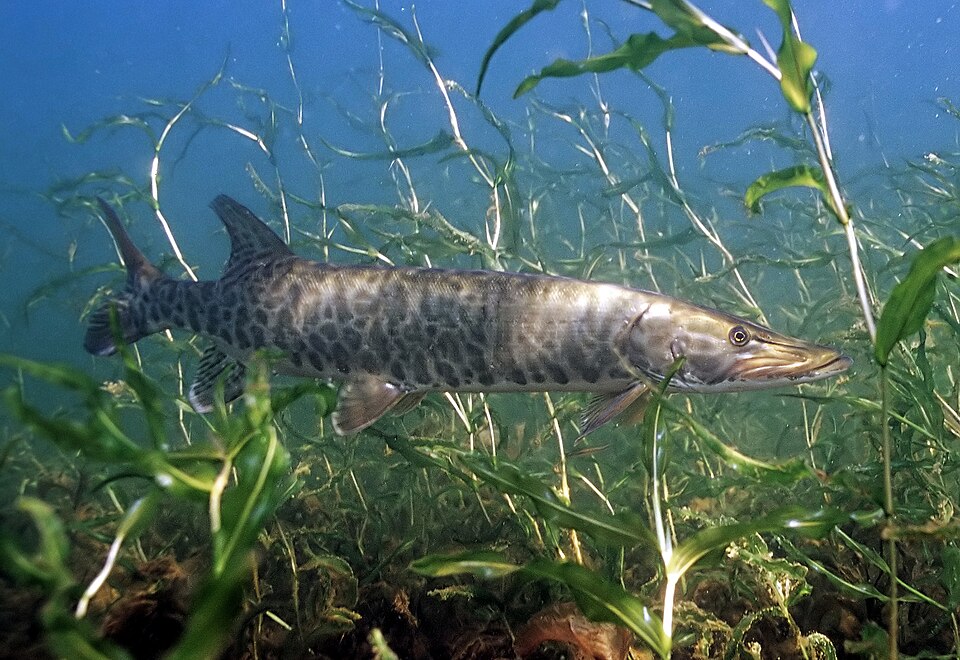
- Pennsylvania and Missouri give no written identification features and point to an illustration comparing pike, musky and walleye. When unsure, check your state agency's fish-ID guide.
Where they hold
- Pennsylvania says muskellunge favor deeper water near underwater structure, such as weed beds, sunken objects and drop-offs.
- Minnesota lists weed edges, rocky shoals and points that drop into deeper water, shallow or semi-shallow weedy bays where they lie in wait, the water around an island, and sunken reefs, humps and shallow sand flats.
- Missouri says to troll deeper, open areas and concentrate on underwater structure such as river channels, humps and points, with deep-diving crankbaits working best near the thermocline.
- Minnesota says muskellunge sometimes school, so if you find one, others may be nearby.
Seasons and time of day
These notes come from the Pennsylvania, Minnesota and Missouri agency pages listed at the bottom. None gives water-temperature numbers for muskellunge.
When the bite is best
Minnesota says fishing typically picks up in middle or late summer, with autumn prime time and many of the largest muskellunge caught in October and November. Missouri lists late September through November and March through mid-June as best, and says muskies are harder to catch in midsummer heat and winter cold.
- Missouri says summer fishing is discouraged because fish caught and released in high water temperatures often die.
Time of day and weather
Minnesota and Missouri say dawn and dusk are good times to fish, and that cool, overcast days are usually best. Minnesota adds that in early summer and late fall, activity may peak during the warmest part of the day. Pennsylvania lists daytime and the first and last few hours of light in spring, daytime and nighttime in summer, and daytime in fall.
- In shallow water, Minnesota and Missouri say to stay back and cast toward a suspected fish rather than approaching it.
Techniques that work
Cast large lures
Missouri says the most common method is casting large artificial lures, typically 5 to 10 inches long and weighing 1 to 3 ounces.
The figure-eight
When a muskellunge follows a lure to the boat without striking, reel the lure to within one foot of the rod tip, keep it in the water, then plunge the rod tip in and sweep it in a wide figure-eight. Missouri says to do this after every cast, even without a visible follow.
Trolling
Large diving crankbaits with a lot of wobble run along weedlines, rocky points and reefs (Minnesota), or deep-diving crankbaits near the thermocline (Missouri).
Watch for follows
Minnesota says to watch for "follows" and that polarized sunglasses help (Missouri).
Baits and lures
Bucktails and spinners
Pennsylvania lists bucktails, jerkbaits, crankbaits and topwater lures. Minnesota lists bucktails and flashy spinners.
Crankbaits and surface lures
Large plastic crankbaits and floating injured-prey imitations, many with propellers that create surface noise (Minnesota). Trolling crankbaits 3 to 12 inches (Pennsylvania).
Soft plastics
Rubber swimbaits 6 to 12 inches (Pennsylvania) and large soft-plastic tube-style jigs (Minnesota).
Live bait
Pennsylvania lists shiners, suckers and bluegills 4 to 10 inches long.
Colors
Pennsylvania says to match the local forage: fire tiger (perch), shad and bluegill patterns are popular.
- Minnesota says beginners may prefer lures with fewer hooks, since unhooking a thrashing fish can be intimidating.
A starter setup
- Rod: at least 7 feet, fast action and heavy power (Pennsylvania); a stout rod 7 to 9 feet long (Minnesota). A baitcasting reel, with a high gear ratio and a strong drag.
- Line: heavy braid, 50 to 80 pound test (Pennsylvania, Missouri).
- Leader: about one foot of steel or fluorocarbon (Minnesota), steel wire or 80 pound test (Pennsylvania), because muskellunge teeth can cut line.
- Other gear: a large net, needle-nose or long-nosed pliers, and a small bolt cutter or strong hook cutters for stubborn hooks (Minnesota, Missouri). Pennsylvania lists treble hooks of at least 3/0 sized to the lure.
If you are releasing a fish
These are general handling tips from Texas Parks & Wildlife. They say nothing about harvest rules: check your state's rules for that.
- Wet your hands, or use a wet rag or glove, before handling a fish.
- Minimize the time the fish is out of the water: no longer than you can hold your breath.
- Use needle-nose pliers, hemostats or a hook remover to take out the hook and protect your hands, and consider barbless hooks.
- If a net is needed, use a rubber-mesh landing net instead of abrasive nylon.
- When fishing in deep water, bring fish in slowly so they can adjust to the changing pressure.
- Minnesota says to keep the fish in the water while removing hooks, since they tend to be calmer there.
Taking this fishing? Save it to your phone so it opens without a signal.
On iPhone: tap the Share button, then Add to Home Screen.
Sources
- Pennsylvania Fish & Boat Commission: Muskellunge
- Minnesota Department of Natural Resources: How to catch muskellunge
- Missouri Department of Conservation: Muskellunge tips for fishing
- Texas Parks & Wildlife: Catch & Release Tips
This page is information only. It reports what the agencies above publish, from different states and years, so local waters can differ. It is not legal advice and does not tell anyone what to keep, catch or eat. Bait, tackle and hook rules vary by state and by water, so confirm with your state fish and wildlife agency. CatchCheck uses AI to identify fish from photos, and the ID can be wrong.