
Mahi-Mahi (Dolphinfish): How to Catch More of Them
A playbook built from state and provincial wildlife pages. Reviewed October 25, 2026.
Also called: dolphinfish, dolphin, dorado, bull and cow dolphin
Jump to: How to recognize one · Where they hold · Baits and lures · Releasing a fish · Sources
The five-minute version
- Look along weed lines and around floating debris offshore (Florida, South Carolina).
- Troll ballyhoo rigged on #7 or #8 steel wire with a 7/0 or 8/0 hook (Florida).
- Artificial lures, feathers and spoons also work trolled (Florida).
- When one hooks up, the rest of the school often stays nearby, so chum with cut bait (Florida).
- Bailing: keep one live fish in the water to attract others to the boat (North Carolina).
How to recognize one
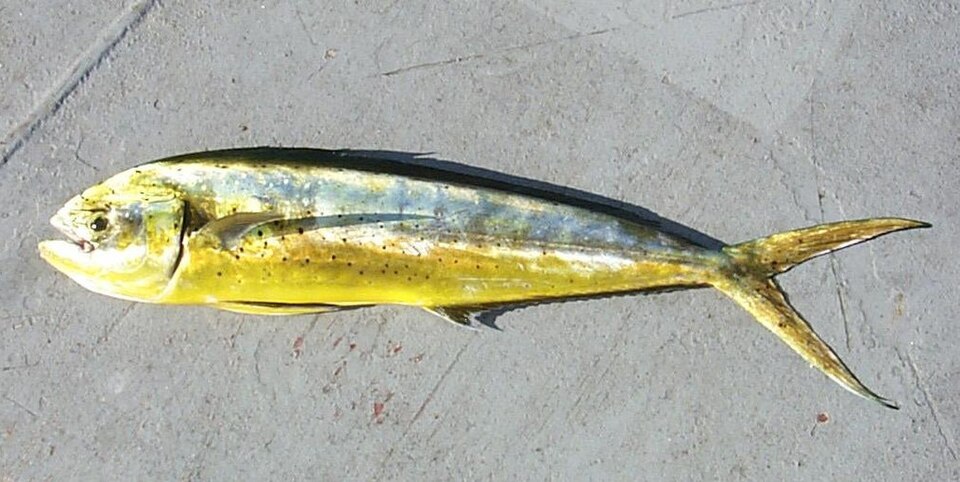
- A bright greenish-blue back with yellow on the sides, and irregular blue or golden blotches scattered over the sides (Florida).
- A single dark dorsal fin runs from above the eye all the way to the tail, and the body tapers sharply from head to tail (Florida).
- Adult males have a nearly vertical head profile, and females have a more sloping one. South Carolina calls the big males "bulls" with a boxy head, and the females "cows" (Florida, South Carolina).
- The bright colors fade almost immediately after death, to a more uniform silvery-yellow (North Carolina, South Carolina).
Look-alikes
- Pompano dolphinfish: Florida says the pompano dolphinfish has a square-shaped tooth patch on the tongue, while the dolphinfish has an oval-shaped one.
- Bottlenose dolphin: North Carolina lists the bottlenose dolphin as an animal that is sometimes confused with this fish. It is a marine mammal, not a fish, and South Carolina notes that the name "dolphin" confuses the two.
Where they hold
- Offshore, in warm waters. The young live in floating Sargassum weed (Florida).
- Adults cruise weed lines in offshore waters, feeding on squid, flying fish and other small fish (Florida).
- North Carolina says they are attracted to Sargassum, which serves as a hiding place and a source of food, and that as shelf waters warm in summer they move closer to shore and are occasionally found within 10 miles of the coast.
- South Carolina says pelagic fish tend to gather near floating objects such as logs, buoys and debris, and that dolphin frequent Sargassum rafts along the warm waters of the Gulf Stream.
Seasons and where they are
These notes come from the Florida, North Carolina, South Carolina and Alabama pages listed at the bottom, and timing shifts by region.
Summer: closer to shore
North Carolina says dolphin spawn off its coast in the Gulf Stream in June and July, and that as shallower shelf waters warm in summer the fish move closer to shore. South Carolina says they follow warm ocean currents into shallower water 20 to 25 miles offshore in early spring and summer.
- Alabama lists June through October as the months anglers catch them in the Gulf, casting to schools of small "chicken" dolphin around Sargassum lines and floating debris.
Techniques that work
Troll
Troll natural baits such as ballyhoo rigged on #7 or #8 steel wire with a 7/0 or 8/0 hook, or artificial lures, feathers or spoons (Florida). North Carolina says sport anglers troll artificial and natural baits from large boats.
Cast to schools
Alabama lists casting to schools of small dolphin around Sargassum lines and floating debris with cut bait (fish or squid) and lures such as bucktails, surface plugs and streamer flies.
Bailing
Keep one live fish in the water to attract others to the boat and incite them into a frenzy (North Carolina). Alabama says dolphin get excited when they see another struggling on a hook, so wait for the next hookup before bringing a hooked fish aboard.
Chum
Chumming with cut bait will bring them in and create a frenzy of activity (Florida).
Baits and lures
Ballyhoo
Florida says to troll natural baits such as ballyhoo rigged on steel wire. Alabama lists balao, which is another name for ballyhoo.
Squid and cut bait
Alabama lists squid and cut bait, including cut fish.
Lures
Florida lists artificial lures, feathers and spoons. Alabama lists offshore trolling lures, bucktails, surface plugs and streamer flies.
- Florida says adults eat squid, flying fish and other small fish while cruising weed lines.
- South Carolina says dolphin are cannibalistic and voracious, feeding mostly on fish, crustaceans and squid.
- If a rule limits the bait or gear you can use, it is in your state's regulations, so check your state agency.
A starter setup
- Florida lists #7 or #8 steel wire and a 7/0 or 8/0 hook for rigged ballyhoo.
If you are releasing a fish
These are general handling tips from Texas Parks & Wildlife. They say nothing about harvest rules: check your state's rules for that.
- Wet your hands, or use a wet rag or glove, before handling a fish.
- Minimize the time the fish is out of the water: no longer than you can hold your breath.
- Use needle-nose pliers, hemostats or a hook remover to take out the hook and protect your hands, and consider barbless hooks.
- If a net is needed, use a rubber-mesh landing net instead of abrasive nylon.
- When fishing in deep water, bring fish in slowly so they can adjust to the changing pressure.
Taking this fishing? Save it to your phone so it opens without a signal.
On iPhone: tap the Share button, then Add to Home Screen.
Sources
- Florida FWC: Dolphinfish
- North Carolina Division of Marine Fisheries: Dolphinfish
- South Carolina DNR: Offshore Pelagics, Tunas, Dolphin and Wahoo
- Outdoor Alabama: Saltwater Fishing Tips
- Texas Parks & Wildlife: Catch & Release Tips
This page is information only. It reports what the agencies above publish, from different states and years, so local waters can differ. It is not legal advice and does not tell anyone what to keep, catch or eat. Bait, tackle and hook rules vary by state and by water, so confirm with your state fish and wildlife agency. CatchCheck uses AI to identify fish from photos, and the ID can be wrong.