
Lingcod: How to Catch More of Them
A playbook built from state and provincial wildlife pages. Reviewed October 25, 2026.
Also called: ling, buckethead
Jump to: How to recognize one · Where they hold · Baits and lures · Releasing a fish · Sources
The five-minute version
- Fish near rocks, inshore and out to deep water (Oregon).
- Bounce bait along the bottom with 5/0 or 6/0 hooks (Oregon).
- Use a 4- to 6-ounce sinker and 20-pound line on a stout rod (Oregon).
- Many anglers also use live bait (Oregon).
- Washington says most fish are in rocky areas at depths of 10 to 100 meters (32 to 328 feet).
How to recognize one
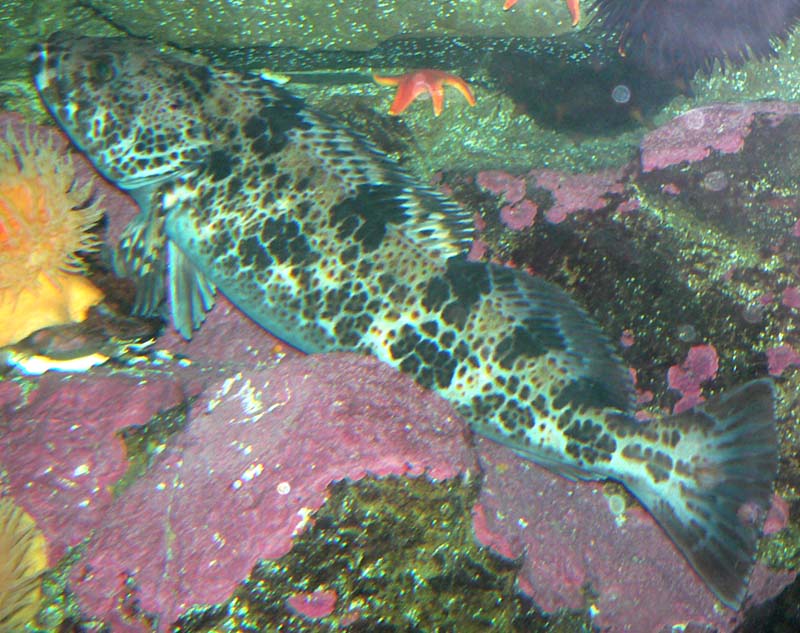
- An elongated body with a large mouth and sharp, canine-like teeth (Oregon).
- Generally mottled gray or brown, but sometimes green or blue (Oregon). Washington says the body is gray to brown, greenish or bluish with darker and lighter spotting, a lighter belly and a prominent whitish lateral line.
- The dorsal fin is long, with the spiny and soft-rayed parts nearly separated by a notch. The upper jaw extends rearward past the eyes, and there is a cirrus above the eye (Washington).
- Oregon says lingcod can reach 5 feet, but those caught in Oregon average 2 to 3 feet.
Look-alikes
- Greenling: Oregon says a green-colored lingcod should not be confused with a greenling.
Where they hold
- Adults like to be near rocks, inshore and to 230 fathoms deep. Young lingcod prefer the sand or mud bottoms of bays and inshore areas (Oregon).
- Washington says lingcod are found on the bottom, with most individuals in rocky areas at depths of 10 to 100 meters (32 to 328 feet), and have been found as deep as 427 meters (1,400 feet). They range from Kodiak Island to northern Baja California.
Techniques that work
Bounce bait on the bottom
Bounce bait along the bottom with 5/0 or 6/0 hooks, a 4- to 6-ounce sinker and 20-pound line on a stout rod (Oregon).
Live bait
Oregon says many anglers also use live bait.
Baits and lures
Bait on the bottom
Oregon says to bounce some bait along the bottom with large hooks.
Live bait
Oregon says many anglers use live bait.
- Washington says lingcod are large and elongate with large, canine-like teeth.
A starter setup
- Oregon lists 5/0 or 6/0 hooks, a 4- to 6-ounce sinker, 20-pound line and a stout rod.
If you are releasing a fish
These are general handling tips from Texas Parks & Wildlife. They say nothing about harvest rules: check your state's rules for that.
- Wet your hands, or use a wet rag or glove, before handling a fish.
- Minimize the time the fish is out of the water: no longer than you can hold your breath.
- Use needle-nose pliers, hemostats or a hook remover to take out the hook and protect your hands, and consider barbless hooks.
- If a net is needed, use a rubber-mesh landing net instead of abrasive nylon.
- When fishing in deep water, bring fish in slowly so they can adjust to the changing pressure.
Taking this fishing? Save it to your phone so it opens without a signal.
On iPhone: tap the Share button, then Add to Home Screen.
Sources
- Oregon Department of Fish & Wildlife: Lingcod
- Washington Department of Fish & Wildlife: Lingcod
- Texas Parks & Wildlife: Catch & Release Tips
This page is information only. It reports what the agencies above publish, from different states and years, so local waters can differ. It is not legal advice and does not tell anyone what to keep, catch or eat. Bait, tackle and hook rules vary by state and by water, so confirm with your state fish and wildlife agency. CatchCheck uses AI to identify fish from photos, and the ID can be wrong.