
Gray Triggerfish: How to Catch More of Them
A playbook built from state and provincial wildlife pages. Reviewed October 25, 2026.
Also called: triggerfish, trigger
Jump to: How to recognize one · Where they hold · Baits and lures · Releasing a fish · Sources
The five-minute version
- Fish reefs, ledges, wrecks and natural bottom (North Carolina, Alabama).
- Alabama lists squid hooked on a very sharp, double-strength 1/0 or 2/0 hook as the best bait.
- Peeled fresh shrimp pieces on a multiple-hook rig are listed by Alabama.
- Because they nibble, North Carolina says they are usually caught by anglers bottom fishing for other reef species.
- Both Alabama and NOAA describe the locking dorsal spine, so keep your hands clear of the mouth and spines.
How to recognize one
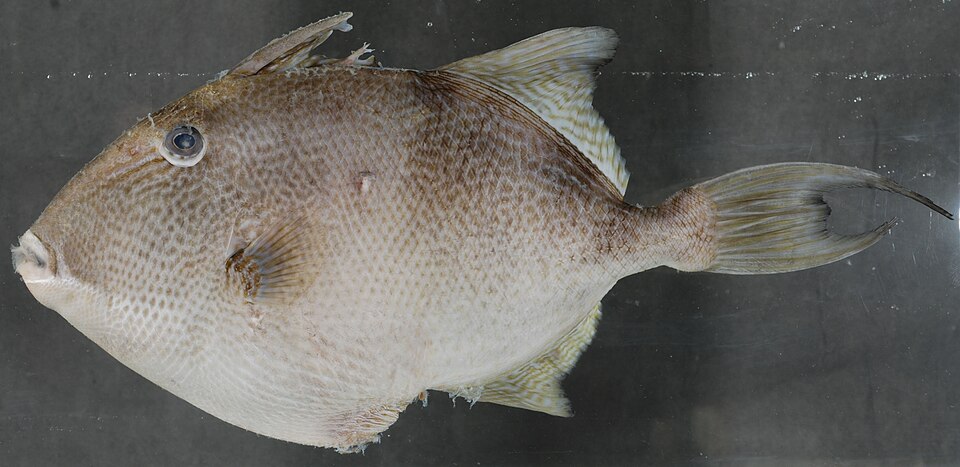
- A deep, laterally compressed body covered with tough, sandpaper-like skin, and large incisor-like teeth (North Carolina).
- Generally gray with green overtones, with about three faint broad dark blotches on the upper body, and often white dots and lines on the lower body and fins (North Carolina). NOAA says adults are olive-gray with blue spots and lines on the upper body and dorsal fin.
- A pale, narrow band on the chin, and the upper rim of the eye is blue (North Carolina).
- The first dorsal spine is large and, when erect, stays locked until the smaller second spine is pushed down, which "triggers" the first (North Carolina, Alabama).
Look-alikes
- Filefish: North Carolina lists filefish as fish that gray triggerfish are sometimes confused with.
Where they hold
- Along the western Atlantic they are typically found in hard-bottom areas such as wrecks, rock outcroppings and coral reefs in water 80 to 300 feet deep (North Carolina). NOAA says they live on hard bottoms, reefs, ledges and artificial reefs at those depths, alone or in small groups.
- Alabama says to look around reefs, natural bottom and rigs in Gulf waters.
- North Carolina says juveniles are often associated with floating Sargassum after hatching.
Seasons
These notes come from the North Carolina, NOAA and Alabama pages listed at the bottom.
Spring and summer: nesting
NOAA says spawning runs from April to August, with males building nests in the sand and females guarding the eggs. North Carolina says adult triggerfish guard the nest.
- NOAA says adults can change color, particularly during spawning: males turn a dark charcoal gray, while nesting females show a contrasting white and black pattern.
Techniques that work
Bottom fish the structure
Triggerfish are usually caught by anglers bottom fishing for other reef species (North Carolina). Alabama lists Gulf waters around reefs, natural bottom and rigs.
Small pieces on sharp hooks
Alabama says the best bait is a piece of squid hooked on a very sharp, double-strength 1/0 or 2/0 hook, on a multiple-hook rig.
Baits and lures
Squid
Alabama says the best bait is a piece of squid.
Peeled shrimp
Alabama lists small pieces of peeled fresh shrimp on a multiple-hook cut-bait rig.
- NOAA says adults mainly eat crabs, sea urchins, shrimp, sand dollars, lobsters and mollusks, and North Carolina says they use their strong jaws to chisel holes in and crush hard-shelled prey.
A starter setup
- Alabama lists a very sharp, double-strength 1/0 or 2/0 hook.
If you are releasing a fish
These are general handling tips from Texas Parks & Wildlife. They say nothing about harvest rules: check your state's rules for that.
- Wet your hands, or use a wet rag or glove, before handling a fish.
- Minimize the time the fish is out of the water: no longer than you can hold your breath.
- Use needle-nose pliers, hemostats or a hook remover to take out the hook and protect your hands, and consider barbless hooks.
- If a net is needed, use a rubber-mesh landing net instead of abrasive nylon.
- When fishing in deep water, bring fish in slowly so they can adjust to the changing pressure.
- Alabama warns that if fingers get too close to the mouth, a triggerfish can bite off a chunk of one, and that pushing down on the third spine releases the other two.
Taking this fishing? Save it to your phone so it opens without a signal.
On iPhone: tap the Share button, then Add to Home Screen.
Sources
- North Carolina Division of Marine Fisheries: Gray Triggerfish
- NOAA Fisheries: Gray Triggerfish
- Outdoor Alabama: Saltwater Fishing Tips
- Texas Parks & Wildlife: Catch & Release Tips
This page is information only. It reports what the agencies above publish, from different states and years, so local waters can differ. It is not legal advice and does not tell anyone what to keep, catch or eat. Bait, tackle and hook rules vary by state and by water, so confirm with your state fish and wildlife agency. CatchCheck uses AI to identify fish from photos, and the ID can be wrong.