
Gray (Mangrove) Snapper: How to Catch More of Them
A playbook built from state and provincial wildlife pages. Reviewed October 25, 2026.
Also called: mangrove snapper, mango, black snapper
Jump to: How to recognize one · Where they hold · Baits and lures · Releasing a fish · Sources
The five-minute version
- Look near structure: reefs, mangroves, seagrass, creeks and inshore rigs (Florida, Alabama).
- Fish on the bottom, which is where they are usually caught (Alabama).
- Cut bait on multiple-hook rigs works for smaller snappers (Alabama).
- Squid with long tentacles, whole cigar minnows, and live pinfish or tomtates are listed for snappers (Alabama).
- Check the tooth patch and spot pattern before deciding it is a gray snapper (Florida).
How to recognize one
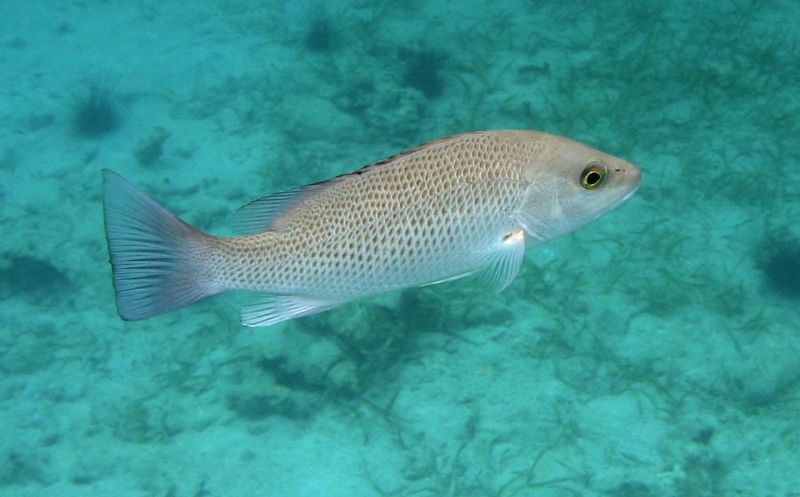
- Dark brown or gray, with red-orange spots in bars along the sides, and dorsal fins with dark or reddish borders (Florida).
- Two large canine teeth near the front of the upper jaw, and an anchor-shaped patch of teeth on the roof of the mouth, called the vomerine tooth patch (Florida).
- The young have a dark stripe from the snout through the eye to the upper edge of the gill cover (Florida).
- Common to 24 inches (10 pounds) (Florida).
Look-alikes
- Cubera snapper: Florida says the cubera snapper has a triangle-shaped tooth patch and grows much larger than a gray snapper.
- Schoolmaster: Florida says the schoolmaster has yellow fins and faint white bars.
- Black snapper: Florida says the true black snapper is rare in Florida and does not range north of the Florida Keys.
Where they hold
- Coastal waters near structure such as reefs, mangroves and seagrass. Juveniles may enter freshwater (Florida).
- Smaller gray snappers are often caught in inshore tidal rivers, creeks and channels, and around inshore gas rigs (Alabama).
Seasons
These notes come from the Florida and Alabama pages listed at the bottom.
Summer: spawning
Florida says gray snapper spawn from June through August, and that they feed on crustaceans and small fish.
- Alabama lists them as available all year in Gulf waters.
Techniques that work
Fish the bottom
Gray snapper are usually caught on the bottom (Alabama).
Work the structure
Smaller fish are often caught inshore in tidal rivers, creeks and channels and around inshore gas rigs (Alabama).
Baits and lures
Cut bait
Alabama says cut bait on multiple-hook rigs is effective for smaller snappers.
Squid and cigar minnows
For snappers Alabama lists squid with long tentacles and whole cigar minnows.
Live pinfish and tomtates
Alabama lists live fish such as pinfish or tomtates, and fresh strips of bonito or amberjack, for the bigger snappers.
- Alabama says the baits for gray snapper are the same as it lists for red snapper.
- Florida says gray snapper feed on crustaceans and small fish.
If you are releasing a fish
These are general handling tips from Texas Parks & Wildlife. They say nothing about harvest rules: check your state's rules for that.
- Wet your hands, or use a wet rag or glove, before handling a fish.
- Minimize the time the fish is out of the water: no longer than you can hold your breath.
- Use needle-nose pliers, hemostats or a hook remover to take out the hook and protect your hands, and consider barbless hooks.
- If a net is needed, use a rubber-mesh landing net instead of abrasive nylon.
- When fishing in deep water, bring fish in slowly so they can adjust to the changing pressure.
Taking this fishing? Save it to your phone so it opens without a signal.
On iPhone: tap the Share button, then Add to Home Screen.
Sources
- Florida FWC: Gray Snapper
- Outdoor Alabama: Saltwater Fishing Tips
- Texas Parks & Wildlife: Catch & Release Tips
This page is information only. It reports what the agencies above publish, from different states and years, so local waters can differ. It is not legal advice and does not tell anyone what to keep, catch or eat. Bait, tackle and hook rules vary by state and by water, so confirm with your state fish and wildlife agency. CatchCheck uses AI to identify fish from photos, and the ID can be wrong.