
Gag Grouper: How to Catch More of Them
A playbook built from state and provincial wildlife pages. Reviewed October 25, 2026.
Also called: gag, grass grouper
Jump to: How to recognize one · Where they hold · Baits and lures · Releasing a fish · Sources
The five-minute version
- Use a depth finder to find rock piles, ledges, wrecks and artificial reefs (North Carolina).
- Fish live bait on the bottom, such as cigar minnows and squid (North Carolina).
- Florida says grouper fishing from a boat typically uses baits fished near the bottom with heavy tackle.
- Live fish and dead cut or whole bait are used (Florida).
- Alabama lists whole cigar minnows, squid, and live pinfish or tomtates for big groupers.
How to recognize one
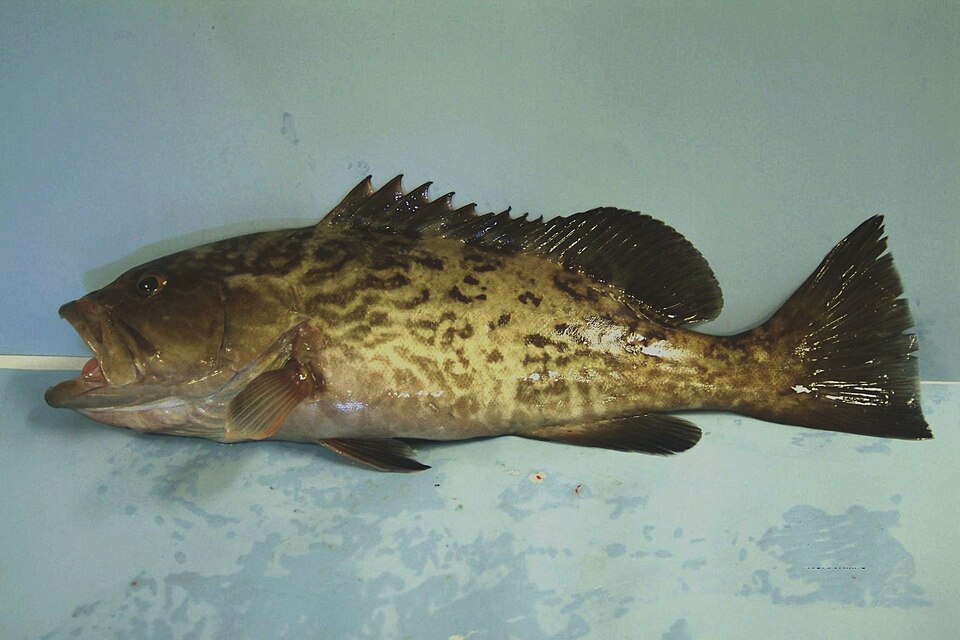
- Brownish-gray, with dark worm-like markings on the sides. Large gag are dark brownish-gray on top and paler below (Florida, North Carolina).
- The bottom of the cheek (preopercle) has a strong serrated spur. Gag also have deeply notched gill covers, which North Carolina says distinguishes them from black grouper.
- The fins are dark, with white edges on the anal fin and tail, and dark lines radiate from the eyes (Florida).
- Smaller fish are much lighter, with many dark brown or charcoal kiss-like marks along the sides (North Carolina).
Look-alikes
- Black grouper: Florida says the spur on a black grouper's cheek is gently rounded, not serrated.
- Scamp: North Carolina lists the scamp as a fish that gag are sometimes confused with.
Where they hold
- Coastal waters near structure such as rocky bottoms, reefs and drop-off walls, in water over 60 feet deep. Juveniles are found in estuaries and seagrass beds (Florida).
- North Carolina says adults can be found from North Carolina to Brazil over low and high profile hard bottom in water 60 to 250 feet deep, often gathered around rocky ledges and swimming in small groups.
Seasons
These notes come from the Florida, North Carolina and Alabama pages listed at the bottom.
Winter and early spring: spawning
Florida says gag spawn between January and May. North Carolina says spawning takes place in February off the Carolinas and from January through March in the Gulf of Mexico.
- Alabama lists grouper as available all year.
Techniques that work
Bottom fishing
Fish live bait on the bottom, using a depth finder to locate deepwater rock piles, ledges, wrecks and artificial reefs (North Carolina).
Heavy tackle
Florida says boat fishing for grouper typically uses baits near the bottom with heavy tackle and heavier line to bring the fish to the surface.
Single-hook rig
Alabama says cut bait on single-hook rigs fished on the bottom around natural structure or artificial reefs is effective for smaller groupers.
Baits and lures
Cigar minnows and squid
North Carolina says live bait such as cigar minnows and squid. Alabama lists squid with long tentacles and whole cigar minnows.
Live pinfish and tomtates
Alabama lists live fish such as pinfish or tomtates for the big groupers.
Cut bait
Alabama lists fresh strips of bonito and cut bait on single-hook rigs.
- North Carolina says gag feed on round scad, sardines, porgies, snappers, grunts, crabs, shrimp and squid.
- Florida says live fish or dead cut or whole bait are used.
If you are releasing a fish
These are general handling tips from Texas Parks & Wildlife. They say nothing about harvest rules: check your state's rules for that.
- Wet your hands, or use a wet rag or glove, before handling a fish.
- Minimize the time the fish is out of the water: no longer than you can hold your breath.
- Use needle-nose pliers, hemostats or a hook remover to take out the hook and protect your hands, and consider barbless hooks.
- If a net is needed, use a rubber-mesh landing net instead of abrasive nylon.
- When fishing in deep water, bring fish in slowly so they can adjust to the changing pressure.
Taking this fishing? Save it to your phone so it opens without a signal.
On iPhone: tap the Share button, then Add to Home Screen.
Sources
- Florida FWC: Gag Grouper
- North Carolina Division of Marine Fisheries: Gag Grouper
- Outdoor Alabama: Saltwater Fishing Tips
- Texas Parks & Wildlife: Catch & Release Tips
This page is information only. It reports what the agencies above publish, from different states and years, so local waters can differ. It is not legal advice and does not tell anyone what to keep, catch or eat. Bait, tackle and hook rules vary by state and by water, so confirm with your state fish and wildlife agency. CatchCheck uses AI to identify fish from photos, and the ID can be wrong.