
Freshwater Drum: How to Catch More of Them
A playbook built from state and provincial wildlife pages. Reviewed October 25, 2026.
Also called: sheepshead, croaker, rock perch, gaspergou
Jump to: How to recognize one · Where they hold · Baits and lures · Releasing a fish · Sources
The five-minute version
- Fish on or near the bottom, in large pools and reservoirs (Indiana).
- Live bait works best: worms, crayfish and small minnows (Indiana).
- Small spinners and fly-and-spinner combinations occasionally work (Indiana).
- Texas says they feed mostly on the bottom, on fish, crayfish and immature insects.
- Drum avoid strong current but tolerate murky water (Indiana).
How to recognize one
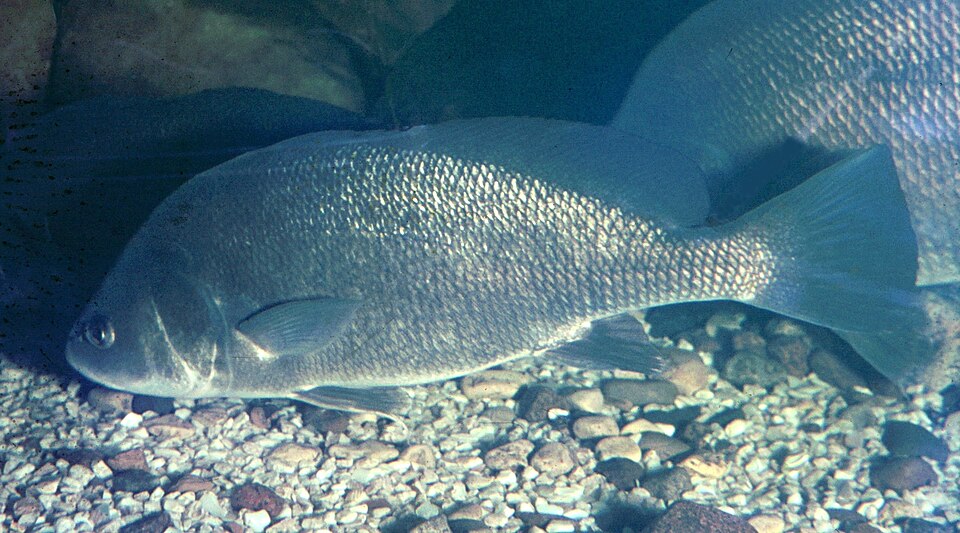
- A silvery, deep-bodied, humpbacked fish with a rounded profile and a small tail (Indiana, Minnesota).
- The long dorsal fin is divided into two distinct parts. Texas says it usually has 10 spines and 29 to 32 rays.
- The mouth is located toward the bottom of the face (Minnesota).
- Minnesota says the lateral line runs right through the tail, which no other freshwater fish does.
- Texas says the fish lacks the distinctive tail spot of the red drum. Indiana says adults commonly measure 12 to 20 inches and weigh up to about 5 pounds.
Look-alikes
- Red drum: Texas says that except for color the freshwater drum resembles its marine relative, the red drum, and that it lacks the red drum's distinctive tail spot.
Where they hold
- Indiana says freshwater drum are common in small and large rivers, reservoirs and the Great Lakes. In streams they are usually found in large pools, and in reservoirs at depths of 30 feet or more. They avoid strong currents but can tolerate murky water.
- Texas says they occur in a variety of habitats and are among the most wide-ranging fish in North America, from Hudson Bay to Guatemala, and that they are basically bottom dwellers.
Seasons
These notes come from the Indiana, Minnesota and Texas pages listed at the bottom.
Spring: the spawn and the grunt
Indiana says freshwater drum spawn in late April or May, make the drumming noise during spawning, and spawn in open water where the eggs float until hatching. Adults move from large rivers and reservoirs into tributary streams to spawn. Texas says Texas drum may spawn in April or May.
- Minnesota says the rumbling and grunting sounds are made by the males to attract mates.
Techniques that work
Fish the bottom
Indiana says most drum are taken on live bait fished on the bottom.
Small spinners
Indiana says they can occasionally be taken on small artificial lures like spinners and fly-and-spinner combinations.
Baits and lures
Worms
Indiana lists worms as a favorite bait.
Crayfish
Indiana lists crayfish. Texas says freshwater drum feed on crayfish.
Small minnows
Indiana lists small minnows.
- Texas says they feed primarily on fish, crayfish and immature insects, often by rooting around in the bottom or moving rocks to dislodge prey, and that heavy throat teeth let them eat some mollusks.
- Indiana says they live mainly on the bottom and move rocks with their snouts to find food.
If you are releasing a fish
These are general handling tips from Texas Parks & Wildlife. They say nothing about harvest rules: check your state's rules for that.
- Wet your hands, or use a wet rag or glove, before handling a fish.
- Minimize the time the fish is out of the water: no longer than you can hold your breath.
- Use needle-nose pliers, hemostats or a hook remover to take out the hook and protect your hands, and consider barbless hooks.
- If a net is needed, use a rubber-mesh landing net instead of abrasive nylon.
- When fishing in deep water, bring fish in slowly so they can adjust to the changing pressure.
Taking this fishing? Save it to your phone so it opens without a signal.
On iPhone: tap the Share button, then Add to Home Screen.
Sources
- Indiana DNR: Freshwater Drum (Animal Information Series, 2012)
- Minnesota DNR: Freshwater Drum (Sheepshead)
- Texas Parks & Wildlife: Freshwater Drum
- Texas Parks & Wildlife: Catch & Release Tips
This page is information only. It reports what the agencies above publish, from different states and years, so local waters can differ. It is not legal advice and does not tell anyone what to keep, catch or eat. Bait, tackle and hook rules vary by state and by water, so confirm with your state fish and wildlife agency. CatchCheck uses AI to identify fish from photos, and the ID can be wrong.