
Crappie: How to Catch More of Them
A playbook built from state and provincial wildlife pages. Reviewed October 25, 2026.
Also called: papermouth, specks, calico bass, slab
Jump to: How to recognize one · Where they hold · Baits and lures · Releasing a fish · Sources
The five-minute version
- Find the cover: brush piles, flooded timber, docks and stake beds hold them most of the year.
- Spring spawn starts around 55 to 64°F (Missouri and Iowa), so watch the water temperature.
- Go small: jigs from about 1/80 to 1/16 ounce and 2 to 4 pound line.
- Go slow, especially in cold water: Missouri says cold-water crappie will not chase fast lures.
- They school tight: if one side of a brush pile gives nothing, cast to the other side.
How to recognize one
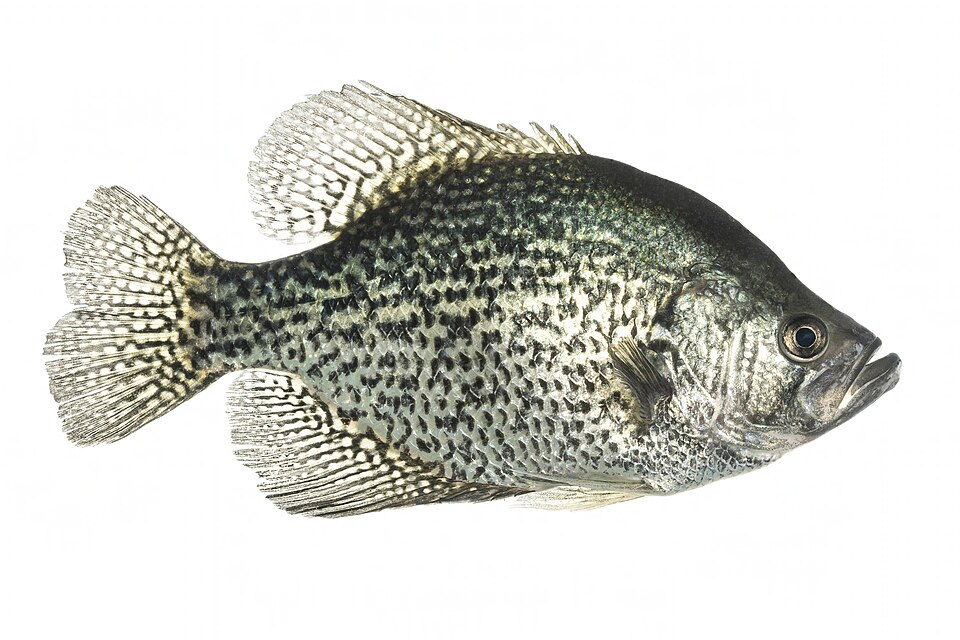
- Black crappie have no distinct vertical bars, a dark back with many green or blackish spots spread unevenly over the sides, and an upper jaw that extends past the middle of the eye (Iowa DNR).
- The dorsal fin has 7 or 8 spines and the anal fin has 6 (Iowa DNR, black crappie).
Look-alikes
- White crappie: Iowa contrasts black crappie with white crappie, which have distinct vertical bars. The page gives little other white crappie detail.
Where they hold
- Natural and man-made lakes, oxbows, reservoirs, small ponds, moderate to large streams, and river backwaters (Iowa DNR).
- Summer: flooded timber, stake beds, brush piles and rock reefs (Iowa). Missouri says to look 10 to 15 feet down in brush in 15 to 20 feet of water, and to target standing timber along creek channels and brush piles on the main lake.
- Fall: weed lines, rocky points, brush piles and flooded stream channels (Iowa). Missouri calls October and November very predictable, with fish in the upper 10 feet near docks.
- Winter: Missouri says fish can be at 20 to 40 feet and move shallower during warm spells.
How the seasons change where they are
These notes come from the Iowa and Missouri agency pages listed at the bottom, and timing shifts by region.
Spring: the spawn starts around 55 to 64°F
Missouri says the spawn generally occurs when water reaches 55°F, from around mid-March in southern Missouri to late May in the north. Iowa says spawning starts at 56 to 64°F, sometime in May. Early in spring fish move into shallows that warm quickly. Missouri adds that spawning depth depends on clarity: about 1 to 2 feet in stained or muddy water, and 20 feet or more in exceptionally clear water.
- Missouri suggests a slow trolling motor and a 1/32 to 1/16 ounce jig worked along shoreline cover and pea gravel banks.
- During a cold front, Missouri says to look for fish on steep banks, close to the bank.
- On heavily fished water, Missouri suggests casting a tiny jig onto the bank and jerking it erratically near cover with the rod tip held up.
Summer: deeper water, or night
Iowa says fish move to deeper, cooler water, 8 to 25 feet, often suspended just above the thermocline in layered lakes. Missouri says from post-spawn through September they hold 10 to 15 feet down in brush in 15 to 20 feet of water.
- Missouri suggests vertical jigging standing timber along creek channels and brush piles on the main lake.
- Around concrete bridge piers in water at least 20 feet deep, Missouri suggests jigging a minnow beside the pier, starting around 10 feet and working deeper.
- In July and August, Missouri suggests night fishing near lights, which draw insects and baitfish.
Fall: docks and brush
Iowa says fish move shallower in fall and cooler water triggers more aggressive feeding. Missouri describes October and November as very predictable and aggressive, with fish in the upper 10 feet of the water near docks.
- Missouri suggests casting into the back of a boat slip or along edges, letting the jig sink 2 to 3 seconds, then retrieving slowly.
- On warm days, Missouri says fish may move shallow to brush piles.
Winter: deep structure
Missouri says fish can be found at 20 to 40 feet, moving shallower during warm spells, and gather in dense schools near structure.
- Missouri says to use a very slow retrieve, since cold-water crappie will not chase fast lures.
- Because they school tightly, casting to one side of a brush pile may produce nothing while the other side does (Missouri).
Techniques that work
Shore or wading
Iowa suggests casting parallel to shore and retrieving slowly, often under a bobber.
Drifting and trolling
Iowa lists drifting (a sea anchor slows the drift in strong wind), trolling with an electric motor in light wind, still-fishing and vertical jigging near structure. It says drift anglers may tie two jigs to one line, a foot or two apart.
Vertical jigging
Missouri says to drop the bait to the bottom, reel up slowly, and fish at the depth where bites occur. Small jigging spoons can be raised and lowered 1 to 2 feet.
Bobber when they are picky
Missouri says a bobber is useful when fish only take a nearly motionless jig or minnow. Adjust the depth to find them. Iowa says to keep jigs at least a foot off the bottom under a bobber.
Baits and lures
Minnows
Iowa lists small minnows, about 1 to 1½ inches, hooked through the back below the dorsal fin, or through both lips when used with a jig. Missouri lists small shiners and fathead minnows.
Jigs
Lead-head jigs with 1 to 1½ inch paddle or curly-tail plastic bodies (Iowa), from about 1/80 to no more than 1/16 ounce. Missouri lists 1/32 to 1/16 ounce for the spring shallows.
Colors
Iowa says white, yellow and chartreuse work best in stained water, and blue or black in clear water.
Small spoons and flies
Missouri lists tiny jigging spoons. Iowa lists wet or dry flies on a fly rod near structure when jigging is slow.
- Missouri says to experiment with depth and technique rather than sticking with one approach.
A starter setup
- Ultra-light spinning or casting rod with a light reel (Iowa DNR). Iowa says long rods, about 12 feet, help with vertical jigging from boats.
- Line: 2 to 4 pound test, not to exceed 6 pound (Iowa).
- Hooks: Iowa lists sizes 4, 6 or 8 with a light split shot about a foot above the hook. Missouri lists a light wire hook near the thermocline.
If you are releasing a fish
These are general handling tips from Texas Parks & Wildlife. They say nothing about harvest rules: check your state's rules for that.
- Wet your hands, or use a wet rag or glove, before handling a fish.
- Minimize the time the fish is out of the water: no longer than you can hold your breath.
- Use needle-nose pliers, hemostats or a hook remover to take out the hook and protect your hands, and consider barbless hooks.
- If a net is needed, use a rubber-mesh landing net instead of abrasive nylon.
- When fishing in deep water, bring fish in slowly so they can adjust to the changing pressure.
- Iowa says crappies have soft, fleshy mouths, so excess force when setting the hook can tear the membrane near the jaw.
Taking this fishing? Save it to your phone so it opens without a signal.
On iPhone: tap the Share button, then Add to Home Screen.
Sources
- Iowa Department of Natural Resources: Crappie
- Missouri Department of Conservation: Crappie tips for fishing
- Texas Parks & Wildlife: Catch & Release Tips
This page is information only. It reports what the agencies above publish, from different states and years, so local waters can differ. It is not legal advice and does not tell anyone what to keep, catch or eat. Bait, tackle and hook rules vary by state and by water, so confirm with your state fish and wildlife agency. CatchCheck uses AI to identify fish from photos, and the ID can be wrong.