
Common Carp: How to Catch More of Them
A playbook built from state and provincial wildlife pages. Reviewed October 25, 2026.
Also called: carp, German carp
Jump to: How to recognize one · Where they hold · Baits and lures · Releasing a fish · Sources
The five-minute version
- Look for large, deep-bodied fish with barbels beside the mouth (Ontario).
- Try warm, shallow, weedy lakes and rivers, clear or murky (Ontario).
- Place natural bait directly on the bottom and still fish (Ontario).
- Doughballs, large kernel corn and earthworms are the listed baits (Ontario, Missouri).
- Early morning and late evening are prime times (Ontario).
How to recognize one
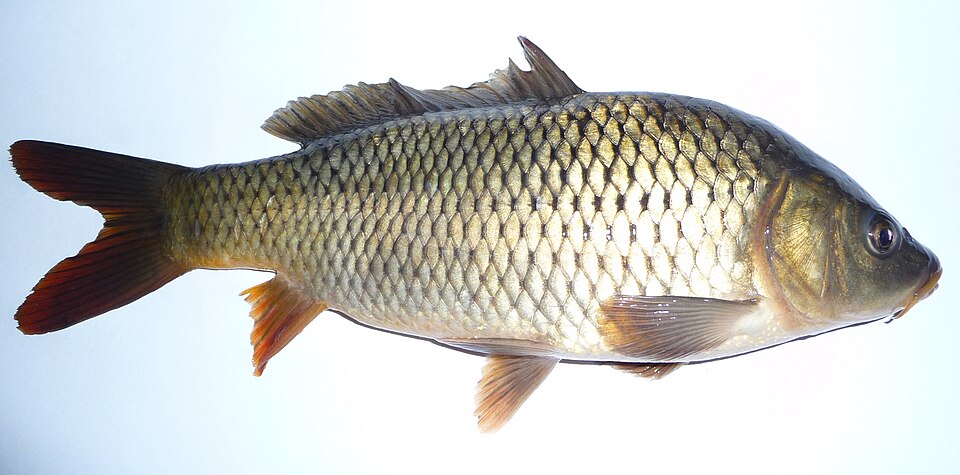
- A large, deep-bodied fish with "whiskers" (barbels) beside the mouth, silver to olive-green, brassy or gray, with a yellowish belly and orange-red lower fins (Ontario).
- A partly scaled cheek and gill cover and one dorsal spine (Ontario).
- Length is 12 to 30 inches and weight 0.5 to 7 pounds, and the Ontario record is 38.5 pounds.
Look-alikes
- Freshwater drum: Ontario lists carp as a similar fish to freshwater drum, which have no barbels.
Where they hold
- Warm, shallow, weedy lakes and rivers, clear or murky. They also inhabit urban areas and places unsuitable for other fish (Ontario).
- Found throughout the Great Lakes region, from the upper St. Lawrence River to Lake Superior, plus many inland lakes, reservoirs and rivers (Ontario).
Techniques that work
Still fish on the bottom
Ontario says still fishing with natural bait works best: place the bait directly on the bottom.
From shore
Ontario says carp are easily caught from shore with a rod and reel.
Be ready
Ontario says carp are large and tough, capable of great speed and power.
Baits and lures
Dough
Doughballs, soft or hard, often homemade; liver paste and bread crumbs rolled into small balls (Ontario). Missouri lists dough balls.
Corn and potato
Large kernel corn and boiled potato (Ontario). Missouri lists whole kernel corn.
Earthworms
Earthworms (Ontario, Missouri).
- Ontario's page does not list lures, line or hook sizes.
If you are releasing a fish
These are general handling tips from Texas Parks & Wildlife. They say nothing about harvest rules: check your state's rules for that.
- Wet your hands, or use a wet rag or glove, before handling a fish.
- Minimize the time the fish is out of the water: no longer than you can hold your breath.
- Use needle-nose pliers, hemostats or a hook remover to take out the hook and protect your hands, and consider barbless hooks.
- If a net is needed, use a rubber-mesh landing net instead of abrasive nylon.
- When fishing in deep water, bring fish in slowly so they can adjust to the changing pressure.
Taking this fishing? Save it to your phone so it opens without a signal.
On iPhone: tap the Share button, then Add to Home Screen.
Sources
- Ontario Ministry of Natural Resources: Common Carp
- Missouri Department of Conservation: Carp
- Texas Parks & Wildlife: Catch & Release Tips
This page is information only. It reports what the agencies above publish, from different states and years, so local waters can differ. It is not legal advice and does not tell anyone what to keep, catch or eat. Bait, tackle and hook rules vary by state and by water, so confirm with your state fish and wildlife agency. CatchCheck uses AI to identify fish from photos, and the ID can be wrong.