
Bullhead Catfish: How to Catch More of Them
A playbook built from state and provincial wildlife pages. Reviewed October 25, 2026.
Also called: black bullhead, brown bullhead, yellow bullhead, horned pout, mud cat
Jump to: How to recognize one · Where they hold · Baits and lures · Releasing a fish · Sources
The five-minute version
- Worms and nightcrawlers catch most of them (Iowa).
- The best catch range is water between 55 and 70°F (Iowa).
- Still fish with a sliding sinker rig and a hook sized No. 2 to 1/0 (Iowa).
- Early spring: daytime. Late spring through summer: after dark (Iowa).
- Watch the spines: grip behind the pectoral spines and keep your hand clear of the dorsal spine (Iowa).
How to recognize one
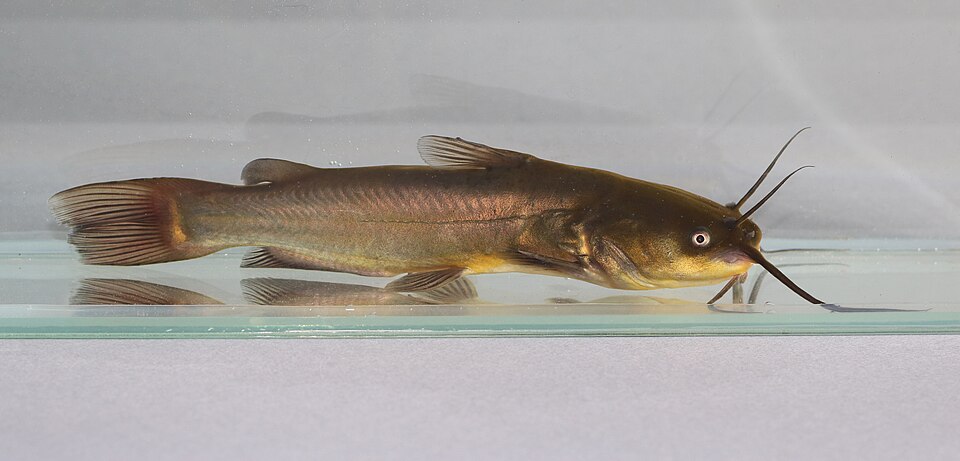
- Smooth, scaleless skin and barbels around the mouth, a square tail and a rounded anal fin (Missouri Department of Conservation).
- Iowa lists a body that is usually dark olive to black, sometimes light brown, with dusky or black chin barbels, a light band at the base of the tail, 17 to 20 rays in the anal fin and a slightly notched tail.
- Ontario lists a square tail as the identifying feature of brown bullhead.
Look-alikes
- Channel catfish: Ontario lists channel catfish as a similar fish to brown bullhead. Channel catfish have a deeply forked tail (North Carolina).
Side-by-side help: Channel vs Blue vs Flathead Catfish (and Bullheads)
Where they hold
- Iowa says shallow water warms faster: on sunny days, shallows can be 10 to 20 degrees warmer than the main lake basin, and inflowing water areas are early-spring hotspots.
- Ontario says brown bullhead prefer slow, warmer waters.
- In deep man-made lakes and reservoirs, a thermocline forms in July and August with little or no dissolved oxygen below it, and bullheads rest and feed in water about 12 to 15 feet deep (Iowa).
- In autumn, look for shallow points near deep water (Iowa).
How the seasons change when they bite
These notes come from the Iowa agency page listed at the bottom, and timing shifts by region.
Cool water: below 60°F
Iowa says bullhead fishing declines significantly when water drops below 60°F as their metabolism slows, though they can still be caught. In cold water the line twitches or moves in spurts, and setting the hook takes practice.
- Early spring: Iowa says daytime is best.
Spring: 55 to 70°F and the spawn
Iowa says the best catch range is water between 55 and 70°F, and that spawning runs from May into early June, lasts about two weeks, and bullheads are easy to catch then. In late spring, fish move offshore by day and return to feed in the evening, so after-dark fishing is recommended.
- Iowa says spawning happens in shallow water near rocks and stumps.
Summer: night fishing
Iowa says night fishing is a must in warm lakes and ponds, and that bullheads are as easy to catch in August as in May. The agency advises against fishing below 15 feet from June through August, because there is little or no oxygen below the thermocline.
- In fall, Iowa says a feeding frenzy occurs before water cools below 60°F.
Techniques that work
Still fishing
Iowa says still fishing is the standard method: cast out and prop the rod in a holder, traditionally a forked stick. Constant motion is unnecessary.
Warm-water bites
Iowa says warm-water bites appear as light taps followed by a line-tightening run, and fish often hook themselves by swallowing the bait.
Sliding sinker rig
Thread the line through a 1/4 to 1/2 ounce sliding sinker, tie on the hook, and pinch a split shot 6 to 12 inches above it to stop the sinker sliding onto the hook (Iowa).
Baits and lures
Worms and nightcrawlers
Catch the majority of bullheads (Iowa).
Other bait
Leeches, live or dead minnows, liver, shrimp, dough balls and stink bait (Iowa).
Crayfish
Iowa calls crayfish the most underused bait: use small whole crayfish, or peel meat from the tail of a larger one.
- Iowa says to carry a hook disgorger or needle-nose pliers for swallowed hooks.
A starter setup
- Rod: medium action with a spinning or spin-cast reel (Iowa).
- Line: 6 to 10 pound monofilament. Heavier line reduces casting effectiveness and makes bites harder to feel (Iowa).
- Hooks: sizes No. 2 to 1/0, long-shanked. Circle hooks are popular because they usually hook the corner of the mouth (Iowa).
If you are releasing a fish
These are general handling tips from Texas Parks & Wildlife. They say nothing about harvest rules: check your state's rules for that.
- Wet your hands, or use a wet rag or glove, before handling a fish.
- Minimize the time the fish is out of the water: no longer than you can hold your breath.
- Use needle-nose pliers, hemostats or a hook remover to take out the hook and protect your hands, and consider barbless hooks.
- If a net is needed, use a rubber-mesh landing net instead of abrasive nylon.
- When fishing in deep water, bring fish in slowly so they can adjust to the changing pressure.
- Iowa says bullheads have sharp pectoral and dorsal spines: grip behind the pectoral spines, keep your hand clear of the dorsal spine, and use a towel or rag as a barrier.
Taking this fishing? Save it to your phone so it opens without a signal.
On iPhone: tap the Share button, then Add to Home Screen.
Sources
- Iowa Department of Natural Resources: Bullheads
- Missouri Department of Conservation: Bullhead
- Ontario Ministry of Natural Resources: Brown Bullhead
- Texas Parks & Wildlife: Catch & Release Tips
This page is information only. It reports what the agencies above publish, from different states and years, so local waters can differ. It is not legal advice and does not tell anyone what to keep, catch or eat. Bait, tackle and hook rules vary by state and by water, so confirm with your state fish and wildlife agency. CatchCheck uses AI to identify fish from photos, and the ID can be wrong.