
Brook Trout: How to Catch More of Them
A playbook built from state and provincial wildlife pages. Reviewed October 25, 2026.
Also called: brookie, speckled trout, speck, squaretail
Jump to: How to recognize one · Where they hold · Baits and lures · Releasing a fish · Sources
The five-minute version
- Think headwaters: brook trout are often found where cool water is available (New York).
- Cool water is key: New York says generally below 72°F; Iowa says 75°F is the maximum for trout.
- Look in slower, more protected eddies and near cover (Iowa).
- Work upstream, move slowly and wear natural colors (New York, Iowa).
- Go light: 4 to 8 pound line (New York), 6 pound or less (Iowa).
How to recognize one
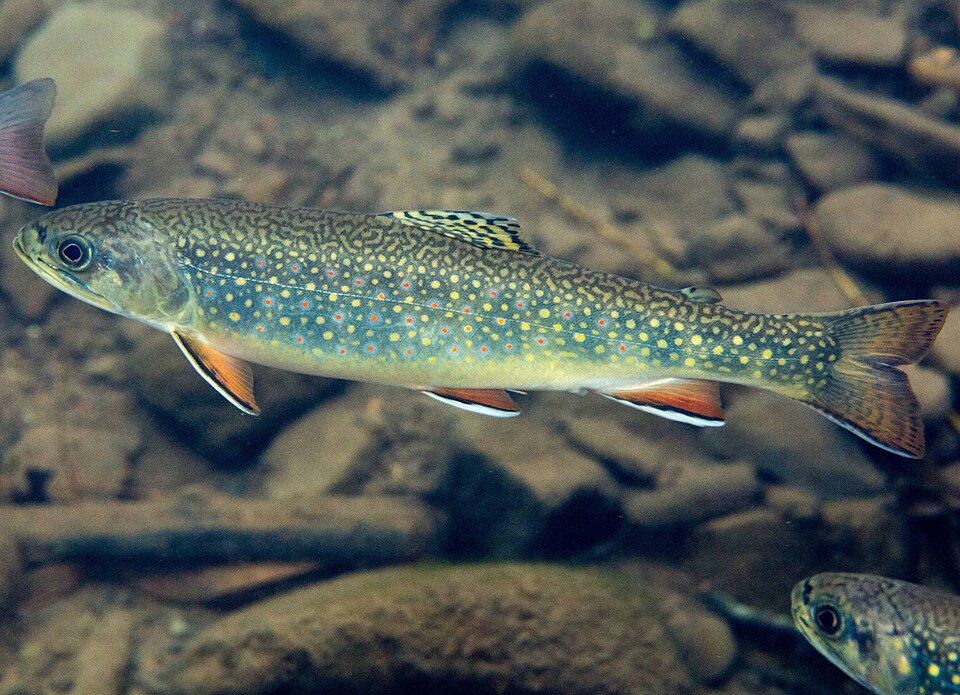
- Vivid white lines on the leading edge of the lower fins, and light worm-like markings (vermiculations) on the back (Iowa DNR).
- The dorsal fin has ten rays, and very small scales, about 230 along the lateral line, make the body feel soft.
Look-alikes
- Rainbow trout: A strikingly prominent pink-red horizontal stripe on each side (Iowa).
- Brown trout: Larger, more prominent side spots (Iowa).
- Lake trout: Ontario says lake trout have wormlike markings but none are red, a white leading edge on the lower fins with no black line, and a deeply forked tail, and that they are commonly confused with brook trout.
Side-by-side help: Rainbow vs Brown vs Brook vs Lake Trout
Where they hold
- New York says brook trout are often found in stream headwaters where cool water is available.
- Iowa says brown and brook trout prefer slower, more protected eddies than rainbows do, and build redds (gravel nests) to lay eggs.
- Pennsylvania calls brook trout the native species and the state fish, and lists cold, clear lakes and streams.
How the seasons and weather change where they are
These notes come from the Iowa, New York and Pennsylvania agency pages listed at the bottom, and timing shifts by region. They apply to rainbow, brown and brook trout.
Water temperature and oxygen
Iowa says the maximum water temperature for trout is 75°F and that dissolved oxygen should be about 7 parts per million. In summer, it says to look for cool springs flowing into streams. New York says to avoid trout fishing during warm summer months when stream temperatures are elevated, and to avoid fishing spring holes when water reaches the mid-70s °F or higher.
- New York says brook trout prefer cool water, generally below 72°F.
Spring: after gentle rain
Iowa says a gentle spring rain raises flows and frees food, and slightly muddy water helps hide line. Pennsylvania lists mid-day in spring.
- Iowa suggests worms, nymphs and streamers after a gentle rain.
Summer: insect hatches and minnow spinners
Iowa says fly fishing is strongest during common insect hatches in summer and that minnow-imitating spinners peak, while temperature and oxygen become critical. Pennsylvania lists early morning and early evening.
- Match your bait to the season: Iowa says insect hatches and natural minnows are most plentiful in summer.
Fall: grasshoppers and bait
Iowa says live or prepared bait, wet flies and spinners return in autumn, and dry-fly hatches are sparser. Early fall is grasshopper time, and nightcrawlers work well after light rain.
- Iowa says to avoid disturbing redds (gravel nests) in late fall and winter, since eggs hatch in late winter or early spring.
Techniques that work
Read the stream
Iowa says trout hold near current edges by protective cover, where food arrives with minimal effort. New York lists pockets behind boulders, the head and tail of pools, and runs.
Work upstream
New York and Iowa say to work upstream when possible, since trout face the current and are less likely to see you coming from behind. Move slowly, wear natural colors and keep a low profile.
Fast then slow
New York suggests fishing upstream with a fast bait like a spinner, then back downstream with a slower presentation like a worm or small jig.
Pockets and pools
New York says to cast upstream of a current break and let the bait drift along the edge of the slack water. At the head of a pool, cast into the current and let the bait flow into deeper water; at the tail, cast into the middle and drift through with more stealth.
Light weight
Use as little weight as possible so the bait drifts naturally and just ticks the bottom (New York). For deep pools or long runs, suspend bait under a float.
Baits and lures
Natural bait
Worms, minnows, crayfish, grasshoppers, crickets, waxworms and other insect larvae (Iowa). New York adds fish eggs, corn, maggots and small marshmallows. Pennsylvania lists minnows, worms, salmon eggs, corn, cheese and prepared baits on a light wire hook drifted on the bottom.
Worms
New York says to hook a worm once or twice, leaving a trailing tail. Iowa suggests threading worms on in at least two places and covering the hook, because trout nibble and drop baits.
Small lures
Small spinners, plugs and jigs (Iowa); small spinners, spoons, jigs, stickbaits and 1 to 2 inch tube jigs and twister tails (New York); spinners and small crankbaits (Pennsylvania). New York suggests a small ball-bearing snap swivel to prevent line twist.
Flies
Iowa lists imitations of mayflies, caddisflies, sculpins, minnows, stoneflies, grasshoppers and midges. New York lists Adams and Elk-Hair Caddis dry flies, Royal Coachman and Black Gnat wet flies, Gold Ribbed Hare's Ear and Prince Nymph nymphs, and Muddler Minnow and Wooly Bugger streamers.
- New York says some areas restrict natural or live bait, so check regulations before using it.
A starter setup
- Spinning: ultra-light gear is preferred. Iowa lists a 5 to 7 foot rod with a quick, sensitive action and line of 6 pound test or less. New York lists light or ultra-light rods of 4½ to 8½ feet with 4 to 8 pound monofilament.
- Hooks: size 6 to 10 (New York), 6 to 14 (Iowa, Pennsylvania). Lure size: 1/32 to 1/8 ounce (Pennsylvania), and Iowa suggests about 1/16 ounce or lighter.
- Fly: Iowa lists a 7½ to 8 foot rod with medium to slow action and a tapered leader with a 3 pound tippet. New York lists a 7½ to 9 foot, 4 to 6 weight rod and a 9 to 12 foot tapered leader.
If you are releasing a fish
These are catch-and-release tips from New York's wildlife agency for stream trout. They say nothing about harvest rules: check your state's rules for that.
- Use barbless hooks and play fish no longer than necessary.
- Wet your hands before handling, avoid the gills, and use a landing net.
- Gently remove the hook, hold the fish underwater facing upstream, and let it swim off. If it turns upside down, hold it in the current until it recovers.
- Avoid stepping on or near redds (Iowa).
Taking this fishing? Save it to your phone so it opens without a signal.
On iPhone: tap the Share button, then Add to Home Screen.
Sources
- Iowa Department of Natural Resources: Trout
- New York State DEC: Stream trout fishing tips
- Pennsylvania Fish & Boat Commission: Trout
- Ontario Ministry of Natural Resources: Lake Trout (look-alike comparison)
This page is information only. It reports what the agencies above publish, from different states and years, so local waters can differ. It is not legal advice and does not tell anyone what to keep, catch or eat. Bait, tackle and hook rules vary by state and by water, so confirm with your state fish and wildlife agency. CatchCheck uses AI to identify fish from photos, and the ID can be wrong.