
Bonefish: How to Catch More of Them
A playbook built from state and provincial wildlife pages. Reviewed October 25, 2026.
Also called: bonefish
Jump to: How to recognize one · Where they hold · Baits and lures · Releasing a fish · Sources
The five-minute version
- Fish shallow flats, often less than a foot deep, over seagrass and sometimes white sand (Florida).
- Live shrimp or jigs tipped with fresh shrimp are Florida's best baits for conventional gear.
- Fly anglers pole slowly through shallow flats, stalking fish (Florida).
- Bonefish are skittish and have keen eyesight (Florida).
- Look for small schools prowling grass beds and sand flats for shrimp and crabs (Florida).
How to recognize one
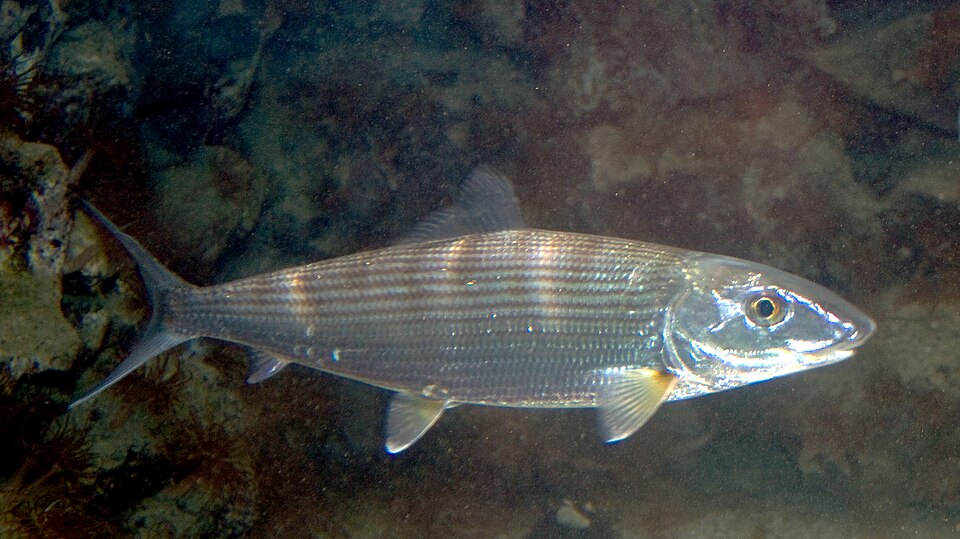
- A silvery fish with a bluish or greenish back and a slender, round body (Florida).
- The snout is long and overhangs the lower jaw (Florida).
- Dark streaks run along the upper half of the body, with faint cross-bands extending down to the lateral line. The tips of the dorsal and tail fins are shaded with black (Florida).
- Florida says fish average 3 to 5 pounds, and can reach 18 pounds but rarely exceed 10.
Look-alikes
- Ladyfish: Florida says the ladyfish has a terminal mouth, at the very front of the head, instead of an overhanging snout.
Where they hold
- An inshore fish living in shallow water often less than one foot deep, usually over lush seagrass flats but occasionally over white sand (Florida).
- They travel in small schools, prowling grass beds and sand flats for shrimp, crabs and other invertebrates (Florida).
Techniques that work
Pole and stalk
Fly anglers patiently pole through shallow flats, stalking the fish (Florida).
Light, quiet approach
Florida describes bonefish as skittish with keen eyesight.
Baits and lures
Live shrimp
Florida says live shrimp are one of the best baits for conventional fishermen.
Jigs tipped with shrimp
Florida says jigs tipped with fresh shrimp are the other best bait.
Flies
Florida says fly fishermen pole through shallow flats to stalk the fish.
- Florida says they feed on shrimp, crabs and other invertebrates.
If you are releasing a fish
These are general handling tips from Texas Parks & Wildlife. They say nothing about harvest rules: check your state's rules for that.
- Wet your hands, or use a wet rag or glove, before handling a fish.
- Minimize the time the fish is out of the water: no longer than you can hold your breath.
- Use needle-nose pliers, hemostats or a hook remover to take out the hook and protect your hands, and consider barbless hooks.
- If a net is needed, use a rubber-mesh landing net instead of abrasive nylon.
- When fishing in deep water, bring fish in slowly so they can adjust to the changing pressure.
- Florida says bonefish are very seldom eaten and should be carefully released.
Taking this fishing? Save it to your phone so it opens without a signal.
On iPhone: tap the Share button, then Add to Home Screen.
Sources
This page is information only. It reports what the agencies above publish, from different states and years, so local waters can differ. It is not legal advice and does not tell anyone what to keep, catch or eat. Bait, tackle and hook rules vary by state and by water, so confirm with your state fish and wildlife agency. CatchCheck uses AI to identify fish from photos, and the ID can be wrong.