
Blue Catfish: How to Catch More of Them
A playbook built from state and provincial wildlife pages. Reviewed October 25, 2026.
Also called: blue cat, chucklehead, humpback blue
Jump to: How to recognize one · Where they hold · Baits and lures · Releasing a fish · Sources
The five-minute version
- Think big water: large rivers and reservoirs, not small ponds (Missouri, Oklahoma).
- Cut shad is the top bait on Oklahoma's page, since shad make up much of their diet.
- Use circle hooks and reel down on the fish instead of sweeping the rod (Oklahoma).
- Bring heavy tackle: Oklahoma lists 10 to 80 pound line, and Missouri says blues of 20 to 50 pounds are common in some waters.
- Early spring (March to May) is often best for big blues in Oklahoma.
How to recognize one
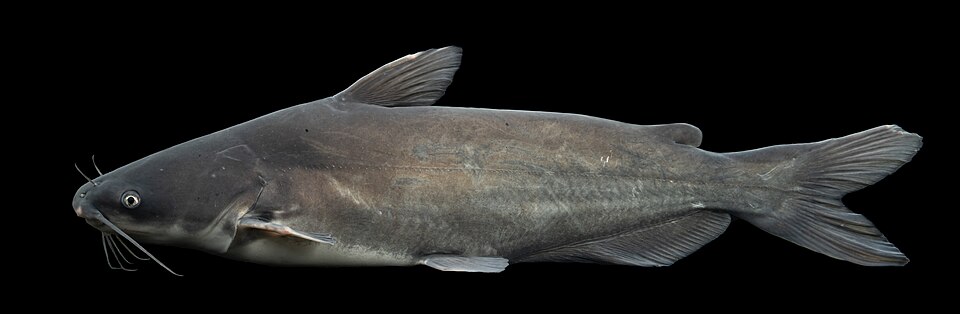
- A forked tail, like a channel catfish, and an anal fin that is straight across the bottom (Oklahoma).
- North Carolina counts the anal fin rays: blue catfish have 30 to 36 rays and a straight outer edge, channel catfish 24 to 29 with a rounded fin.
Look-alikes
- Channel catfish: Rounded anal fin with 24 to 29 rays, plus black spots on the back and sides (North Carolina).
- Flathead catfish: No forked tail, and a darker, mottled body with a broad flat head (Oklahoma, North Carolina).
Side-by-side help: Channel vs Blue vs Flathead Catfish (and Bullheads)
Where they hold
- Large reservoirs, large rivers and a few small lakes (Missouri). Oklahoma says blue catfish are native to the Red River watershed but now live in most of its major river and reservoir systems.
- Rivers: swift current and deep water along the main channel, near the tips of wing dikes, or just below locks and dams (Missouri).
- Tailwaters below reservoir dams are good, but usually limited to rod-and-reel fishing (Missouri).
- Reservoirs: creek-channel ledges, dam riprap, and the main-channel edges of the upper ends of lakes, over sand, gravel or rock bottoms (Oklahoma). Missouri says blues can be found at many depths in large lakes.
Seasons
These notes come from the Missouri and Oklahoma agency pages listed at the bottom, and timing shifts by region. Neither page gives water-temperature numbers for blue catfish.
Early spring: March through May
Oklahoma says early spring, March through May, is often best for big blues, and that blues can be caught almost year-round.
- Missouri says tailwater areas right below dams are good for blues.
After the spawn and through summer
Oklahoma says that after spawning, blues move to flats and channel edges and follow schooling bait. Missouri says they may feed during the heat of the day on very shallow flats.
- Missouri says jug lines drifted over deeper sand flats often produce good catches.
Techniques that work
Cut shad on the bottom or under a float
Oklahoma suggests cut shad on a circle hook fished on the bottom or below a float, around creek-channel ledges and dam riprap.
Circle hook, reel down
Oklahoma recommends snelling circle hooks and reeling down on the fish instead of setting the hook with a sweep.
Jug fishing
Oklahoma describes jug fishing next to the main channel with shad as a common way to catch many blues. Missouri lists rod and reel, trotlines and jug lines as the methods that work best.
Baits and lures
Cut shad
Fresh cut shad is Oklahoma's top choice. Missouri lists cut bait, usually gizzard shad or skipjack herring.
Live or dead fish
Live shad, bluegill and minnows (Oklahoma). Missouri lists live or dead fish, especially sunfish and goldfish.
Other
Oklahoma also lists hotdogs, and says natural foods include mussels, crayfish and insects.
- Missouri says to use heavy gear and large hooks.
A starter setup
- Rod and reel: a medium to extra-heavy rod with a spinning, spincasting, baitcasting or casting reel (Oklahoma). Bank anglers at big reservoirs may want surf-type rods for distance.
- Line: 10 to 80 pound test (Oklahoma).
- Hooks: circle hooks (Oklahoma).
If you are releasing a fish
These are general handling tips from Texas Parks & Wildlife. They say nothing about harvest rules: check your state's rules for that.
- Wet your hands, or use a wet rag or glove, before handling a fish.
- Minimize the time the fish is out of the water: no longer than you can hold your breath.
- Use needle-nose pliers, hemostats or a hook remover to take out the hook and protect your hands, and consider barbless hooks.
- If a net is needed, use a rubber-mesh landing net instead of abrasive nylon.
- When fishing in deep water, bring fish in slowly so they can adjust to the changing pressure.
Taking this fishing? Save it to your phone so it opens without a signal.
On iPhone: tap the Share button, then Add to Home Screen.
Sources
- Missouri Department of Conservation: Catfish tips for fishing
- Oklahoma Department of Wildlife Conservation: Catfish angler guide
- North Carolina Wildlife Resources Commission: Channel Catfish (for the fin-ray comparison)
- Texas Parks & Wildlife: Catch & Release Tips
This page is information only. It reports what the agencies above publish, from different states and years, so local waters can differ. It is not legal advice and does not tell anyone what to keep, catch or eat. Bait, tackle and hook rules vary by state and by water, so confirm with your state fish and wildlife agency. CatchCheck uses AI to identify fish from photos, and the ID can be wrong.