
Black Sea Bass: How to Catch More of Them
A playbook built from state and provincial wildlife pages. Reviewed October 25, 2026.
Also called: sea bass, pinbass
Jump to: How to recognize one · Where they hold · Baits and lures · Releasing a fish · Sources
The five-minute version
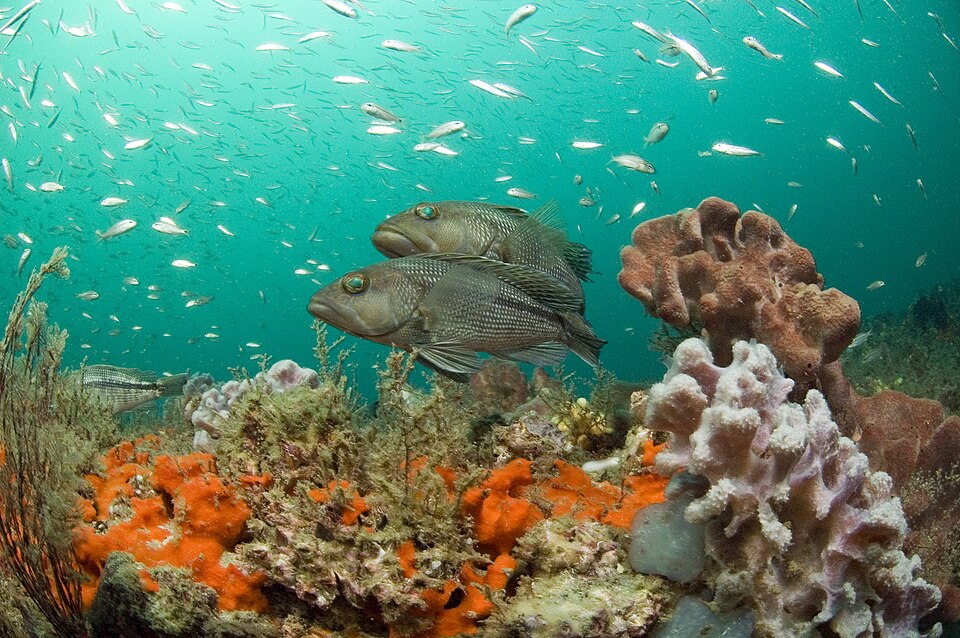
- Larger fish are black, smaller fish dusky brown, with white spots and bands on the dorsal fin (North Carolina).
- Fish wrecks, reefs and other irregular hard bottom (North Carolina).
- Strips of squid or fish are the bait the agency names.
- Anglers bottom fish over wrecks and reefs (North Carolina).
- They are opportunistic: crabs, shrimp, worms, small fish and clams are favorite foods (North Carolina).
How to recognize one
- Larger fish are black, and smaller fish are dusky brown. The dorsal fin has white spots and bands, and the upper tail lobe ends in a filament (North Carolina DMF).
- Spawning males may show a blue hump at the nape. Maximum size is 24 inches and 6 pounds.
Look-alikes
- Black drum, bank and rock sea bass: North Carolina says black sea bass are often confused with black drum, bank sea bass and rock sea bass.
Where they hold
- Irregular hard-bottom areas such as wrecks and reefs, from Cape Cod, Mass., to Cape Canaveral, Fla. South Atlantic fish usually occur closer inshore, with tropical reef species such as snappers and groupers (North Carolina).
- Juveniles are common in high-salinity estuary areas in summer (North Carolina).
Seasonal movements
These notes come from North Carolina's marine fisheries agency, which gives no exact dates, distances or water temperatures.
Spawning and migration
North Carolina says in the South Atlantic spawning occurs from February through May, and that north of Cape Hatteras there are seasonal inshore and offshore migrations.
- Anglers bottom fish over wrecks and reefs (North Carolina).
Baits and lures
Squid and fish strips
Strips of squid or fish are the bait named by North Carolina.
Natural foods
Crabs, shrimp, worms, small fish and clams are the preferred foods (North Carolina).
- North Carolina does not list lures, rigs, rods, reels or line for black sea bass.
If you are releasing a fish
These are general handling tips from Texas Parks & Wildlife. They say nothing about harvest rules: check your state's rules for that.
- Wet your hands, or use a wet rag or glove, before handling a fish.
- Minimize the time the fish is out of the water: no longer than you can hold your breath.
- Use needle-nose pliers, hemostats or a hook remover to take out the hook and protect your hands, and consider barbless hooks.
- If a net is needed, use a rubber-mesh landing net instead of abrasive nylon.
- When fishing in deep water, bring fish in slowly so they can adjust to the changing pressure.
Taking this fishing? Save it to your phone so it opens without a signal.
On iPhone: tap the Share button, then Add to Home Screen.
Sources
- North Carolina Division of Marine Fisheries: Black Sea Bass
- Texas Parks & Wildlife: Catch & Release Tips
This page is information only. It reports what the agencies above publish, from different states and years, so local waters can differ. It is not legal advice and does not tell anyone what to keep, catch or eat. Bait, tackle and hook rules vary by state and by water, so confirm with your state fish and wildlife agency. CatchCheck uses AI to identify fish from photos, and the ID can be wrong.