
Atlantic Cod: How to Catch More of Them
A playbook built from state and provincial wildlife pages. Reviewed October 25, 2026.
Also called: cod, codfish
Jump to: How to recognize one · Where they hold · Baits and lures · Releasing a fish · Sources
The five-minute version
- Fish the bottom along rocky slopes and ledges in cold water (NOAA).
- Maine lists a 5 to 8 foot medium to heavy rod with a heavy reel and 50 pound dacron line as standard gear.
- Jig a 10-ounce or heavier jig with a plastic-worm teaser off the bottom with a jerking motion (Maine).
- Or fish bait, such as clams and shrimp (Maine).
- Check the chin whisker and upper jaw to separate cod from hake, pollock and haddock (Maine).
How to recognize one
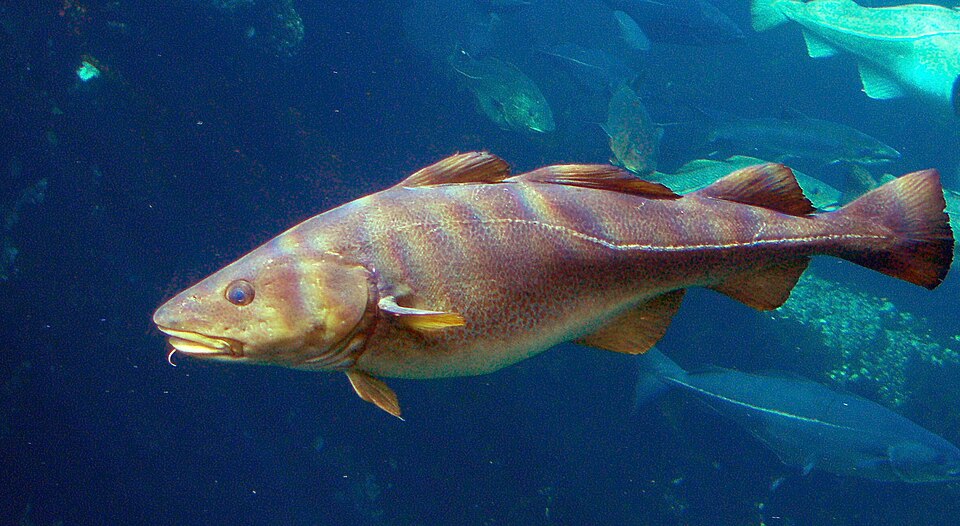
- Heavy-bodied with a large head, blunt snout, and a distinct barbel under the lower jaw (NOAA).
- Color varies from light yellowish-green to red, olive, gray or reddish-brown, usually with darker speckles on the head, fins, tail and body, and a light belly (NOAA, Maine).
- A pale, almost white lateral line, three rounded dorsal fins, two anal fins, no fin spines, and a broad square tail fin. The upper jaw is blunt and extends beyond the lower (Maine).
Look-alikes
- Hake, pollock and haddock: Maine lists hake, pollock and haddock as similar Gulf of Maine species.
Where they hold
- Atlantic cod live near the ocean floor along rocky slopes and ledges. They prefer cold water, at depths of around 30 to 500 feet, on bottoms with coarse sediments rather than on mud and silt (NOAA).
- Maine says they are bottom-dwelling fish that prefer rock to small gravel bottoms, found inshore and offshore.
- NOAA says that in the Northwest Atlantic they range from Greenland to Cape Hatteras, and that in U.S. waters they are most common on Georges Bank and in the western Gulf of Maine.
Seasons
These notes come from the NOAA and Maine pages listed at the bottom.
Cold water: winter into early spring
NOAA says cod prefer to live in cold water and spawn near the ocean floor from winter to early spring.
- Maine says cod are the target species of many of its headboat anglers.
Techniques that work
Jig with a teaser
Maine says successful anglers use a jig of 10 ounces and up coupled with a teaser (a plastic worm), fished off the bottom with a jerking motion.
Bait the bottom
Maine lists fishing bait such as clams and shrimp.
Heavy standard gear
Maine lists a 5 to 8 foot medium to heavy action rod with a heavy reel, spooled with 50 pound test dacron line.
Baits and lures
Clams and shrimp
Maine lists clams and shrimp.
Jigs with a plastic-worm teaser
Maine says jigs of 10 ounces and up coupled with a teaser.
- NOAA says cod are top predators in the bottom ocean community, feeding on a variety of invertebrates and fish.
- Rules for what gear and bait can be used differ by area, so check NOAA Fisheries and your state agency.
A starter setup
- Maine lists a 5 to 8 foot medium to heavy rod, a heavy reel, and 50 pound dacron line.
If you are releasing a fish
These are general handling tips from Texas Parks & Wildlife. They say nothing about harvest rules: check your state's rules for that.
- Wet your hands, or use a wet rag or glove, before handling a fish.
- Minimize the time the fish is out of the water: no longer than you can hold your breath.
- Use needle-nose pliers, hemostats or a hook remover to take out the hook and protect your hands, and consider barbless hooks.
- If a net is needed, use a rubber-mesh landing net instead of abrasive nylon.
- When fishing in deep water, bring fish in slowly so they can adjust to the changing pressure.
Taking this fishing? Save it to your phone so it opens without a signal.
On iPhone: tap the Share button, then Add to Home Screen.
Sources
- NOAA Fisheries: Atlantic Cod
- Maine Department of Marine Resources: Atlantic Cod
- Texas Parks & Wildlife: Catch & Release Tips
This page is information only. It reports what the agencies above publish, from different states and years, so local waters can differ. It is not legal advice and does not tell anyone what to keep, catch or eat. Bait, tackle and hook rules vary by state and by water, so confirm with your state fish and wildlife agency. CatchCheck uses AI to identify fish from photos, and the ID can be wrong.