
American Shad: How to Catch More of Them
A playbook built from state and provincial wildlife pages. Reviewed October 25, 2026.
Also called: shad, white shad, Atlantic shad
Jump to: How to recognize one · Where they hold · Baits and lures · Releasing a fish · Sources
The five-minute version
- Use bright, shiny or colorful offerings: shad rarely feed in rivers (Virginia).
- Shad darts of 1/32 to 1/8 ounce are Virginia's top choice: heavier early or in murky water, lighter late or in clear water.
- Cast across and retrieve so the lure swings in front of the fish; casting slightly upstream lets it sink first (Virginia).
- Add a split shot a foot above the lure to get it deeper (Virginia).
- Late in the run, downsize lures and use lighter line (Virginia).
How to recognize one
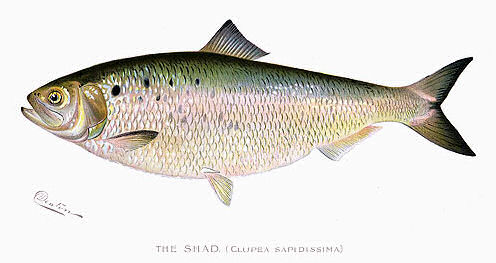
- A herring-family fish with a thin body, silvery scales, a bluish back and a saw-toothed ridge along the belly (North Carolina).
- One or more spots along each side behind the gill cover (North Carolina). Connecticut says the cheek patch is deeper than wide, the most reliable cue for separating it from other herring.
- Commonly 15 to 24 inches (Connecticut).
Look-alikes
- Hickory shad: North Carolina says the hickory shad has a protruding lower jaw and a cheek patch that is longer than deep, the reverse of American shad. Virginia says to learn to tell the two apart.
Side-by-side help: American Shad vs Hickory Shad
Where they hold
- Anadromous: adults live most of their lives at sea and enter fresh water in spring to spawn, traveling farther upstream than any other herring (North Carolina, Connecticut).
- Virginia lists the Mattaponi, Occoquan, James, Pamunkey, Potomac and Rappahannock rivers. North Carolina says each spring they ascend the Roanoke, Chowan, Neuse, Tar and Cape Fear rivers.
- North Carolina lists locks and dams on the Cape Fear River and park and bridge access on the Tar and Neuse rivers as good spots during the spring run.
The spring run
These notes come from the Virginia, North Carolina and Connecticut agency pages listed at the bottom. Timing differs a lot by river and region.
Spring: the run starts when water warms into the 50s
Virginia says shad start running up its rivers in February, but most anglers start in March when water temperatures warm into the 50s, with good fishing through April and some shad remaining until mid-May.
- Virginia says to scout access points, boat launches and bank spots in advance, and notes that spring flows are high and the water is cold.
- North Carolina says to cast upstream along current breaks and retrieve as the lure sinks and drifts downstream.
Techniques that work
Swing it across
Cast across and retrieve so the lure swings in front of the fish. Casting slightly upstream lets it sink before reaching the holding area (Virginia).
Twitches and steady
Flies are better fished with sharp spurts. Lures work both with twitches and with steady retrieves (Virginia).
Tandem rigs
Tie a second fly or lure to a long tag end of a blood knot, or use a three-way swivel with 18 to 24 inch and 10 to 12 inch leaders (Virginia).
Baits and lures
Shad darts
1/32 to 1/8 ounce, the top choice. Chartreuse bodies with green or red heads are popular on the Rappahannock (Virginia).
Spoons
Silver or gold, effective in cloudy water and good for trolling. Pair one with a dart (Virginia). North Carolina lists small shiny spoons.
Spinners
Silver or gold blade, chartreuse or orange body. Steady reeling tends to produce more solid hookups (Virginia). Connecticut lists small jigs and spinners.
Flies
Sizes 4 to 8: a shad fly with a rabbit-fur body and white marabou wing, a Crazy Charlie bonefish fly, and bead-head or cone-head woolly buggers in bright colors (Virginia). North Carolina names a small Clouser minnow with a flashy tail.
- Virginia says shad rarely feed in rivers, so use colorful or shiny offerings to trigger strikes.
A starter setup
- Spin: a 6 to 7½ foot light-action rod with 4 to 8 pound line (Virginia). North Carolina lists light spinning gear with 4 to 8 pound test.
- Fly: an 8 to 9 foot rod for a 5 to 7 weight line, a fast-sinking tip line, and a short tapered leader with 4 to 8 pound tippet (Virginia).
- Wading: Virginia says it requires chest waders, a staff and a flotation vest, since spring flows are high and the water is cold.
If you are releasing a fish
These are general handling tips from Texas Parks & Wildlife. They say nothing about harvest rules: check your state's rules for that.
- Wet your hands, or use a wet rag or glove, before handling a fish.
- Minimize the time the fish is out of the water: no longer than you can hold your breath.
- Use needle-nose pliers, hemostats or a hook remover to take out the hook and protect your hands, and consider barbless hooks.
- If a net is needed, use a rubber-mesh landing net instead of abrasive nylon.
- When fishing in deep water, bring fish in slowly so they can adjust to the changing pressure.
Taking this fishing? Save it to your phone so it opens without a signal.
On iPhone: tap the Share button, then Add to Home Screen.
Sources
- Virginia Department of Wildlife Resources: Get ready for shad
- North Carolina Wildlife Resources Commission: American Shad
- Connecticut DEEP: American Shad
- Texas Parks & Wildlife: Catch & Release Tips
This page is information only. It reports what the agencies above publish, from different states and years, so local waters can differ. It is not legal advice and does not tell anyone what to keep, catch or eat. Bait, tackle and hook rules vary by state and by water, so confirm with your state fish and wildlife agency. CatchCheck uses AI to identify fish from photos, and the ID can be wrong.